
Introduction
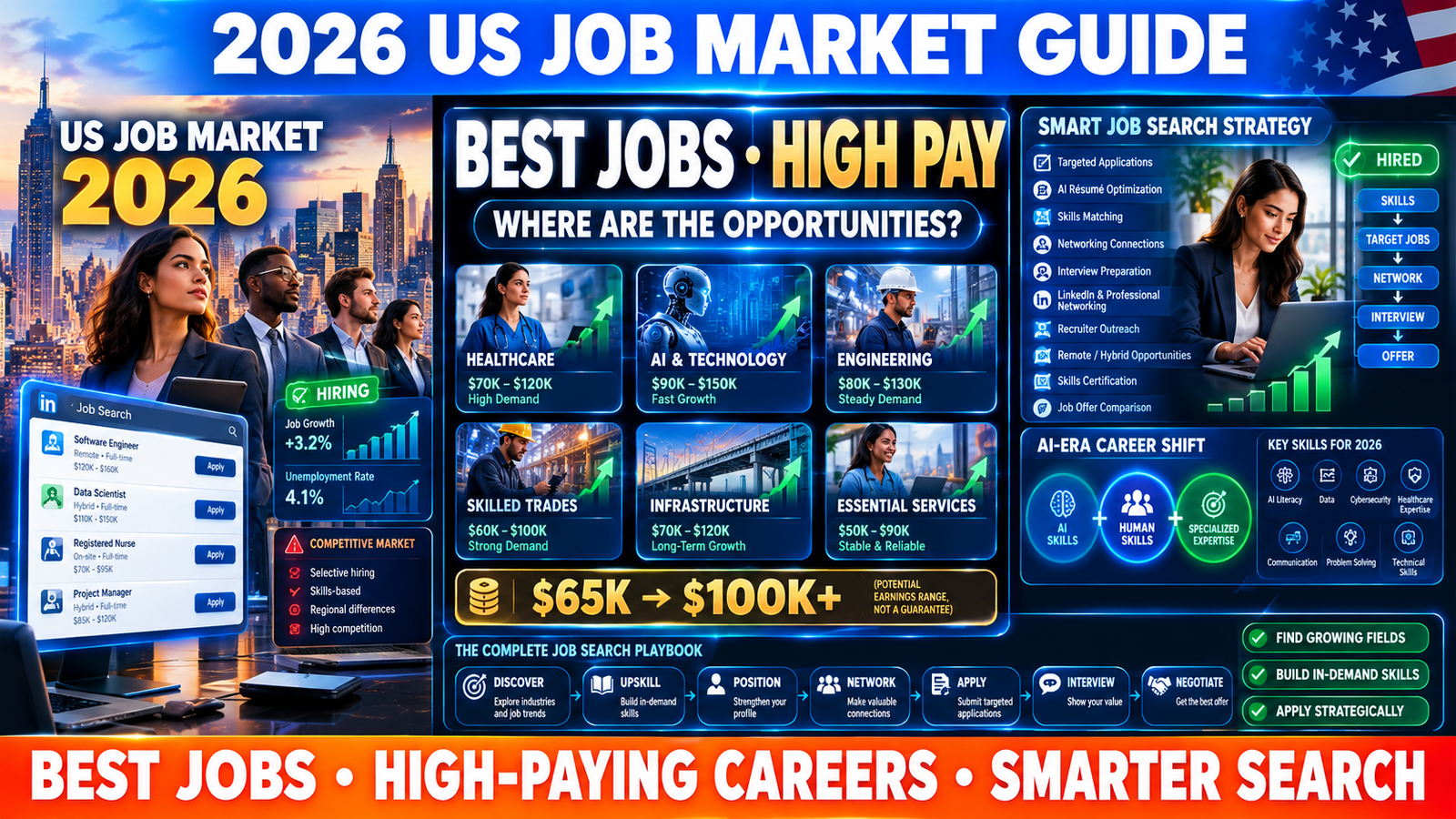
The 2026 US labor market sits at a strange crossroads. On the surface, the numbers look healthy — unemployment hovers around 4.2% to 4.3%, and layoffs have dropped to a four-year low. Yet hiring has gone quiet, leaving many job seekers feeling stuck in a “low-hire, low-fire” economy. As Laura Ullrich, a research director at Indeed Hiring Lab, put it: “The overall labor market has been in a low-hire, stagnant state for the last year. The one big exception is healthcare.”
That stagnation doesn’t mean opportunity has vanished. It means opportunity is now concentrated in specific fields, specific skills, and specific roles. For anyone job hunting or considering a career pivot in 2026, understanding where the growth actually is matters more than ever. This guide breaks down the best jobs, the highest-paying roles, the industries still hiring aggressively, and the practical strategies that work in today’s market — all based on fresh data from Indeed, U.S. News, Fortune, and LinkedIn.
The Best Jobs of 2026: Healthcare Dominates
Indeed’s 2026 Best Jobs report found that all top ten roles pay six-figure salaries — and seven of the ten are in healthcare. Healthcare roles make up just 11% of US job postings but have driven roughly 72% of all job growth, a lopsided ratio that reflects aging demographics and rising demand for chronic care.
Indeed’s Top 10 Best Jobs of 2026
| Rank | Job Title | Median Salary | Salary Growth (since 2022) |
|---|---|---|---|
| 1 | Cardiac medical technologist | $133,907 | 34% |
| 2 | Truck driver (owner-operator) | $160,000 | -5% |
| 3 | Nurse practitioner | $143,183 | 10% |
| 4 | Speech-language pathologist | $109,431 | 14% |
| 5 | Licensed professional counselor | $107,812 | 33% |
| 6 | Licensed clinical social worker | $119,618 | 20% |
| 7 | Physical therapist | $110,848 | 0% |
| 8 | Occupational therapist | $105,580 | 6% |
| 9 | Radiation therapist | $115,923 | 26% |
| 10 | Data scientist | $115,079 | -3% |
Cardiac medical technologists took the top spot, with both salary and job postings up 34% since 2022. Indeed’s researchers noted that this demand reflects rising chronic illness, an aging population, and the fact that heart disease remains the leading cause of death in the United States.
U.S. News Best Jobs Rankings 2026
U.S. News uses a different scoring model — weighing growth potential, salary, employment stability, and work-life balance. Nurse practitioner claimed the #1 spot for the third consecutive year, cited for “immediate demand, flexibility, and a strong 10-year outlook.”
U.S. News Top 10 Best Jobs of 2026:
- Nurse practitioner
- Financial manager
- IT manager
- Information security analyst
- Physician assistant
- Medical and health services manager
- Software developer
- Data scientist
- Speech-language pathologist
- Pilot
Notably, software developer ranked seventh on the U.S. News list, with an projected 267,600 new positions by 2034 — the largest number of new jobs among the top ten.
Where Hiring Demand Is Strongest in 2026
According to a Fortune-reported 2026 employer survey, roughly two-thirds of US employers plan to increase hiring, with technology and healthcare leading demand.
Fields employers most want to hire for:
- Technology: 78%
- Healthcare: 75%
- Finance and accounting: 74%
- Marketing and creative: 65%
- Legal: 58%
- Human resources: 56%
- Administrative and customer support: 52%
Even as AI reshapes many support roles, HR and customer support positions remain in relatively high demand. WTW’s research adds that employers are prioritizing sales, customer experience, and AI skills — especially as economic conditions tighten.
AI’s Dual Impact on the Job Market
The most significant structural shift in the 2026 job market comes from AI’s deepening reach. LinkedIn’s 2026 Skills Report reveals a clear “dual-track” split: the fastest-growing skills fall into both technical AI capabilities (prompt engineering, AI implementation) and human-centric skills (executive communication, leadership influence, cross-functional collaboration) — growing at nearly identical rates.
Harvard Business School research analyzing nearly all US job postings from 2019 through March 2025 found that structured, repetitive cognitive roles declined 13% after ChatGPT’s release, while demand for analytical, creative, and leadership-intensive work grew 20%.
Real-world examples of this split are already visible inside major companies. Morgan Stanley cut roughly 2,500 roles in early 2026 — but financial advisors were not included, because client relationships and judgment cannot be replaced by a model. Goldman Sachs introduced AI into onboarding, loan analysis, and regulatory reporting — yet headcount actually grew, with investment shifting toward roles where experience and judgment matter most.
J.P. Morgan’s analysis echoes this: about a quarter of announced layoffs cite AI as a factor, but economists note “we are not seeing a deterministic outcome where AI simply destroys jobs. Some firms augment workers with AI, others replace them, and there’s a big band of uncertainty.”
What this means for job seekers: Invest in skills AI can’t easily replicate — relationship-building, complex situational judgment, strategic communication — rather than skills that can be standardized.
High-Paying Jobs That Don’t Require a Four-Year Degree
Indeed’s report highlighted that many top jobs don’t require a bachelor’s degree — they’re accessible through vocational training, certifications, or associate degrees.
High-paying roles without a four-year degree include:
- Owner-operator truck driver: median salary $160,000, among the highest in the country
- HVAC technician: strong demand, competitive pay, short training runway
- Radiation therapist: median salary $115,923, typically requires an associate degree or certification
- Cardiac medical technologist: median salary $133,907, typically requires specialized training
- Licensed practical nurse (LPN): a faster, lower-cost path into healthcare
For workers who want to avoid student debt while still earning six figures, these pathways deserve serious attention.
The Highest-Paying Jobs Overall in 2026
For those focused purely on compensation, U.S. News and other rankings show where the ceiling is highest:
| Job Title | Median Salary |
|---|---|
| Anesthesiologist | $371,500 |
| Oral and maxillofacial surgeon | $359,500 |
| Obstetrician and gynecologist | $348,000 |
| Orthodontist | $341,000 |
| Psychiatrist | $299,000 |
| Surgeon | $297,000 |
| Physician (general) | $255,000 |
| Pilot | $226,600 |
| Financial manager | $161,700 |
| IT manager | $171,200 |
Healthcare dominates the top of the pay scale, but management and specialized technical roles — IT managers, financial managers, pilots — also offer strong six-figure earning potential without requiring medical school.
Industries Still Hiring Aggressively
Beyond healthcare, several sectors are quietly expanding:
Skilled trades and logistics: Owner-operator trucking, HVAC, electrical work, and manufacturing technicians remain in short supply. These roles offer strong pay, low automation risk, and short training timelines.
Defense and aerospace: Geopolitical tensions have boosted defense budgets, driving demand for engineers, project managers, and security-cleared professionals.
Energy and utilities: The push for grid modernization and renewable infrastructure has created steady demand for engineers, technicians, and project managers.
Cybersecurity: Information security analysts rank #4 on U.S. News, with demand driven by ransomware, AI-enabled threats, and regulatory compliance.
Accounting and finance: Finance manager ranks #2 on U.S. News, and 74% of employers want to hire in finance and accounting.
Job Search Strategies That Work in 2026
The 2026 market rewards precision over volume. Here’s what actually works:
1. Target growth sectors, not job boards. Applying broadly to hundreds of postings rarely works in a low-hire market. Focus on the sectors listed above, and tailor each application to the specific role.
2. Lead with skills, not job titles. LinkedIn’s data shows employers are shifting toward skills-based hiring. Highlight concrete capabilities — AI implementation, cross-functional leadership, client relationship management — rather than past titles.
3. Build a portfolio of proof. For technical and creative roles, a portfolio of real work (code, campaigns, case studies, dashboards) outperforms a resume alone.
4. Network deliberately. In a stagnant market, referrals carry more weight. Reach out to people doing the job you want, ask specific questions, and stay in touch.
5. Invest in AI-adjacent skills. You don’t need to become an AI engineer, but understanding how AI tools work in your field — and being able to use them productively — is now a baseline expectation in many roles.
6. Consider the trades and healthcare pathways. If you’re early in your career or pivoting, the fastest route to a six-figure salary may not run through a four-year degree.
7. Negotiate with data. With salary data now widely available (Indeed, Glassdoor, BLS), you can anchor negotiations in facts rather than guesses.
Frequently Asked Questions
What is the best job in the US in 2026?
According to Indeed, cardiac medical technologist ranks #1, with a median salary of $133,907 and 34% growth since 2022. U.S. News ranks nurse practitioner #1 for the third consecutive year.
Which industries are hiring the most in 2026?
Technology (78% of employers hiring), healthcare (75%), and finance/accounting (74%) top the list, according to Fortune’s 2026 employer survey.
Are there high-paying jobs that don’t require a college degree?
Yes. Owner-operator truck drivers earn a median of $160,000, and radiation therapists earn $115,923 — both without a four-year degree.
How is AI affecting jobs in 2026?
AI is splitting the market. Repetitive cognitive roles have declined 13% since ChatGPT’s release, while analytical, creative, and leadership roles grew 20%, per Harvard Business School research.
What skills are most in demand in 2026?
LinkedIn reports dual demand: technical AI skills (prompt engineering, AI implementation) and human skills (executive communication, leadership, cross-functional collaboration).
Is it hard to find a job in 2026?
The market is “low-hire, low-fire” — not collapsing, but not booming. Success depends on targeting growth sectors and leading with specific, in-demand skills.
Conclusion
The 2026 US job market is not hostile — it is selective. Healthcare is booming, skilled trades are paying six figures, and AI is reshaping which skills hold value. The workers who thrive will be those who target growth sectors, invest in skills that AI cannot replace, and treat their job search as a focused, data-driven campaign rather than a numbers game.
Whether you’re entering the workforce, changing careers, or returning after a break, the opportunity is real — it just requires knowing where to look.