
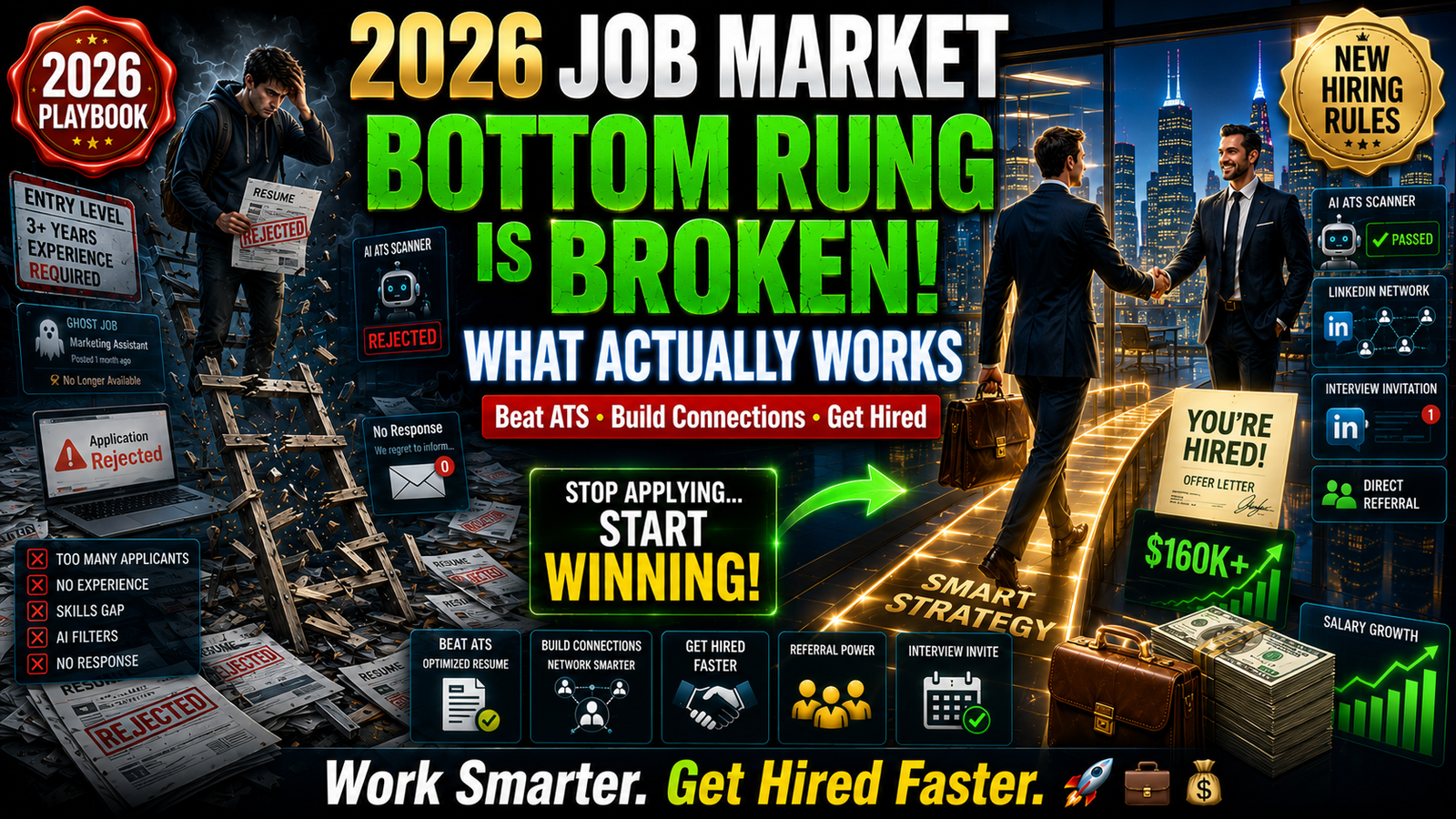
If you have been sending out applications and hearing nothing back, you are not alone—and it is not because something is wrong with you. The 2026 U.S. job market is defined by a “low-hire, low-fire” equilibrium that has fundamentally altered how people find work. Success requires understanding the structural shifts reshaping the market and adopting strategies that bypass the broken systems.
The “Low-Hire, Low-Fire” Reality
The U.S. labor market remains in an unusual phase characterized by restrained hiring and unusually low job churn. From January 2025 through May 2026, job gains averaged just 40,000 per month . While more recent data shows some stabilization—job creation averaged a firmer +188,000 over March-May 2026—the underlying dynamic remains cautious . As U.S. Bank Economics notes, “the combination of slower job growth and still-low unemployment reflects a sharp pullback in both labor demand and labor supply” .
What This Means for Job Seekers
In a low-hire, low-fire economy, firms prioritize efficiency over expansion. The result is fewer new opportunities, less job-to-job switching, and greater difficulty for new entrants to gain a foothold .
The Numbers That Explain Everything:
| What’s Happening | Current State | Why It Matters |
|---|---|---|
| Hiring rate | Near weakest since 2013 | Fewer entry points into the labor market |
| Job openings-to-unemployed ratio | ~1:1 | More competition per role |
| Quits rate | Near post-2008 lows | Workers are “job hugging”—staying put |
| Unemployment rate | 4.3% (May 2026) | Historically low but masking fragility |
The key stabilizing factor remains that layoffs are low. As long as job losses remain contained, the labor market can hold in a relatively stable equilibrium . But “even a modest shock could have an outsized impact on unemployment, growth, and policy decisions” .
The Broken Bottom Rung: Why Young Workers Are Hit Hardest
Young adult workers typically rely on vacancy creation for jobs. When hiring slows, they are the first to feel the effects . The St. Louis Fed has documented that since April 2023, the employment-to-population ratio of new-entrant college graduates has fallen 3.2 percentage points nationally . Even recent college graduates are facing longer job searches, higher unemployment rates, and lower employment-to-population ratios .
As the St. Louis Fed explains, “a labor market can appear strong on the surface while becoming much less hospitable to new entrants” .
The Dual Labor Market
The Federal Reserve Bank of Dallas has documented a stark divide in the labor market :
- Roughly 55% of the population exists in a primary sector with high wages and immense job stability
- All the volatility—accounting for 61% of total unemployment—is concentrated in a much smaller secondary sector comprising just 14% of the population
The normal “trickle-down” mechanism where senior workers changing jobs creates entry-level vacancies has broken down. The transmission mechanism “seems either weak, lagged or broken” . This explains why even as some sectors hire, new entrants are being left behind.
The Ghost Job Problem: Why Your Applications Vanish
Job seekers face an additional hurdle: “ghost jobs”—listings for positions that don’t actually exist. According to a Resume Builder survey, 40% of companies have posted fake job listings over the past year, and 79% of companies using ghost job tactics still maintain active listings .
Why Companies Post Ghost Jobs
The survey of 649 hiring managers reveals the strategic reasons behind this practice :
- 67% wanted to appear open to attracting talent
- 66% sought to show they were in a growth phase
- 63% aimed to convince current employees that workloads would ease with new hires
- 62% used postings to signal to workers they could be replaced
- 59% collected resumes for future use
The practice is not a rogue individual act. Decisions to post ghost jobs come from HR departments (37%), senior management (29%), and executives (25%) .
The Human Cost
A Fast Company analysis based on an Enhancv study of 1,000 U.S. professionals found :
| Finding | Percentage |
|---|---|
| Job seekers paying a “ghost tax” | 37% |
| Applied for roles later discovered nonexistent | 47% |
| Tech workers reporting ghost jobs | 85.7% |
| Marketing professionals reporting ghost jobs | 87.5% |
| Senior professionals applying/interviewing for ghost jobs | Over 50% |
| Have abandoned major job boards entirely | 12.1% |
“When job seekers are losing actual money to engage with a company’s brand, we aren’t just looking at an HR problem, we’re looking at a systemic breakdown of the professional social contract,” said Enhancv co-founder Volen Vulkov .
How to Spot a Ghost Job
Key red flags to watch for :
- Posting age: Real roles are often filled within 30 days; anything live 3+ months is likely a ghost job (19% of companies keep ghost postings up for 3 months or more)
- Reposting patterns: Seeing a “brand new” job reposted after receiving an automatic rejection
- Vague, template-style descriptions: Active roles are specific about team context and priorities
- No named recruiter or hiring manager: Active roles usually have a point of contact
- Company recently announced layoffs or hiring freeze: Listings kept live are likely pipeline plays
The Hidden Job Market: Where Careers Actually Happen
Glassdoor data shows that online applications still account for 60% of job offers, making them the single largest hiring source . But they are no longer sufficient on their own. The remaining 40% come from referrals, recruiter outreach, and direct engagement—the hidden job market .
The Referral Advantage
A Glassdoor Community poll found that over 70% of workers are pessimistic about their job search prospects in 2026, citing repeated rejections and delayed responses . However, candidates who secured interviews through referrals were 35% more likely to receive job offers than those who applied online . About 64% of respondents said personal connections helped them advance their careers .
The “Weak Ties” Advantage
One Senior Software Engineer in the Glassdoor Community put it simply: “‘Weak ties.’ Your friend’s friend is more likely to get you the job than anyone else (including your own friend)” . Casual connections often bridge job seekers to entirely new networks.
Where Employers Are Hiring
Top Hiring Cities
A Robert Half survey of more than 2,000 U.S. hiring managers found that 66% plan to increase permanent hiring in the second half of 2026, up from 57% a year ago.
| Rank | City | Plans to Increase Hiring |
|---|---|---|
| 1 | Denver | 83% |
| 2 | Minneapolis | 76% |
| 3 | San Francisco | 73% |
| 4 | Houston | 69% |
| 5 | Seattle | 69% |
Strongest demand by specialization: Technology (78%), Healthcare (75%), and Finance and Accounting (74%).
The AI Skills Premium: Your Career Leverage
The most significant opportunity in 2026 is the explosion in demand for AI skills. Two numbers tell the story :
- Workers with AI skills earn a 62% wage premium over those without them
- Job postings requiring AI skills have grown 144% year over year—nearly eight times faster than the overall job market
The premium has climbed fast: 25% in 2024, 57% in 2025, and now 62% in 2026, according to PwC’s Global AI Jobs Barometer, which analyzed more than 1 billion job advertisements across 27 countries . It reaches as high as 118% in consumer-facing roles .
The Two-Track Labor Market
PwC’s analysis reveals that AI is driving a “two-track” global labor market :
- Professionalised roles—where AI acts as a “force multiplier” for human expertise—are seeing twice the growth in available jobs and 42% faster salary growth than democratised roles
- Democratised roles—where AI makes the role itself easier for non-experts to perform—are growing slower
Examples of professionalised roles: radiologists, recruiters. Examples of democratised roles: IT service managers, medical secretaries .
The Entry-Level Shift
Perhaps the most significant finding for job seekers: AI-exposed entry-level roles are now seven times more likely to require traditionally senior-level skills like leadership, judgment, and strategic thinking . These “seniorised” entry-level roles have grown 35% since 2019, while other entry-level roles have declined by 10% .
What Actually Works in 2026
1. Stop Relying on Online Applications Alone
A veteran recruiter with 30 years of experience argues that job seekers in 2026 should move away from traditional online applications, which have become a digital “black hole” . The rise of AI-automated application tools has flooded job boards, making it nearly impossible for even qualified candidates to stand out .
2. Focus on Quality Over Quantity
One of the biggest shifts in recent years is the move away from mass applications. Candidates who apply thoughtfully to fewer roles consistently perform better than those who apply broadly without customization . Employers can quickly tell when an application is generic, and those tend to blend into the background .
3. Leverage “Weak Ties”
Reach out to your second-degree connections. Research shows these casual connections often bridge job seekers to entirely new networks and opportunities.
4. Build Your AI Fluency
The 62% wage premium makes this non-negotiable. Across job postings, employers are looking for practical skills: prompt engineering, workflow automation via tools like Make.com or Zapier, AI-augmented analytics, and the ability to critically evaluate AI outputs .
5. Target Growth Sectors
Technology, healthcare, and finance and accounting lead hiring plans. Denver, Minneapolis, and San Francisco are top hiring cities.
Your Action Plan for 2026
1. Stop relying on online applications alone. Online applications are no longer sufficient on their own. The hidden job market accounts for a significant share of hiring.
2. Leverage “weak ties.” Your second-degree connections are more valuable than you think.
3. Build your AI fluency. The 62% wage premium makes this non-negotiable. You don’t need a degree—practical skills carry weight.
4. Target growth sectors and cities. Technology, healthcare, and finance and accounting lead hiring plans. Denver, Minneapolis, and San Francisco are top hiring cities.
5. Be patient and persistent. The market is defined by intent, not urgency. Searches are taking longer—prepare mentally for a marathon.
Disclaimer: This article is for informational purposes only and does not constitute financial or legal advice.
FAQs
Why is it so hard to find a job right now?
The US is in a “low-hire, low-fire” economy. Hiring rates are near recession levels while layoffs remain low. The bottom rung of the job ladder is “broken” for new entrants, and the normal trickle-down of vacancies has broken down .
What are ghost jobs?
Listings for positions that don’t exist. 40% of companies have posted fake job listings in the past year . Companies post them to gather competitive intelligence, signal growth, or manage employee perceptions .
What is the AI skills premium?
Workers with AI skills earn a 62% wage premium over those without them, reaching 118% in consumer-facing roles .
What’s the best way to get hired in 2026?
Networking and leveraging “weak ties.” Referrals are 35% more likely to lead to job offers than online applications .
What cities are hiring most?
Denver (83%), Minneapolis (76%), and San Francisco (73%) lead hiring plans.