
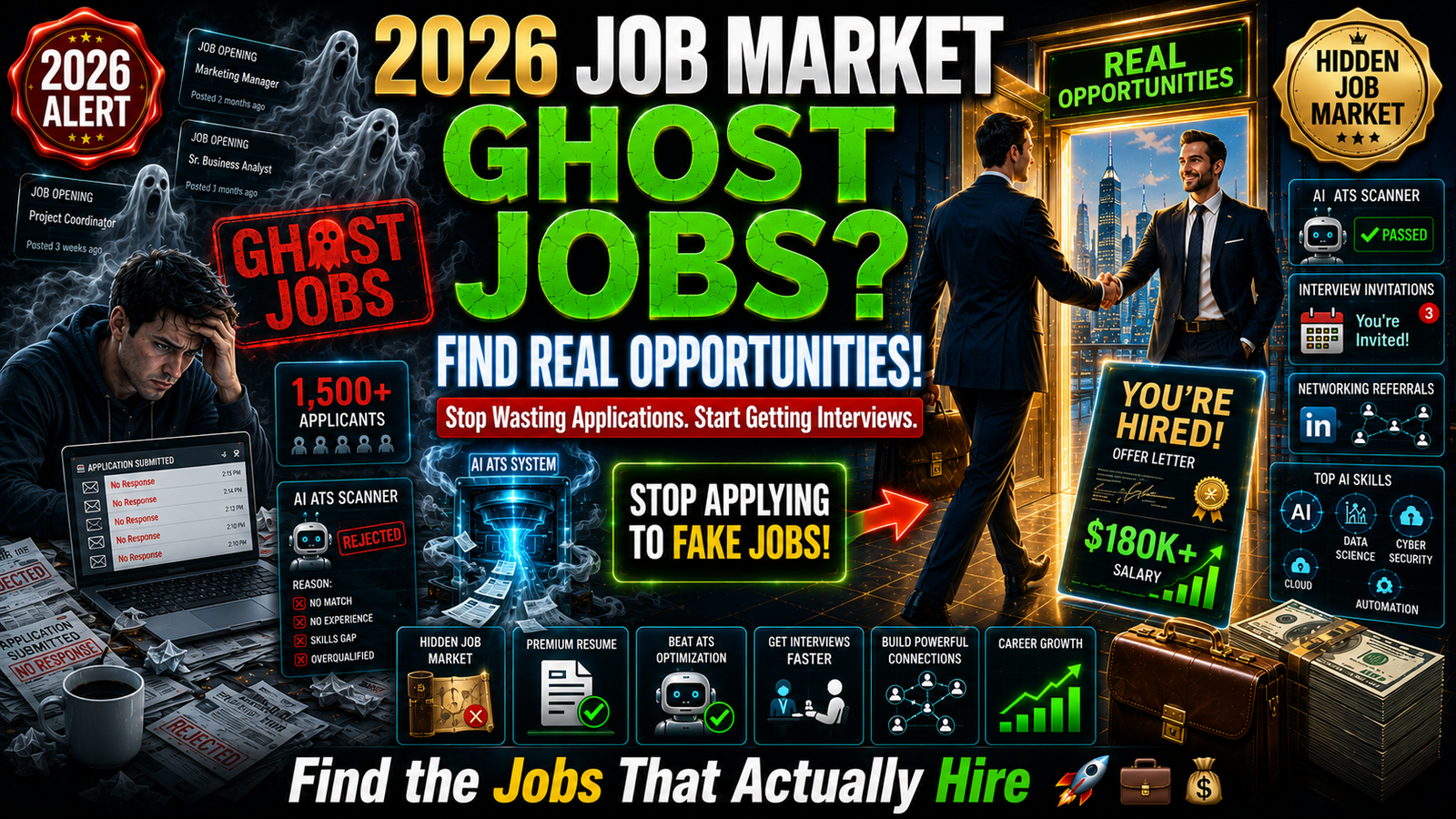
If you have sent out dozens of applications and heard nothing back, you are not alone—and it is not because something is wrong with you. The U.S. job market in 2026 has become a minefield of fake listings, shifting employer strategies, and a broken hiring system that disproportionately hurts new entrants. Understanding this new reality is the first step to finding real opportunities.
The “Ghost Job” Epidemic: The 40% Problem
The single biggest reason your applications are vanishing into a void is the widespread prevalence of “ghost jobs” —listings for positions that companies have no intention of filling. According to a Resume Builder survey, 40% of employers admitted to posting fake job listings over the past year, with 79% of companies using this tactic still maintaining active listings . This practice has become so pervasive that Senator Ruben Gallego recently demanded federal investigations into what he calls a “deceptive job advertisement” practice that “erodes worker confidence and undermines trust in the labor market” .
Why Companies Post Jobs They Won’t Fill
| Reason | Percentage of Companies |
|---|---|
| Look open to attracting talent | 67% |
| Show they were in a growth phase | 66% |
| Convince employees workloads would ease | 63% |
| Signal to workers they could be replaced | 62% |
| Collect resumes for future use | 59% |
Source: Resume Builder survey of 649 hiring managers
What is particularly concerning is that 70% of hiring managers consider this practice ethically acceptable . The decisions to post these listings come from HR departments (37%), senior management (29%), and executives (25%). This is not a rogue individual act—it is an institutional strategy.
The Human Cost of Ghost Jobs
A comprehensive study by Enhancv found that 37% of job seekers are paying a “ghost tax”—out-of-pocket expenses including travel, childcare, and paid certifications—chasing phantom listings . Nearly half (47%) have applied for roles they later discovered were non-existent.
The toll is staggering:
- 85.7% of tech workers and 87.5% of marketing professionals report ghost jobs in their fields
- Over 50% of senior professionals have applied and interviewed for jobs that were never real
- 12.1% of job seekers have completely abandoned major job boards due to the “soul-crushing” cycle
“When job seekers are losing actual money to engage with a company’s brand, we aren’t just looking at an HR problem, we’re looking at a systemic breakdown of the professional social contract.” — Enhancv co-founder Volen Vulkov
How to Spot a Ghost Job
- Posting age: Real roles are typically filled within 30 days. Anything live for 3+ months is likely a ghost job .
- Reposting patterns: The same job appearing every few weeks with the same description.
- Vague, template-style descriptions: Active roles are specific about team context and priorities .
- No named recruiter or hiring manager: Active roles usually have a point of contact.
- Missing from the company site: The role appears on job boards but not on the employer’s careers page.
The “Low-Hire, Low-Fire” Economy: Stability That Masks Fragility
The ghost job problem exists within a broader economic context that economists call a “low-hire, low-fire” labor market . Former Federal Reserve Chair Jerome Powell coined this phrase to describe a standoff between cautious employers and workers staying put.
What the Numbers Tell Us
From January 2025 through May 2026, job gains averaged just 40,000 per month . While more recent data shows some stabilization—job creation averaged a firmer +188,000 over March–May 2026—the underlying dynamic remains fragile . As Indeed’s Hiring Lab explains, “growth that leans on people staying put rather than employers ramping up hiring is a fragile kind of growth” .
| Indicator | Current State | Why It Matters |
|---|---|---|
| Hiring rate | 3.2% (near weakest since 2013) | Fewer entry points into the labor market |
| Separation rate | 3.1% (even lower than hiring) | Job growth relies on people staying put |
| Job openings-to-unemployed ratio | ~1:1 | More competition per role |
| Quits rate | Near post-2008 lows | Workers are “job hugging”—staying put |
The gap between hires and separations is what creates net employment gains. Right now, that gap is positive not because employers are bringing on many new workers, but because relatively few are leaving . The April hires rate was 3.2%, but the separation rate (including quits, layoffs, and discharges) was even lower at 3.1% . This means the building fills a little more each month—but through the thin trickle of people leaving, not through strong hiring.
The Demographic Reality
Labor supply growth has slackened as demographic forces reduce the pool of available workers: population aging, lower birth rates, and shifting migration flows . The “breakeven” employment growth rate—the monthly pace of job creation needed to keep the unemployment rate steady—has fallen sharply. U.S. Bank Economics estimates it in the range of roughly 25,000 to 50,000 jobs per month .
The Broken Bottom Rung: Why Young Workers Are Hit Hardest
The Federal Reserve Bank of Dallas has documented that the normal “trickle-down” mechanism where senior workers changing jobs creates entry-level vacancies has broken down . The transmission mechanism “seems either weak, lagged or broken” .
A Dual Labor Market
The Dallas Fed research reveals a stark divide :
- Roughly 55% of the population exists in a primary sector with high wages and immense job stability
- All the volatility—accounting for 61% of total unemployment—is concentrated in a much smaller secondary sector comprising just 14% of the population
The labor market is generating two conflicting realities: increased efficiency for those already employed, alongside heightened vulnerability for new entrants. Renewed churn at the top of the job ladder is highly efficient—workers are moving to better-fitting roles, which boosts productivity. However, because the trickle-down mechanism is broken, this efficiency does not reach the broader workforce .
Young Workers Are Bearing the Brunt
Young adult workers typically rely on vacancy creation for jobs. When hiring slows, they are the first to feel the effects . Since April 2023, the employment-to-population ratio of new-entrant college graduates has fallen 3.2 percentage points nationally . Even recent college graduates are facing longer job searches, higher unemployment rates, and lower employment-to-population ratios .
As the St. Louis Fed explains: “A labor market can appear strong on the surface while becoming much less hospitable to new entrants” . The distinction is critical—workers who already have jobs are particularly insulated in a low-hire, low-fire economy. Young adults and new entrants are not.
The Hidden Job Market: Where Real Opportunities Live
Given that online applications have become a “digital black hole,” experts estimate that between 40% and 80% of positions are filled through the hidden job market—referrals, recruiter outreach, and direct engagement with employers.
What the Hidden Job Market Really Is
Summer Delaney, founder and CEO of CollabWORK, describes the hidden job market as “the places where careers actually happen, not just where jobs are posted” .
The three layers of the hidden job market:
- Trusted Professional Communities: Facebook groups, Slack communities, Discord servers, Reddit threads, industry newsletters, alumni networks, and professional associations. “When a job is shared in that context, it carries far more credibility.”
- AI-Powered Discovery: ChatGPT, Gemini, Claude, and Perplexity increasingly rely on these same trusted sources to understand employers and recommend opportunities.
- Existing Talent Databases: Former applicants, finalists, interns, and passive candidates already in employer ATS or CRM systems who have simply gone cold.
How to Tap Into the Hidden Job Market
Connect with employees inside target organizations before submitting applications . Participate in professional communities where trusted recommendations are shared—the more specific the hiring need, the more community matters . Leverage “weak ties”—acquaintances and indirect contacts often provide access to opportunities unavailable through close networks.
Relationships are built by consistently providing value, not by repeatedly asking someone to apply. “Instead of asking, ‘Where can I post another job?’ employers should ask, ‘Where are the conversations already happening, and how do we become part of them?'” . This applies to job seekers, too.
The AI Skills Premium: Your Career Leverage
The most significant opportunity in 2026 is the explosion in demand for AI skills. According to PwC’s 2026 Global AI Jobs Barometer, which analyzed more than 1 billion job advertisements across 27 countries :
- Jobs requiring specific AI skills are growing nearly eight times (69%) faster than the total jobs market (9%)
- The average wage premium for workers with AI skills has risen to 62% , up from 57% last year
- The premium reaches as high as 118% in consumer markets
The Entry-Level Shift
Perhaps the most significant finding for job seekers: AI-exposed entry-level roles are now seven times more likely to require traditionally senior-level skills like judgment, leadership, and strategic thinking . These “seniorised” entry-level roles have grown 35% since 2019, while other entry-level roles have declined by 10% .
What Employers Want in AI Fluency
Across job postings, employers are looking for :
- Practical prompt engineering using structured frameworks
- Workflow automation via tools like Make.com or Zapier
- AI-augmented analytics in Power BI, Excel, or SQL
- The ability to critically evaluate AI outputs—hallucination detection now appears in job descriptions
Your Action Plan for 2026
1. Stop relying on online applications alone. The hidden job market accounts for a significant share of hiring. Ghost jobs have turned online applications into a “soul-crushing” cycle.
2. Tap into the hidden job market. Connect with employees at target companies before submitting applications. Participate in professional communities where trusted recommendations are shared. Build presence, not just applications.
3. Build your AI fluency. The 62% wage premium makes this non-negotiable. Focus on practical, demonstrable skills that employers can verify.
4. Be patient and persistent. The market is defined by intent, not urgency. Searches are taking longer.
FAQs
What are ghost jobs?
Listings for positions that don’t exist. 40% of companies have posted fake job listings. Companies post them to gather competitive intelligence, signal growth, or manage employee perceptions .
Why is it so hard to find a job right now?
The US is in a “low-hire, low-fire” economy. Hiring rates are near recession levels while layoffs remain low. The bottom rung of the job ladder is “broken” for new entrants .
What is the AI skills premium?
Workers with AI skills earn a 62% wage premium over those without them, reaching 118% in consumer-facing roles .
What cities are hiring most?
Denver (83%), Minneapolis (76%), and San Francisco (73%) lead hiring plans, according to Robert Half.