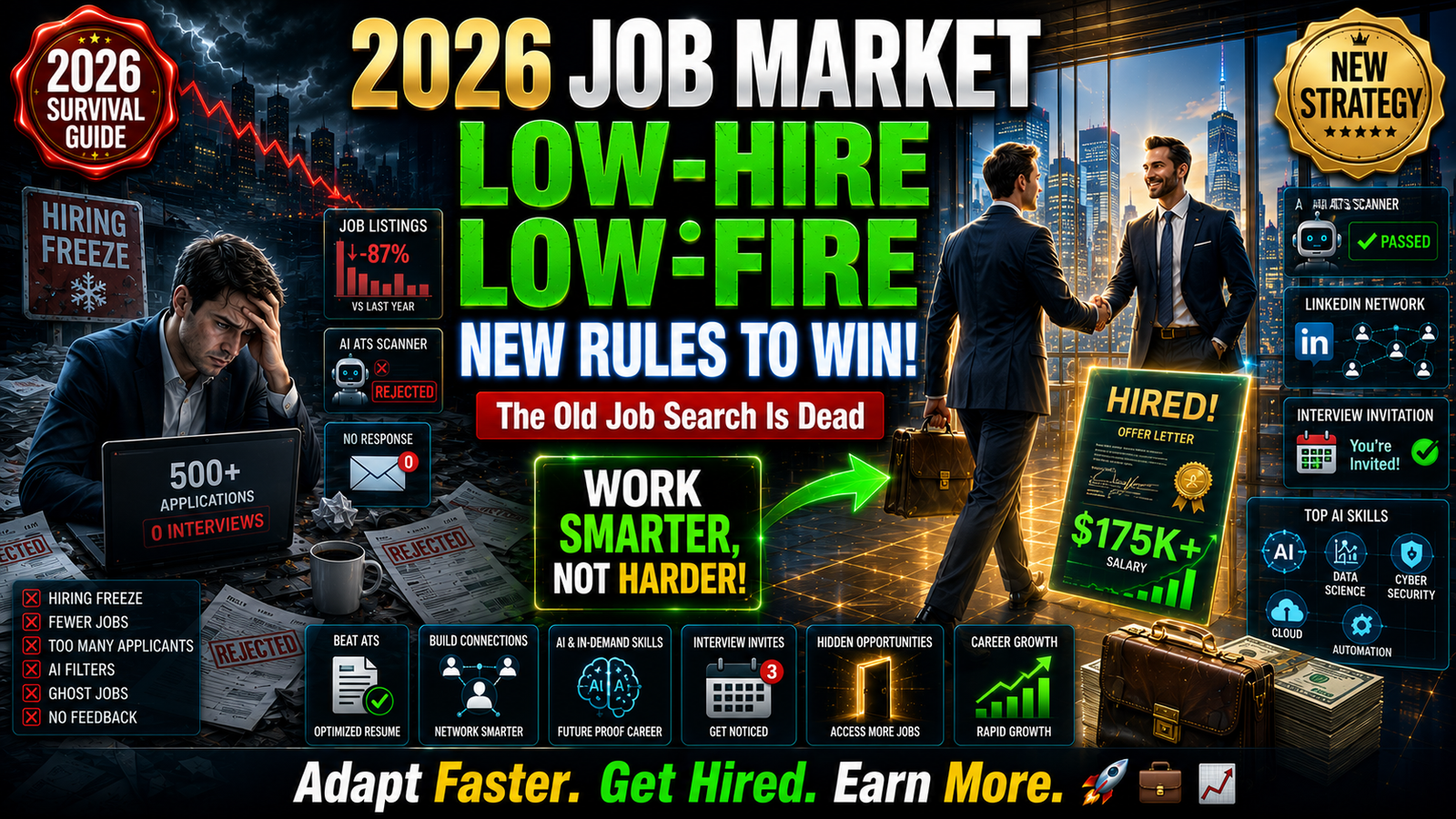
If you have been sending out applications and hearing nothing back, you are not alone—and it is not because something is wrong with you. The 2026 U.S. job market has fundamentally changed, and the old rules no longer apply. Success requires understanding three key realities: the “low-hire, low-fire” economy, the prevalence of ghost jobs, and the growing importance of the hidden job market.
The “Low-Hire, Low-Fire” Economy: Stability on the Surface
The U.S. labor market remains in an unusual phase characterized by restrained hiring and unusually low job churn. Federal Reserve Chair Jerome Powell has described this as a “low-hire, low-fire” economy, a framing economists have widely adopted to describe a standoff between cautious employers and workers staying put .
What the Numbers Tell Us
From January 2025 through May 2026, job gains averaged just 40,000 per month . While more recent data shows some stabilization—job creation averaged a firmer +188,000 over March-May 2026—the underlying dynamic remains cautious . The combination of slower job growth and still-low unemployment reflects a sharp pullback in both labor demand and labor supply .
| What’s Happening | Current State | Why It Matters |
|---|---|---|
| Hiring rate | Near weakest since 2013 | Fewer entry points into the labor market |
| Separation rate | Even lower than hiring rate | Job growth relies on people staying put, not strong hiring |
| Unemployment rate | 4.3% (May 2026) | Historically low but masking fragility |
| Quits rate | Near post-2008 lows | Workers are “job hugging”—staying put out of caution |
The gap between hires and separations is what creates net employment gains. Right now, hiring is positive not because employers are bringing on many new workers, but because relatively few are leaving . As Indeed’s Hiring Lab explains, “growth that leans on people staying put rather than employers ramping up hiring is a fragile kind of growth” .
Demographic Forces at Play
Labor supply growth has slackened as demographic forces reduce the pool of available workers: population aging, lower birth rates, and shifting migration flows . The “breakeven” employment growth rate—the monthly pace of job creation needed to keep the unemployment rate steady—has fallen sharply. U.S. Bank Economics estimates it in the range of roughly 25,000 to 50,000 jobs per month .
The Ghost Job Problem: Why Your Applications Vanish
Job seekers face an additional hurdle: “ghost jobs”—listings for positions that don’t actually exist. A Resume Builder survey found that 40% of companies have posted fake job listings over the past year . Industry data shows that between 18% and 22% of roles posted on Greenhouse fall into this category at any given time .
Why Companies Post Ghost Jobs
According to the Resume Builder survey of 649 hiring managers, companies post these listings to :
- 67%: Appear open to attracting talent
- 66%: Show they were in a growth phase
- 63%: Convince current employees that workloads would ease with new hires
- 62%: Signal to workers they could be replaced
- 59%: Collect resumes for future use
The practice is not a rogue individual act. Decisions to post ghost jobs come from HR departments (37%), senior management (29%), and executives (25%) . Perhaps most concerning, 70% of hiring managers consider this practice ethically acceptable .
The Human Cost
A JobLeads poll found that nearly 80% of professionals have applied to a role they believed was not real, with almost 60% saying it has happened more than once . Some estimates put the share of ghost jobs as high as 40% across recent research .
How to Spot a Ghost Job
Key red flags to watch for:
- Posting age: Real roles are often filled within 30 days. Anything live 3+ months is likely a ghost job
- Reposting patterns: The same job appearing every few weeks with the same description
- Vague, template-style descriptions: Active roles are specific about team context and priorities
- No named recruiter or hiring manager: Active roles usually have a point of contact
- Company recently announced layoffs or hiring freeze: Listings kept live are likely pipeline plays
The Hidden Job Market: Where Careers Actually Happen
Experts estimate that between 40% and 80% of positions are filled through the hidden job market—referrals, recruiter outreach, and direct engagement with employers . Glassdoor data shows that online applications still account for nearly 60% of job offers, but they are no longer sufficient on their own due to heavy competition and automated screening .
What the Hidden Job Market Really Is
Summer Delaney, founder and CEO of CollabWORK, describes the hidden job market as “the places where careers actually happen, not just where jobs are posted” .
The three layers of the hidden job market :
- Trusted Professional Communities: Facebook groups, Slack communities, Discord servers, Reddit threads, industry newsletters, alumni networks, and professional associations. When a job is shared in that context, it carries far more credibility.
- AI-Powered Discovery: ChatGPT, Gemini, Claude, and Perplexity increasingly rely on these same trusted sources to understand employers and recommend opportunities.
- Existing Talent Databases: Former applicants, finalists, interns, and passive candidates already in employer ATS or CRM systems who have simply gone cold.
The Referral Advantage
A Glassdoor Community poll found that over 70% of workers are pessimistic about their job search prospects in 2026, citing repeated rejections and delayed responses . However, candidates who secured interviews through referrals were 35% more likely to receive job offers than those who applied online . About 64% of respondents said personal connections helped them advance their careers .
The AI Skills Premium: Your Career Leverage
The most significant opportunity in 2026 is the explosion in demand for AI skills. According to PwC’s 2026 Global AI Jobs Barometer, which analyzed more than 1 billion job advertisements across 27 countries :
- Jobs requiring specific AI skills are growing nearly eight times (69%) faster than the overall jobs market (9%)
- The average wage premium for workers with AI skills has risen to 62% , up from 57% last year
- The premium reaches as high as 118% in consumer markets
The Two-Track Labor Market
PwC’s analysis reveals that AI is driving a “two-track” global labor market :
- Professionalised roles—where AI acts as a “force multiplier” for human expertise, requiring more human-intensive skills like judgment and leadership—are seeing twice the growth in available jobs and 42% faster salary growth than democratised roles
- Democratised roles—where AI makes the role itself easier for non-experts to perform—are growing slower
Examples of professionalised roles include radiologists and recruiters. Examples of democratised roles include some IT service managers and medical secretaries .
The Entry-Level Shift
Perhaps the most significant finding for job seekers: AI-exposed entry-level roles are now seven times more likely to require traditionally senior-level skills like judgment, leadership, and strategic thinking . These “seniorised” entry-level roles have grown 35% since 2019, while other entry-level roles have declined by 10% .
Where Employers Are Hiring
Top Hiring Cities
A Robert Half survey of more than 2,000 U.S. hiring managers found that 66% plan to increase permanent hiring in the second half of 2026, up from 57% a year ago .
| Rank | City | Plans to Increase Hiring |
|---|---|---|
| 1 | Denver | 83% |
| 2 | Minneapolis | 76% |
| 3 | San Francisco | 73% |
| 4 | Houston | 69% |
| 5 | Seattle | 69% |
Strongest demand by specialization: Technology (78%), Healthcare (75%), and Finance and Accounting (74%) .
The Geographic Divide
A 2026 Lever analysis ranking all 50 states shows striking differences in hiring pressure :
- Tightest markets: South Dakota (Pressure Score 82.1), North Dakota, and Oklahoma. The entire top 10 sit outside major coastal markets, stretching from the Great Plains through the Mountain West and into the South .
- Cooling hubs: California (Score 17.5), Washington State, Massachusetts, Illinois, Oregon, New Jersey, Nevada, and New York all sit in the bottom 10. California’s quits rate of 1.5% signals workers staying put, while its 5.5% unemployment rate gives employers a wider pool to choose from .
- Washington, D.C. (Score 8.3): The only single-digit score on the index, with the highest unemployment rate at 6.7% and tied-lowest quits rate of 1.4%—driven by federal workforce reductions .
What Actually Works in 2026
1. Stop Relying on Online Applications Alone
Online applications are no longer sufficient on their own due to heavy competition and automated screening . The hidden job market accounts for a significant share of hiring. Focus on building presence in professional communities where trusted recommendations are shared .
2. Tap Into the Hidden Job Market
Summer Delaney’s advice: “Instead of asking, ‘Where can I post another job?’ employers should ask, ‘Where are the conversations already happening, and how do we become part of them?'” . The same applies to job seekers.
Practical ways to tap in:
- Connect with employees inside target organizations before submitting applications
- Participate in professional communities—Slack groups, industry newsletters, alumni networks
- Leverage “weak ties”—acquaintances and indirect contacts often provide access to opportunities unavailable through close networks
3. Build Your AI Fluency
The 62% wage premium makes this non-negotiable. Across job postings, employers are looking for practical skills . You don’t need a degree—demonstrated work carries more weight than coursework.
4. Focus on Quality Over Quantity
Candidates who apply thoughtfully to fewer roles consistently perform better than those who apply broadly without customization . Employers can quickly tell when an application is generic, and those tend to blend into the background.
5. Target Growth Sectors and Cities
Technology, healthcare, and finance and accounting lead hiring plans. Denver, Minneapolis, and San Francisco are top hiring cities. But don’t overlook smaller markets—Augusta, Richmond, and Reno are seeing strong hiring momentum outside major coastal hubs .
Your Action Plan for 2026
1. Stop relying on online applications alone. The hidden job market accounts for 40-80% of hiring. Referrals are 35% more likely to lead to job offers than online applications .
2. Tap into the hidden job market. Connect with employees at target companies before submitting applications. Participate in professional communities where trusted recommendations are shared .
3. Build your AI fluency. The 62% wage premium makes this non-negotiable. Focus on practical, demonstrable skills .
4. Target growth sectors and cities. Technology, healthcare, and finance and accounting lead hiring plans. Consider smaller markets like Augusta, Richmond, and Reno .
5. Be patient and persistent. The market is defined by intent, not urgency. Searches are taking longer—prepare mentally for a marathon.
Disclaimer: This article is for informational purposes only and does not constitute financial or legal advice.
FAQs
Why is it so hard to find a job right now?
The US is in a “low-hire, low-fire” economy. Hiring rates are near their weakest since 2013, while layoffs remain historically low. Job growth depends on workers staying put rather than strong hiring .
What are ghost jobs?
Listings for positions that don’t exist. 40% of companies have posted fake job listings in the past year. Companies post them to gather competitive intelligence, signal growth, or manage employee perceptions .
What is the hidden job market?
Opportunities that are never advertised publicly—filled through professional communities, referrals, and direct employer engagement. It operates through trusted communities where candidates ask peers where to work and what it’s really like .
What is the AI skills premium?
Workers with AI skills earn a 62% wage premium over those without them, reaching 118% in consumer-facing roles. Jobs requiring AI skills have grown 69% since 2019, nearly eight times faster than the overall job market .
What cities are hiring most?
Denver (83%), Minneapolis (76%), and San Francisco (73%) lead hiring plans. The tightest hiring markets are in the Great Plains and Mountain West, not coastal hubs .