
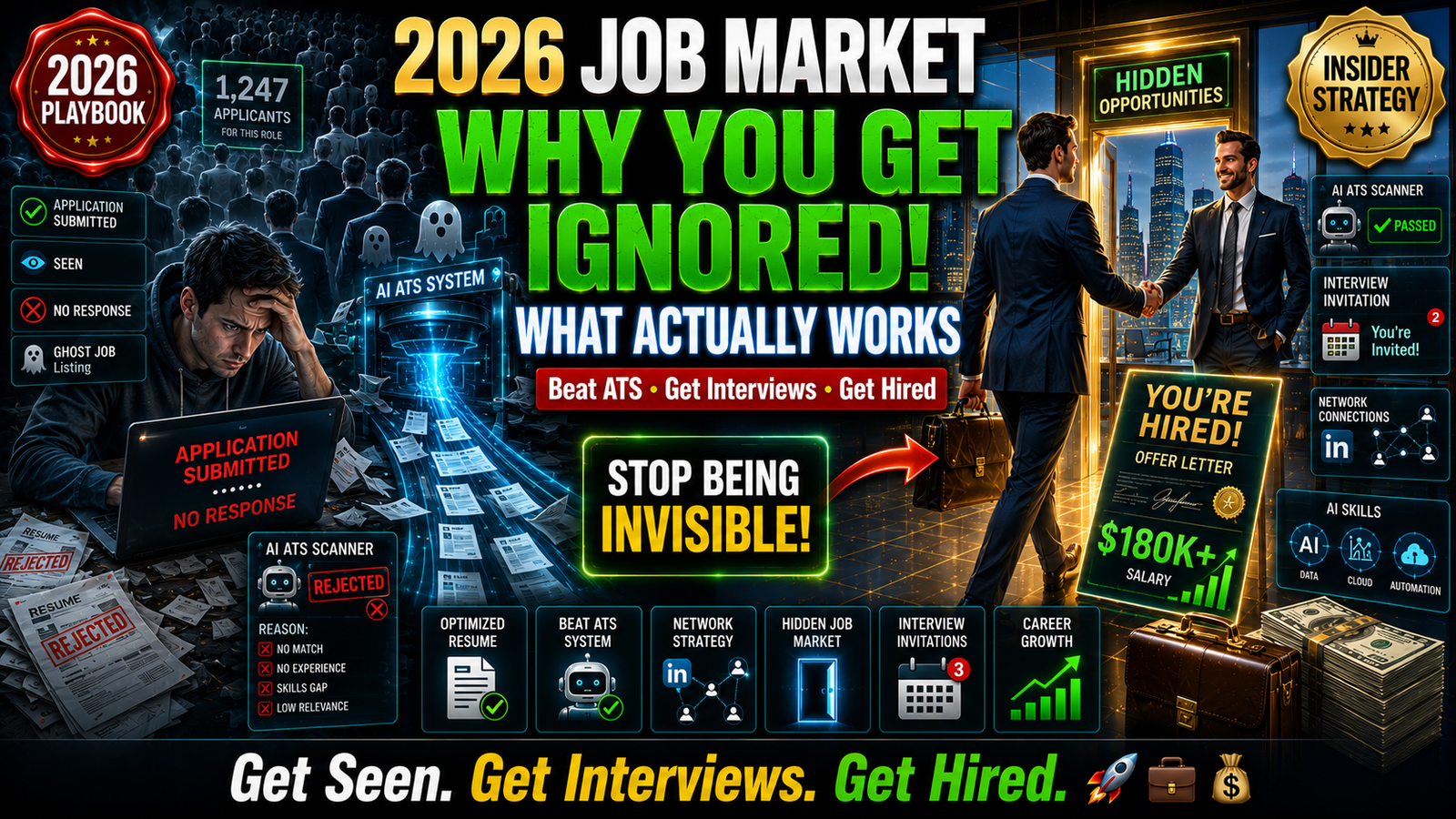
If you’ve been sending out applications and hearing nothing back, you are not alone—and it is not because something is wrong with you. The U.S. job market in 2026 is defined by a “low-hire, low-fire” dynamic that has fundamentally changed how people find work.
The “Low-Hire, Low-Fire” Reality
The U.S. labor market remains in an unusual phase characterized by restrained hiring and unusually low job churn. From January 2025 through May 2026, job gains averaged just 40,000 per month—a pace reflecting both weak hiring and weak layoffs. Federal Reserve Chair Jerome Powell has described this as a “low-hire, low-fire” economy .
What This Means for Job Seekers
| What’s Happening | Current State | Why It Matters |
|---|---|---|
| Hiring rate | Near weakest since 2013 | Fewer entry points into the labor market |
| Quits rate | Near post-2008 lows | Workers are “job hugging”—staying put |
| Unemployment rate | 4.3% (May 2026) | Historically low but masking fragility |
In a low-hire, low-fire labor market, firms prioritize efficiency over expansion. The result is fewer new opportunities, less job-to-job switching, and greater difficulty for new entrants to gain a foothold in the workforce .
The “Broken Bottom Rung”
Young adult workers typically rely on vacancy creation for jobs. When hiring slows, they are the first to feel the effects . Since April 2023, the employment-to-population ratio of new-entrant college graduates has fallen 3.2 percentage points nationally . Even recent college graduates are facing longer job searches, higher unemployment rates, and lower employment-to-population ratios .
As the St. Louis Fed explains: “A labor market can appear strong on the surface while becoming much less hospitable to new entrants” .
Is There Any Good News?
Job creation has shown some stabilization, averaging a firmer +188,000 over March-May 2026. Businesses have also been hiring more temporary workers—typically signaling that firms may need to add permanent staff . The key stabilizing factor remains that layoffs are low: “as long as job losses remain contained, the labor market can hold in a relatively stable—albeit subdued—equilibrium” .
The Ghost Job Problem
Job seekers face an additional hurdle: “ghost jobs”—listings for positions that don’t actually exist.
The Data
A Resume Builder survey of 649 hiring managers found that 40% of companies have posted fake job listings over the past year, and 79% of companies using ghost job tactics still maintain active listings .
Industry data shows that between 18% and 22% of roles posted on Greenhouse, a major hiring platform, fall into this category at any given time . Nearly 80% of professionals have applied to a role they believed was not real, with almost 60% saying it has happened more than once .
The Human Cost
A March 2026 study of 1,000 U.S. professionals by Enhancv found :
- 37% of job seekers are paying a “ghost tax”—out-of-pocket expenses chasing phantom listings
- 47% have applied for roles they later discovered were nonexistent
- 85.7% of tech workers and 87.5% of marketing professionals report ghost jobs
- Over 50% of senior professionals report applying and interviewing for ghost jobs
“When job seekers are losing actual money to engage with a company’s brand, we aren’t just looking at an HR problem, we’re looking at a systemic breakdown of the professional social contract,” said Enhancv co-founder Volen Vulkov .
Why Companies Post Ghost Jobs
According to the Resume Builder survey :
- 67% wanted to appear open to attracting talent
- 66% sought to show they were in a growth phase
- 63% aimed to convince employees workloads would ease with new hires
- 62% signaled to workers they could be replaced
- 59% collected resumes for future use
70% of hiring managers consider this practice ethically acceptable . The decisions come from HR departments (37%), senior management (29%), and executives (25%) .
How to Spot a Ghost Job
Key red flags :
- Posting age: Anything live 3+ months is likely a ghost job
- Reposting patterns: Same job appearing every few weeks
- Vague, template-style descriptions: Active roles are specific about team context
- No named recruiter or hiring manager: Active roles usually have a point of contact
- Company recently announced layoffs or hiring freeze: Listings kept live are pipeline plays
- Missing from company site: The role appears on job boards but not on the employer’s careers page
The Hidden Job Market
Experts estimate that between 40% and 80% of positions are filled through the hidden job market—referrals, recruiter outreach, and direct engagement with employers .
What the Hidden Job Market Really Is
Summer Delaney, founder and CEO of CollabWORK, describes the hidden job market as “the places where careers actually happen, not just where jobs are posted” .
The three layers of the hidden job market :
- Trusted Professional Communities: Facebook groups, Slack communities, industry newsletters, alumni networks
- AI-Powered Discovery: ChatGPT, Gemini, and Claude increasingly rely on trusted sources to recommend opportunities
- Existing Talent Databases: Former applicants, finalists, and passive candidates already in employer systems
The Referral Advantage
A Glassdoor Community poll found that over 70% of workers are pessimistic about their job search prospects in 2026, citing repeated rejections and delayed responses. However, candidates who secured interviews through referrals were 35% more likely to receive job offers . About 64% of respondents said personal connections helped them advance their careers .
How to Tap Into the Hidden Job Market
Connect with employees inside target organizations before submitting applications . Join professional communities—Slack groups, industry newsletters, alumni networks . And leverage “weak ties”—acquaintances and indirect contacts often provide access to opportunities unavailable through close networks .
The AI Skills Premium
The most significant opportunity in 2026 is the explosion in demand for AI skills. According to PwC’s 2026 Global AI Jobs Barometer, which analyzed more than 1 billion job advertisements across 27 countries :
- Workers with AI skills earn a 62% wage premium over those without them
- Job postings requiring AI skills have grown 144% year over year—nearly eight times faster than the overall job market
- The premium reaches as high as 118% in consumer-facing roles
The Two-Track Labor Market
PwC’s analysis reveals that AI is driving a “two-track” global labor market :
- Professionalised roles—where AI acts as a “force multiplier” for human expertise—are seeing twice the growth in available jobs and 42% faster salary growth than democratised roles
- Democratised roles—where AI makes the role itself easier for non-experts to perform—are growing slower
The Entry-Level Shift
AI-exposed entry-level roles are now seven times more likely to require traditionally senior-level skills like leadership, judgment, and strategic thinking . These “seniorised” entry-level roles have grown 35% since 2019, while other entry-level roles have declined by 10% .
What Actually Works in 2026
1. Stop Relying on Online Applications Alone
Online applications account for nearly 60% of job offers but are no longer sufficient on their own due to heavy competition and automated screening .
2. Tap Into the Hidden Job Market
Summer Delaney’s advice: “Instead of asking, ‘Where can I post another job?’ employers should ask, ‘Where are the conversations already happening, and how do we become part of them?'” . The same applies to job seekers.
3. Build Your AI Fluency
The 62% wage premium makes this non-negotiable. You don’t need a degree—practical skills carry weight. Focus on prompt engineering, workflow automation, and the ability to critically evaluate AI outputs .
4. Focus on Quality Over Quantity
Candidates who apply thoughtfully to fewer roles consistently perform better .
FAQs
Why is it so hard to find a job right now?
The US is in a “low-hire, low-fire” economy. Hiring rates are near recession levels while layoffs remain low. The bottom rung of the job ladder is “broken” for new entrants .
What are ghost jobs?
Listings for positions that don’t exist. 40% of companies have posted fake job listings. Companies post them to gather competitive intelligence or signal growth .
What’s the best way to get hired in 2026?
Networking. Referrals are 35% more likely to lead to job offers than online applications. The hidden job market accounts for 40-80% of hiring .
What is the AI skills premium?
Workers with AI skills earn a 62% wage premium over those without them, reaching 118% in consumer-facing roles .