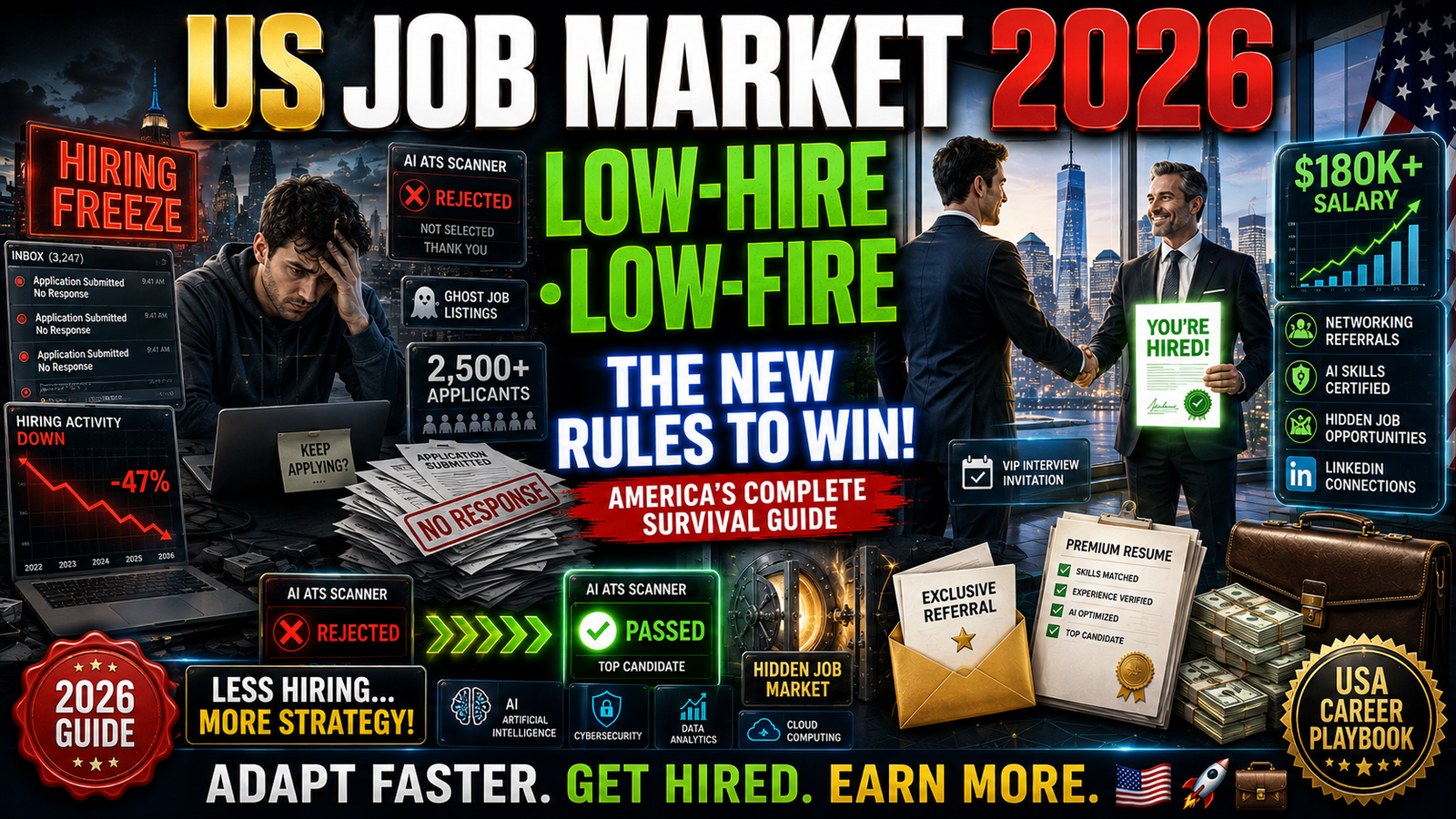
The American job market in 2026 is not booming, and it’s not collapsing. It’s something much more complex and challenging to navigate. Economists at Indeed have coined a phrase that perfectly captures the current environment: a “low-hire, low-fire” economy.
This means hiring is cautious, layoffs remain historically low, and a palpable tension exists. Millions of workers are eager to switch jobs, but they are finding a market where employers hold the leverage and opportunities are scarcer than in the boom years of 2021-2022. This article serves as your comprehensive guide to understanding and succeeding in the 2026 US job market. We will dissect the latest data, identify which sectors are truly hiring, explain the crucial rules of the ATS game, and provide actionable strategies to secure your next role.
This information is current as of July 2026, based on the latest available data from the Bureau of Labor Statistics (BLS), major hiring firms like Robert Half, and economic analysis from institutions like J.P. Morgan.
Part 1: The Current State of the 2026 U.S. Job Market
To succeed, you must understand the underlying trends. The data paints a picture of a market that has cooled significantly from the post-pandemic frenzy.
Key Indicators: What the Numbers Say
Let’s look at the hard numbers that define the 2026 job market.
- Unemployment & Job Growth: The unemployment rate was 4.2% in June 2026, which is low by historical standards. However, job growth has been modest, with the U.S. adding an average of 92,000 jobs per month in the first half of 2026, a recovery from the slowdown in 2025 but still below pre-pandemic averages. For context, June saw only 57,000 jobs added, well below expectations, highlighting the market’s fragility.
- The Shift in Leverage: The single most important statistic for job seekers is the vacancy-to-unemployment ratio. For the first time since the pandemic boom, there are now fewer job openings than unemployed workers, with the ratio sitting at 0.9. What does this mean? Employers have the leverage. They can be more selective, take their time with hiring, and are less pressured to offer sky-high salaries to attract candidates.
- Wages vs. Inflation: Wage growth is steady but has slowed. Average hourly earnings grew by 3.5% year-over-year in June 2026. While this is a solid increase, it’s barely keeping pace with inflation, which sat at 3.8%. This means that although paychecks are bigger, the purchasing power of workers is not significantly improving. The period of massive real wage gains is over for now.
- The “Stay-Put” Mentality: The quits rate – a measure of how many workers voluntarily leave their jobs – has dropped to 2.0%, a level not seen since 2018. People are not jumping ship without a guarantee. This “stay-put” mentality is a clear sign of worker caution in a competitive market.
The Paradox of Worker Ambition vs. Market Reality
Herein lies the core paradox of the 2026 market. A survey by Robert Half found that 38% of employed workers plan to launch a new job search in the first half of 2026, a significant jump from 27% in July 2025. Workers are motivated by a desire for better benefits (36%), limited career advancement (34%), and more competitive pay (33%).
However, this ambition is clashing with a market that offers fewer opportunities. The same survey found that 59% of job seekers believe there’s too much competition for available positions, and 68% expect their current job search to take longer than previous ones. The key takeaway? You cannot rely on the passive job search strategies of 2021. You need a deliberate, optimized, and patient approach.
Part 2: The Top Industries and Jobs in the 2026 U.S. Market
While the national picture may seem stagnant, specific sectors are defying the trend and actively hiring. Knowing where to focus your energy is half the battle.
Healthcare: The Undisputed Leader
Healthcare and social assistance is the powerhouse of the 2026 job market, and it’s projected to remain so for the next decade. An aging population and an increase in chronic illness are driving insatiable demand.
- Top Roles: The fastest-growing role in the country is Nurse Practitioner (NP), with a projected growth of 38% through 2032. Physician Assistants (PAs) and specialized roles like Psychiatric NPs are also in incredibly high demand.
- Other Opportunities: Beyond clinical roles, there is massive demand for Medical Receptionists, Medical Administrative Assistants, and Patient Access Specialists in clinics and hospital networks.
Technology: A Tale of Two Markets
The tech sector is the most complex story in 2026. While overall software development job postings have dropped by 30% compared to pre-pandemic levels, a specific niche is booming: Artificial Intelligence (AI) . Over 5% of all US job postings now mention AI. As a result, the market is fiercely competitive for generalist roles but desperate for AI specialists.
- High-Demand Tech Roles: AI/ML Engineers, Data Scientists, and Cloud Architects command massive salaries and have significant negotiating power. The demand for cybersecurity skills is also sky-high, with a projected 32% growth through 2032.
- The Federal and Defense Sector: Major employers like Boeing are actively hiring Entry-level Software Engineers for mission-critical projects. These roles often require a Bachelor’s Degree and the ability to obtain a U.S. Security Clearance, emphasizing the ongoing demand in the defense and space sectors.
Manufacturing and Production: The Reshoring Boom
Manufacturing is experiencing a resurgence fueled by government infrastructure spending and a trend toward reshoring production back to the US. The BLS projects nearly 1 million openings in production occupations annually.
- Key Drivers: The fastest-growing manufacturing sub-sector is battery manufacturing, driven by the demand for electric vehicles and energy storage.
- Top Roles: The single occupation projected to add the most jobs in manufacturing is Industrial Machinery Mechanics (41,200 new jobs projected), highlighting the need for technicians to maintain increasingly automated factories.
Business & Professional Services
This massive sector continues to be the engine for a broad range of white-collar jobs, contributing over 648,000 openings in the second half of 2025 alone.
- Top Roles: It is a primary employer for Software Engineers, Customer Service Specialists, and Administrative Project Managers. Product Managers also remain in high demand, bridging the gap between business goals and technical execution.
Part 3: Conquering the ATS: Your Resume is Step One
You can be the perfect candidate for a job, but your application will never reach a human if it can’t beat the Applicant Tracking System (ATS). In 2026, this is the first and most critical hurdle. A staggering 85% of enterprise and tech hiring is managed by just six ATS platforms.
The ATS Challenge in Numbers
Different ATS platforms parse resumes with varying degrees of accuracy. Using the wrong format can be disastrous.
| ATS Platform | Who Uses It | Single-Column Parse Rate | Two-Column Parse Rate |
|---|---|---|---|
| Workday | 60%+ of Fortune 500 (Amazon, Walmart, Bank of America) | 98-99% | 64% |
| Greenhouse | Mid-market tech (Airbnb, HubSpot, Stripe) | 97% | 71% |
| iCIMS | Mid-market (Uber, Best Buy, healthcare networks) | 91% | 47% |
| Taleo | Legacy enterprise & government (AT&T, Nike, US federal gov) | ~85% | <50% |
| Ashby | Fast-growth startups (Notion, Linear, Ramp) | 95%+ | ~85% |
Data sourced from StylingCV’s ATS analysis of major platforms.
Your 3-Step ATS Survival Strategy
- Sacrifice Style for Substance: The data is clear: two-column resumes are a gamble. Workday’s parser drops from 99% to 64% accuracy when faced with a two-column layout. That’s a 35% chance your resume will be rendered unreadable. The safest and most effective format is a single-column, cleanly formatted PDF.
- Use Standard Headers and Keywords: An ATS is not a human; it doesn’t appreciate creativity. Use standard section headings like “Work Experience,” “Education,” and “Skills.” More importantly, you must match the keywords from the job description literally. If a job description asks for “Salesforce Admin” three times, use the exact phrase “Salesforce Admin” on your resume, not a synonym like “CRM Administrator.”
- Tailor Your Resume for the System: The “one-size-fits-all” resume is dead. Each ATS parses differently, and each job description has unique keywords. You must tailor your resume for every single application to maximize your chances of passing the automated screening.
Part 4: Where to Find These Jobs and What They Pay
The Best Job Boards in 2026
- Indeed: The volume leader with 250+ million unique monthly visitors. Best for a wide range of roles from service to entry-level white-collar jobs.
- LinkedIn: With a 27.7% market share among job boards, it’s essential for professional networking and finding corporate roles. The algorithm rewards consistent and active profiles.
- ZipRecruiter: Known for its strong AI matching, it is a good choice for small-to-mid-sized companies.
- USAJOBS: The official portal for federal government jobs. This is the place to look for stable, pension-backed careers.
- Built In: A network of city-specific tech hubs (e.g., Built In Chicago, Built In NYC). Great for finding roles at startups and scale-ups.
2026 Salary Reality Check
Salary transparency laws are spreading across states like Colorado, New York, and California, giving candidates more power to know their worth. Here’s a breakdown of what you can expect to earn in some of the most in-demand roles.
Figures are based on combined data from Robert Half, Hays, DrJobPro, and other salary guides.
Part 5: Strategies for Job Seekers in a Cooler Market
Given the challenges of 2026, a passive approach will not work. Here are the strategies you need to adopt to stand out.
- Be Laser-Focused on Business Needs: Employers are not just looking for a list of skills; they want to see how your experience translates to outcomes like “improving efficiency,” “reducing risk,” or “advancing priority initiatives.” Your resume and interviews must connect your experience directly to these business needs.
- Use AI Wisely, Not Lazily: Generative AI can help you draft and polish your application materials. However, relying on it too heavily will result in generic resumes that are easily spotted by recruiters. Authenticity and strong communication skills are becoming a key differentiator in a sea of AI-generated applications. Over-reliance can even make your skills harder for a hiring manager to verify.
- Stay Flexible and Explore Adjacent Roles: If the perfect role isn’t available, broaden your search. Consider contract or temporary assignments, which are up 22% as companies avoid long-term commitments. Expanding your search to include adjacent roles, different industries, or employers that value transferable skills will keep you active in the market.
- Consider Geographic Mobility: While coastal tech hubs like San Francisco and New York still have jobs, the fastest-growing job markets are in smaller, more affordable cities. LinkedIn’s 2026 “Cities on the Rise” list highlights places like Augusta, GA; Richmond, VA; and Reno, NV, where healthcare and manufacturing are driving strong hiring. Exploring these markets could yield better opportunities with a lower cost of living.
Conclusion
The 2026 U.S. job market demands a more strategic and resilient job seeker. While the era of “easy hiring” is over, the market is far from closed. Strong opportunities exist, particularly in healthcare, AI, and advanced manufacturing. The key to success lies in understanding the new rules of the game: a rigid, precise, and ATS-optimized approach to your resume, a target that is focused on the right industries, and the patience to navigate a slower but not stagnant hiring process. The opportunities are there – you just need to know how to find them and fight for them.