
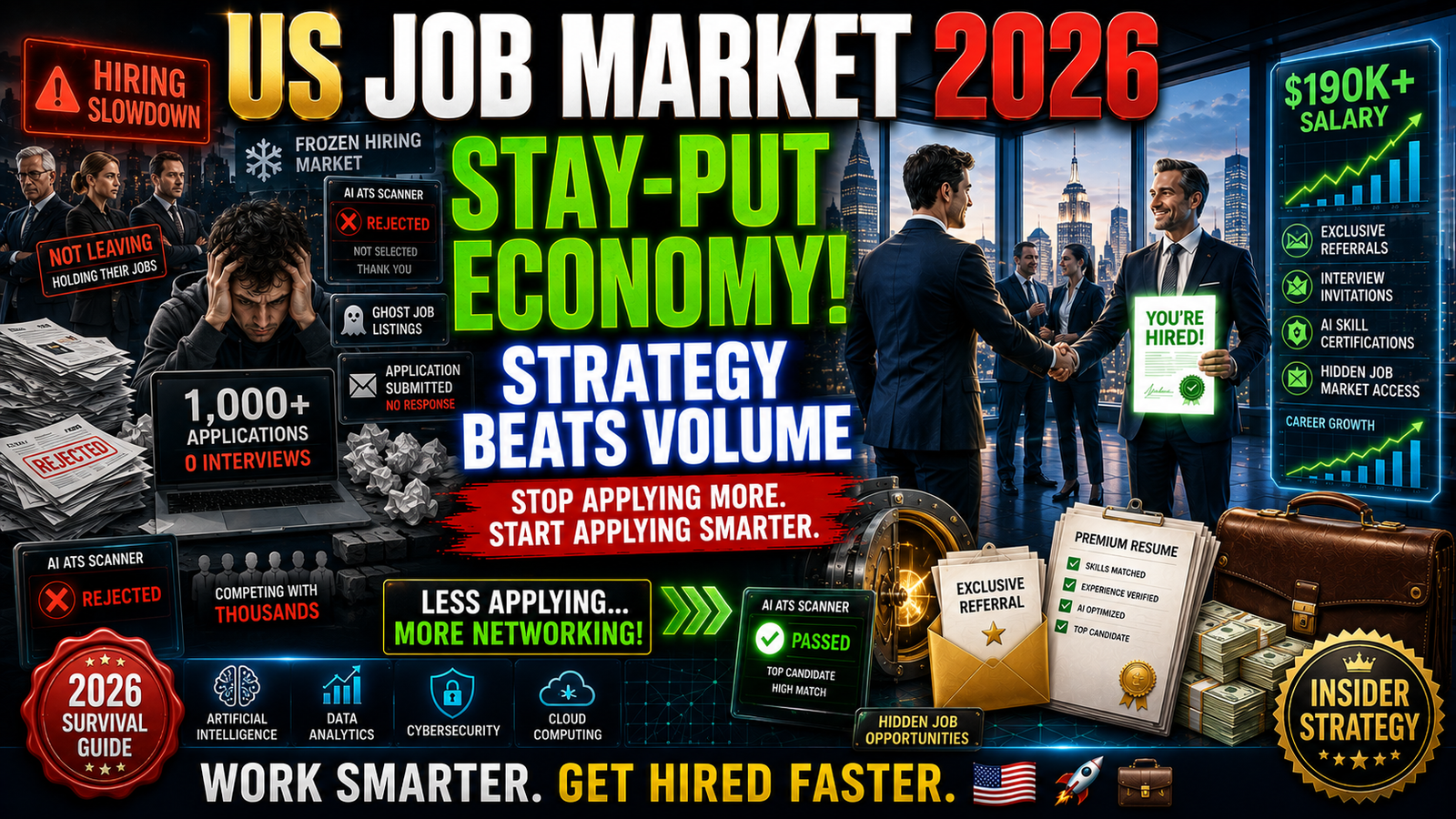
The US job market in 2026 has settled into an uneasy equilibrium. It is not crashing, but it is not thriving either. For job seekers, this translates into a frustrating paradox: the unemployment rate remains historically low at 4.2%, yet landing a new role feels more difficult than it has in years .
This is the reality of a “low-hire, low-fire” economy. Companies are not laying off workers in droves, but they are also not expanding their workforces rapidly. The result is a market characterized by cautious hiring, longer job searches, and a palpable sense of stagnation. This guide cuts through the noise to provide a clear-eyed view of the 2026 job market and a practical playbook for navigating it successfully.
The Big Picture: What the 2026 Data Actually Means
The headlines can be deceptive. While a 4.2% unemployment rate suggests a healthy job market, the underlying data reveals a more complex and challenging picture for job seekers .
Decoding the “Low-Hire” Paradox
In June 2026, the US economy added only 57,000 jobs, significantly below expectations, and prior months’ gains were revised downward . While average monthly job growth for the first half of 2026 was 92,000, this is a recovery from the 2025 slump but still below pre-pandemic levels .
The key to understanding this is the concept of “breakeven employment growth” —the number of jobs needed each month to keep the unemployment rate from rising. The Federal Reserve Bank of St. Louis estimates this range to be between 15,000 and 87,000 jobs per month, a wide range that reflects deep uncertainty about immigration flows .
So, how can the market be adding jobs, yet feel so stagnant? Because the quits rate has dropped to levels not seen since 2018 . Workers are staying put. The ambition to find a new role is high—38% of workers plan to look for a new job in the first half of 2026—but the market is not providing enough opportunities to absorb this ambition . With the vacancy-to-unemployment ratio now below 1.0, there are fewer job openings than unemployed workers, giving employers the leverage .
Who Is Hiring (and Who Isn’t)
While overall hiring is sluggish, several sectors are defying the trend. Understanding these is crucial for targeting your search effectively.
The data from Robert Half for the second half of 2025 shows strong job openings in the following industries :
- Healthcare (126,000 new openings): This sector continues to be a pillar of stability. The demand is not just for clinical roles but also for administrative staff. Medical Receptionists (15,600 job postings) and Medical Administrative Assistants (10,400) are among the most in-demand roles .
- Manufacturing (140,700 new openings): Driven by reshoring and government infrastructure spending, manufacturing is seeing significant hiring. Key roles include Software Engineers (16,300) and Customer Service Specialists (16,200) .
- Financial Services (137,800 new openings): A 16% increase year-over-year. Demand is strong for Software Engineers (19,000) and Data Engineers .
- Business and Professional Services (648,100 new openings): This massive sector offers the most opportunities, spanning tech, administrative, and financial roles. Software Engineers (60,100 job postings) and Administrative Project Managers (39,200) are top targets .
In contrast, LinkedIn’s May 2026 Workforce Report showed that hiring in April 2026 was 8.5% lower than in April 2025, with deceleration in 19 of 20 industries . The month-over-month decline in hiring was most pronounced in Oil, Gas, and Mining (-8.3%) and Retail (-6.6%) . This paints a clear picture: the job market is contracting in many areas, making it imperative to focus your efforts where demand remains.
Winning Strategies for the 2026 Job Market
In a market that favors employers, a generic, high-volume approach is a recipe for burnout. Here is how to flip the script.
1. Abandon the “Spray and Pray” Method
Submitting dozens or hundreds of applications online is becoming increasingly ineffective. The rise of AI-automated tools has flooded job boards, meaning even qualified candidates are getting lost in the “black hole” of online portals .
The experts at Robert Half note that employers are hiring with “intention.” They are creating roles and pursuing talent only when the business case is clear. This means your application must demonstrate a direct, impactful connection to their specific needs .
2. Implement the “10/10 Rule” to Access the Hidden Job Market
Career coach Beth Hendler-Grunt recommends the “10/10 rule”: identify 10 companies you’re interested in, find 10 people at those companies in roles you’d like, and contact them .
The goal is not to ask for a job on the first date. Instead, the strategy is to build a genuine connection. Send a brief, focused message about a shared interest, their career path, or a specific question. This approach taps into the “hidden job market” where many roles are filled before they are even posted . As one expert stated, “A single human connection beats 50 automated submissions” .
3. Manage Your Mental Health and Protect Your Identity
The job search in 2026 is a psychological marathon. The constant silence and rejection can take a significant toll.
Experts recommend creating a “proof file” —a running document of your wins, positive feedback, and problems you’ve solved. Read it before interviews to counter the self-doubt that rejection breeds .
It is also vital to manage your energy. Do not spend eight hours a day on your search. Treat it like a work block with a defined start and end. “When you already have other opportunities in front of you, rejection stings a lot less” . Protect your identity outside of the job search to prevent it from becoming the only lens through which you see yourself .
Regional Hotspots: Where the Jobs Are
Not all cities are created equal in 2026. Robert Half’s research identified the top 12 US cities for hiring plans in the second half of 2026 :
| Rank | City | % of Employers Planning to Increase Hiring |
|---|---|---|
| 1 | Denver | 83% |
| 2 | Minneapolis | 76% |
| 3 | San Francisco | 73% |
| 4 | Houston | 69% |
| 5 | Seattle | 69% |
| 6 | Boston | 66% |
| 7 | Dallas | 65% |
| 8 | Los Angeles | 64% |
| 9 | Atlanta | 63% |
| 10 | Chicago | 63% |
| 11 | New York | 59% |
| 12 | Washington, D.C. | 57% |
Denver, Minneapolis, and San Francisco are leading the pack. The strongest demand is for Technology (78% of employers planning to hire), Healthcare (75%), and Finance and Accounting (74%) professionals . While LinkedIn data shows year-over-year hiring is down even in these hubs, the concentration of planned growth makes them markets worth targeting .
Conclusion: Your Action Plan for Success in 2026
The 2026 US job market is not for the faint of heart, but it is navigable. The era of getting a job through sheer volume is over. Your path forward requires a fundamental shift in strategy.
Your action plan:
- Focus Your Targeting: Don’t spray your resume everywhere. Zero in on the industries that are hiring—Healthcare, Tech, Manufacturing, and Financial Services.
- Network, Don’t Just Apply: Your best chance to land a job is through a human connection. Actively build relationships using the “10/10 rule” to bypass the ATS bottleneck.
- Be Intentional: Employers are looking for candidates who can solve specific business problems. Tailor your resume and interviews to demonstrate your direct impact.
- Prioritize Your Well-Being: Job searching is a marathon. Manage your energy, fight off rejection’s psychological toll, and treat it as a professional task, not an all-consuming identity.
The tools to succeed are different in 2026, but they are effective. By adopting these strategies, you can stop struggling against the market and start navigating it with confidence.