
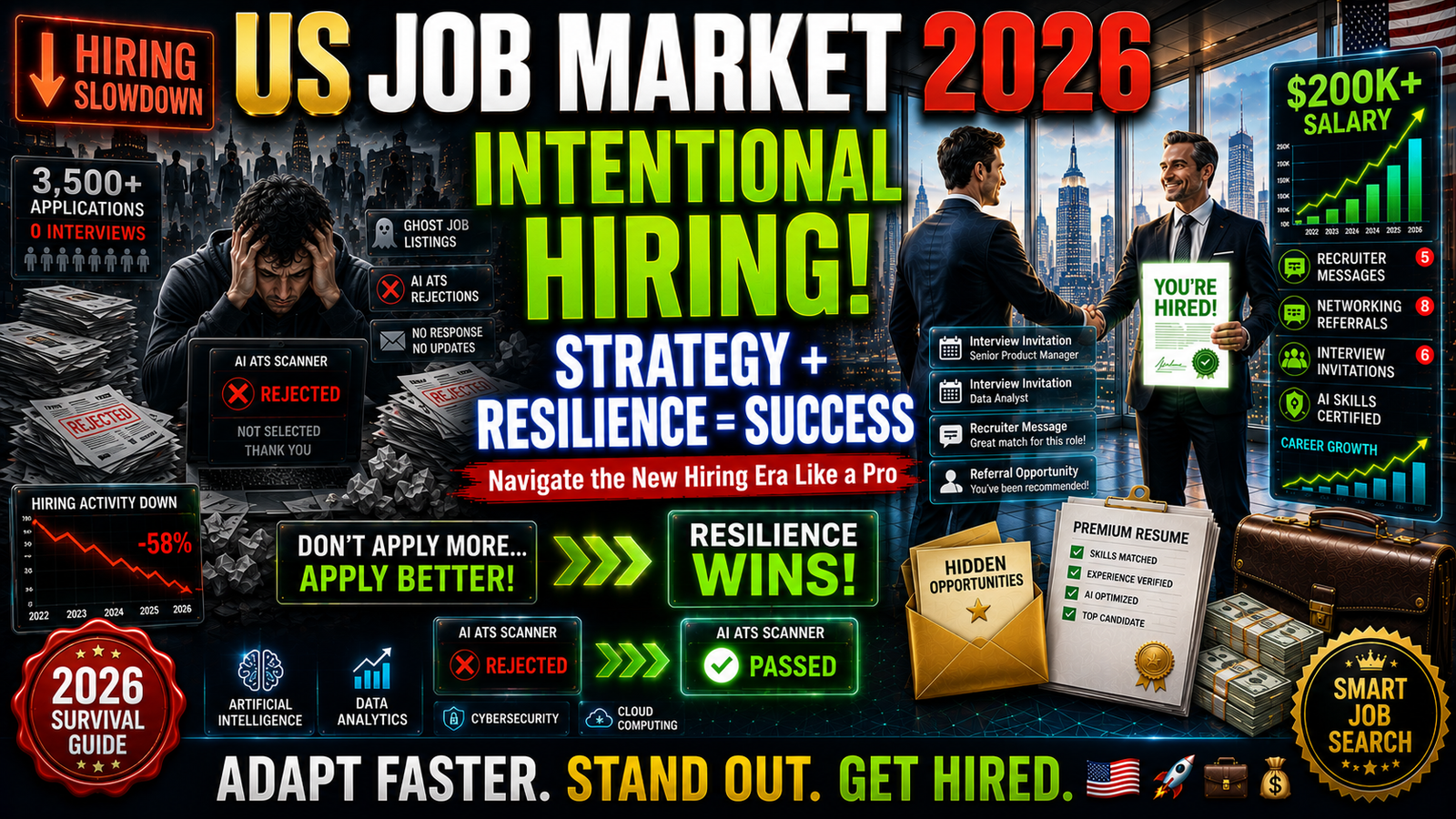
The US job market in 2026 is a study in contrasts, a landscape that demands a fundamental shift in how you approach your career search. The data paints a picture of stability, but for millions of job seekers—particularly young Americans—the experience is one of frustration and prolonged uncertainty. The market is not collapsing, but it is also not booming. This is the era of “intentional hiring,” where employers are selective, strategic, and laser-focused on roles that drive business impact .
This article will decode the current state of the labor market, identify the industries and skills that are genuinely in demand, and provide a practical, step-by-step action plan for navigating your job search with confidence and resilience.
Part 1: The Big Picture – What the 2026 Data Actually Means
The headline numbers for the 2026 job market present a paradox. The national unemployment rate stood at a low 4.2% in June, a figure that historically signals a healthy economy . However, this number masks a more complex reality.
Job Growth: A Tale of Moderation
The economy has added an average of 92,000 jobs per month in the first half of 2026. While this is a significant rebound from the anemic growth of 2025 (which averaged just 10,000 jobs per month), it remains well below the 2024 average of 122,000 jobs . June’s report was particularly weak, with only 57,000 jobs added, far below expectations, and the prior months’ gains were revised downward by 74,000 . This cooling momentum is a defining feature of the 2026 job market.
The Deceptive Unemployment Rate
The low unemployment rate of 4.2% is partly a statistical illusion. It fell slightly in June because the labor force participation rate dropped to 61.5% . In simpler terms, the unemployment rate went down partly because fewer people are actively looking for work. Since December 2025, roughly 2 million workers have left the labor force . This “exit” from the workforce is a critical factor in understanding why the job market feels so difficult, even with a seemingly healthy unemployment rate.
Wage Growth and Inflation: The Squeeze on Purchasing Power
Wage growth has been steady, with average hourly earnings growing by 3.5% on an annual basis in June . However, this growth is barely keeping pace with inflation. Real wages in the US grew by only 0.6% in the year to Q1 2026 and remained 1.4% below their Q1 2021 level, prior to the post-COVID inflation surge . This means that while paychecks are slightly larger, the purchasing power of workers has not significantly improved. As Robert Half notes, compensation is increasingly tied to specialized expertise, with average salary increases projected at around 2.1%, but with sharper uplifts for specialist skills .
Part 2: The “Two-Track” AI Revolution and What It Means for You
Artificial intelligence is not just a buzzword; it is fundamentally reshaping the labor market and creating what PwC’s 2026 AI Jobs Barometer describes as a “two-track” employment landscape .
Track 1: Professionalised Roles
In these roles, AI acts as a “force multiplier” for human expertise. AI automates routine tasks, allowing professionals to focus on high-value activities like judgment, creativity, and leadership . These roles are seeing twice the job growth and 42% faster salary growth than their counterparts . Examples include radiologists, recruiters, and other roles where human expertise is amplified by AI.
Track 2: Democratised Roles
In these roles, AI makes the job itself easier for non-experts to perform. This can potentially reduce the value of specialized skills and increase competition . Examples include software developers and loan officers, where some of the technical aspects of the job can be automated.
The Entry-Level Shift: Senior Skills Required Earlier
Perhaps the most striking finding from the PwC report is the transformation of entry-level roles. AI-exposed entry-level positions are now seven times more likely to require traditionally senior-level skills like leadership, creativity, and face-to-face interactions . Job openings for these “seniorised” entry-level roles have grown 35% since 2019, while other entry-level roles have shrunk by 10% . This means entry-level candidates must demonstrate skills that were once expected only after years of experience.
The AI Skill Premium
The demand for AI skills is exploding. Jobs requiring specific AI skills—like prompt engineering or machine learning—are growing eight times (69%) faster than the overall jobs market . The average wage premium for workers with AI skills has surged to 62%, up from 57% last year, and can be as high as 118% in some sectors, like consumer markets . According to Naukri’s World AI Day Report 2026, AI-related skills now appear in 15.4% of technology job descriptions, up from just 0.9% in 2020, reflecting a nearly 17-fold increase in employer demand . The message is clear: developing AI fluency is no longer optional—it is becoming a baseline requirement.
Part 3: Where the Jobs Are – Industries and Roles in Demand
While overall hiring is measured, specific sectors are actively recruiting.
Key Industries
- Healthcare and Social Assistance: This sector continues to be a pillar of stability, with job growth trending upward. In June 2026, it added 47,000 jobs combined .
- Professional and Business Services: This sector is also seeing strong hiring, adding 36,000 jobs in June .
- Financial Services, Technology, and Manufacturing: Robert Half highlights these as areas with strong competition for talent, particularly for roles that directly impact revenue and strategic decision-making . HireQuest also predicts growth in manufacturing and construction, driven by reshoring and infrastructure investment .
Sectors Slowing Down
- Leisure and Hospitality: Employment in this sector declined by 61,000 jobs in June, reflecting weaker-than-usual seasonal hiring .
- Administrative and Office Support: These roles are expected to continue slowing as they are most susceptible to automation through AI .
Part 4: Job Search Strategies That Actually Work in 2026
In this competitive and “intentional” hiring environment, a passive, high-volume approach to applications is a recipe for burnout. Success requires a strategic, targeted, and people-first approach.
1. Focus on Quality Over Quantity
One of the biggest shifts in recent years is the move away from mass applications . Candidates who apply thoughtfully to fewer roles consistently perform better. Employers can quickly tell when an application is generic, and those tend to blend into the background . Be selective with your search, targeting roles that genuinely align with your skills and interests .
2. Build and Use Your Network Intentionally
Research continues to show that a large percentage of roles are filled through referrals and connections rather than solely through job boards . Networking is not about asking for a job; it’s about building relationships and staying visible. Effective networking includes reconnecting with former colleagues, booking informational conversations, and engaging thoughtfully on LinkedIn . Many opportunities never become public postings; they surface through conversations first .
3. Strengthen Your Personal Brand
Your online presence is often part of the hiring process . A strong LinkedIn profile reinforces your credibility. This includes a clear headline, a summary that tells a cohesive career story, and experience descriptions that focus on outcomes and impact .
4. Tailor Your Application to Stand Out
In a crowded market, a tailored approach matters. Use the language of the job description to clearly show how your experience meets the employer’s needs . Include keywords from the job description to help your application pass through Applicant Tracking Systems .
5. Use Technology Wisely
Technology is deeply embedded in the hiring process. Use it to support your search, not replace human connection. Ensure your resume is clean and ATS-friendly, and use tools to track your applications and follow-ups .
Part 5: Protecting Your Mental Health
The job search in 2026 is a psychological marathon. The constant silence and rejection can be corrosive. Taking care of your mental health is a strategic necessity.
- Treat the job search like a part-time job: Set a schedule with a clear start and end time to avoid burnout .
- Archive ghosting and move on: If a company doesn’t respond after one or two polite follow-ups, archive it and move on .
- Reframe rejection: “Treat rejection as data, and nothing more.” It does not define your value.
- Create a “proof file”: Keep a running document of your wins, positive feedback, and problems you’ve solved. Read it before interviews to counter self-doubt .
Conclusion: Your Action Plan for 2026
The 2026 US job market rewards strategic, intentional, and human-centric job searching. The era of the “easy” job search is over, but opportunities remain for those who adapt.
Your action plan is clear:
- Focus your search on sectors that are hiring, such as healthcare, financial services, technology, and manufacturing.
- Develop AI fluency—it’s becoming a baseline requirement.
- Build your network intentionally—referrals and connections are your best path to opportunities.
- Emphasize outcomes and skills over job titles in your resume and interviews.
- Use AI as a tool for research and editing, but maintain your authentic voice.
- Protect your mental health—the search is a marathon, not a sprint.
By adopting these strategies, you can navigate the 2026 job market with confidence and purpose