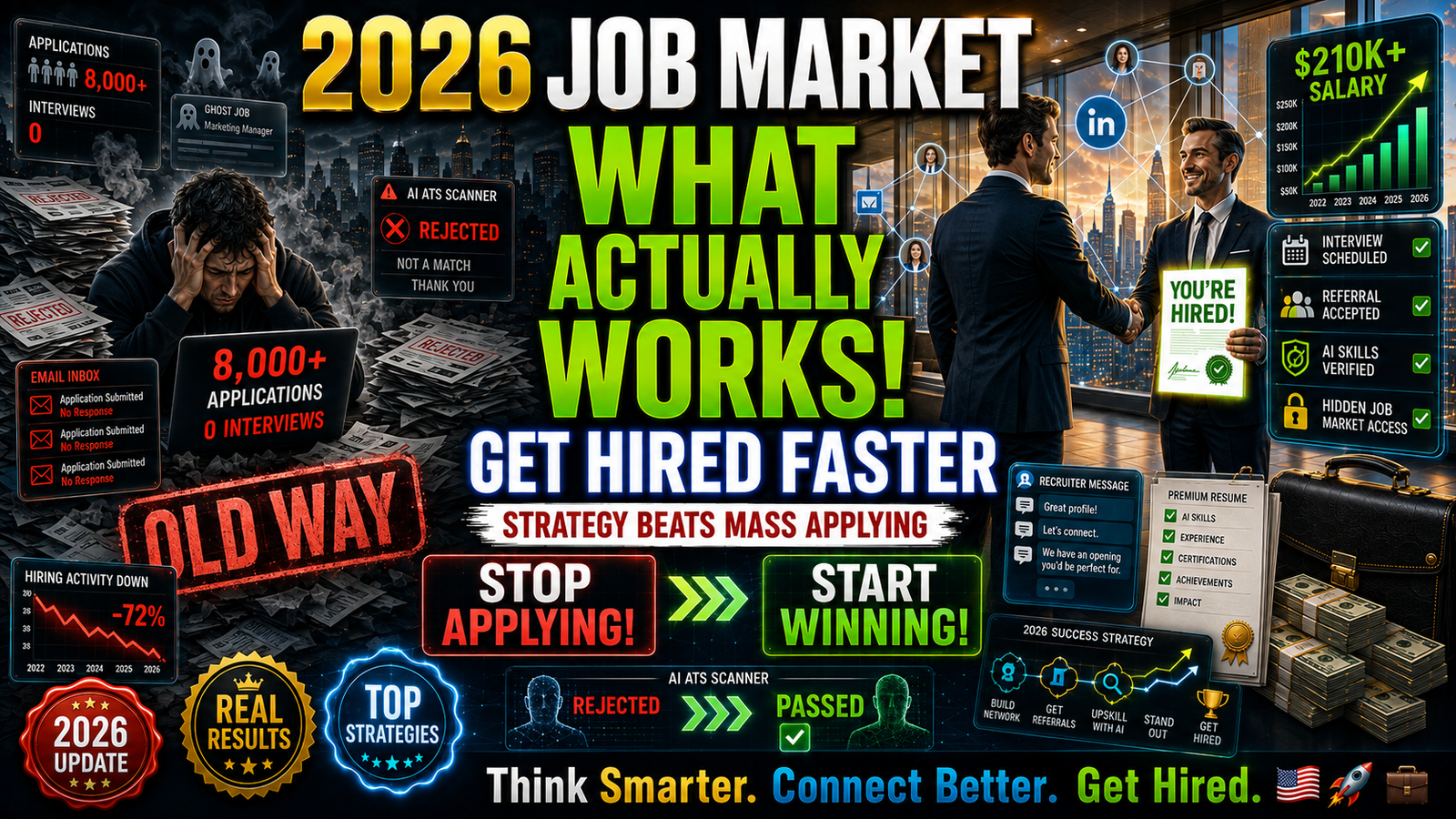
If you are searching for a job in 2026 and finding the process more grueling than expected, you are not alone—and it is not because something is wrong with you. The US job market has fundamentally changed, and the old rules of job searching no longer apply.
Here is a ground-level view of what is actually happening, backed by the latest data.
The New Reality: Why Online Applications No Longer Work
A veteran recruiter with 30 years of experience argues that job seekers in 2026 should move away from traditional online applications, which have become a digital “black hole” . The rise of AI-automated application tools has flooded job boards, making it nearly impossible for even qualified candidates to stand out through standard portals .
The numbers tell the story. A Glassdoor Community poll found that over 70% of workers are pessimistic about their job search prospects in 2026, citing repeated rejections and delayed responses . Candidates who secured interviews through referrals were 35% more likely to receive job offers than those who applied online .
The Market Right Now: Mixed but Moving
Job Growth Is Uneven
The US economy added just 57,000 jobs in June 2026, well below expectations . While the unemployment rate fell slightly to 4.2%, this was driven by 720,000 workers exiting the labor force entirely—meaning the drop was not because hiring was strong .
Job gains are heavily concentrated in specific sectors :
- Healthcare and social assistance: +47,000 jobs
- Professional and business services: +36,000 jobs
- Construction: +11,000 jobs
Meanwhile, consumer-facing sectors experienced deep cuts:
- Leisure and hospitality: -61,000 jobs
- Retail and information: -7,500 jobs combined
Hiring Confidence Is Growing
Despite the uneven picture, 66% of employers plan to increase permanent hiring in the second half of 2026, up from 57% a year ago . The strongest demand is in technology (78%), healthcare (75%), and finance and accounting (74%) .
Denver tops the list of cities with hiring plans, followed by Minneapolis and San Francisco .
The AI Divide: Your Career Leverage
The Two-Track Labor Market
PwC’s 2026 Global AI Jobs Barometer, analyzing more than one billion job ads, reveals that the labor market is splitting into two distinct tracks :
- Professionalised roles: Jobs where AI acts as a “force multiplier” for human expertise. Workers in these roles are seeing twice the job growth and 42% faster salary growth than the other track .
- Democratised roles: Jobs where AI makes tasks easier for non-experts to perform. These roles are growing slower .
The AI Skills Premium
Jobs requiring specific AI skills are growing nearly eight times faster (69%) than the overall jobs market . The average wage premium for workers with AI skills has surged to 62%—up from 57% last year—and can be as high as 118% in some consumer-facing sectors .
The Entry-Level Shift
AI-exposed entry-level roles are now seven times more likely to require traditionally senior-level skills like judgment, creativity, and leadership. These “seniorised” entry-level roles have grown 35% since 2019, while other entry-level roles declined by 10% . Entry-level workers with AI skills earn significantly more than their peers without them .
Where the Jobs Are
Top Hiring Cities
LinkedIn’s “Cities on the Rise” list highlights the fastest-growing destinations for jobs and talent :
- Augusta, Georgia
- Richmond, Virginia
- Reno, Nevada
- North Port-Bradenton-Sarasota, Florida
- Harrisburg, Pennsylvania
Healthcare is the common thread—hospitals and healthcare rank among the top hiring industries in 23 of the 25 metros on the list . Augusta is driven by defense, cybersecurity, and healthcare, with top employers including Savannah River Nuclear Solutions, the U.S. Army, and Augusta University .
Workers Are Planning to Move
Nearly half of US workers plan to look for a new job within the next six months . Healthcare is the most popular target industry, followed by technology and marketing . Workers under 45 are leading this trend, while only about two in ten baby boomers are considering a move .
- Better benefits and workplace perks (47%)
- Career growth and promotion opportunities (43%)
- Flexible work arrangements (39%)
- Higher pay (35%)
Job Search Strategies That Actually Work
1. Stop Relying on Online Applications Alone
The “spray and pray” method is dead. A veteran recruiter now advises moving away from traditional online applications and prioritizing direct networking and internal referrals . Online applications still account for about 60% of job offers, but they are no longer sufficient on their own .
2. Focus on Quality Over Quantity
Candidates who apply thoughtfully to fewer roles consistently perform better . Employers can quickly tell when an application is generic, and those tend to blend into the background . Target roles that genuinely align with your skills and tailor each application .
3. Build and Use Your Network Intentionally
Networking does not mean asking for a job. It means building relationships, having conversations, and staying visible within your professional community . Many opportunities never become public postings—they surface through conversations first .
The “hidden job market” —which includes referrals, recruiter outreach, and direct employer engagement—accounts for 40% of hiring . Experts recommend connecting with employees inside target organizations before submitting applications .
4. Leverage “Weak Ties”
Acquaintances and indirect contacts can introduce you to new professional circles. Research suggests these connections often provide access to opportunities unavailable through close networks .
5. Strengthen Your Personal Brand
Employers and recruiters regularly review LinkedIn profiles to better understand a candidate’s background, communication style, and career progression . A strong profile reinforces your credibility and makes it easier for opportunities to find you . This includes a clear headline, a cohesive career summary, and experience descriptions that focus on outcomes .
6. Emphasize Skills and Outcomes Over Job Titles
Employers are increasingly focused on what candidates can do, how they solve problems, and how quickly they can contribute . Focus your resume on measurable results and transferable skills .
Key Takeaways
| Strategy | Why It Works |
|---|---|
| Stop mass-applying online | AI-automated tools have flooded job boards; referrals are 35% more likely to lead to offers |
| Build your network | 40% of hiring happens through the “hidden job market” |
| Develop AI fluency | AI skills command a 62% wage premium and are growing 8x faster than the overall job market |
| Target high-growth sectors | Healthcare, professional services, and tech are hiring; consumer-facing sectors are cutting |
| Consider emerging cities | Smaller metros like Augusta, Richmond, and Reno are seeing strong hiring momentum |
Your Action Plan
- Stop treating online applications as your primary strategy—networking is now the differentiator
- Develop AI fluency—even basic proficiency can command a significant premium
- Target healthcare, tech, and professional services—these sectors are hiring
- Consider emerging cities like Augusta, Richmond, and Reno
- Emphasize outcomes and skills over job titles in your resume and interviews
The 2026 job market rewards strategic, intentional job searching. The era of the “easy” job search is over, but opportunities remain for those who adapt.