
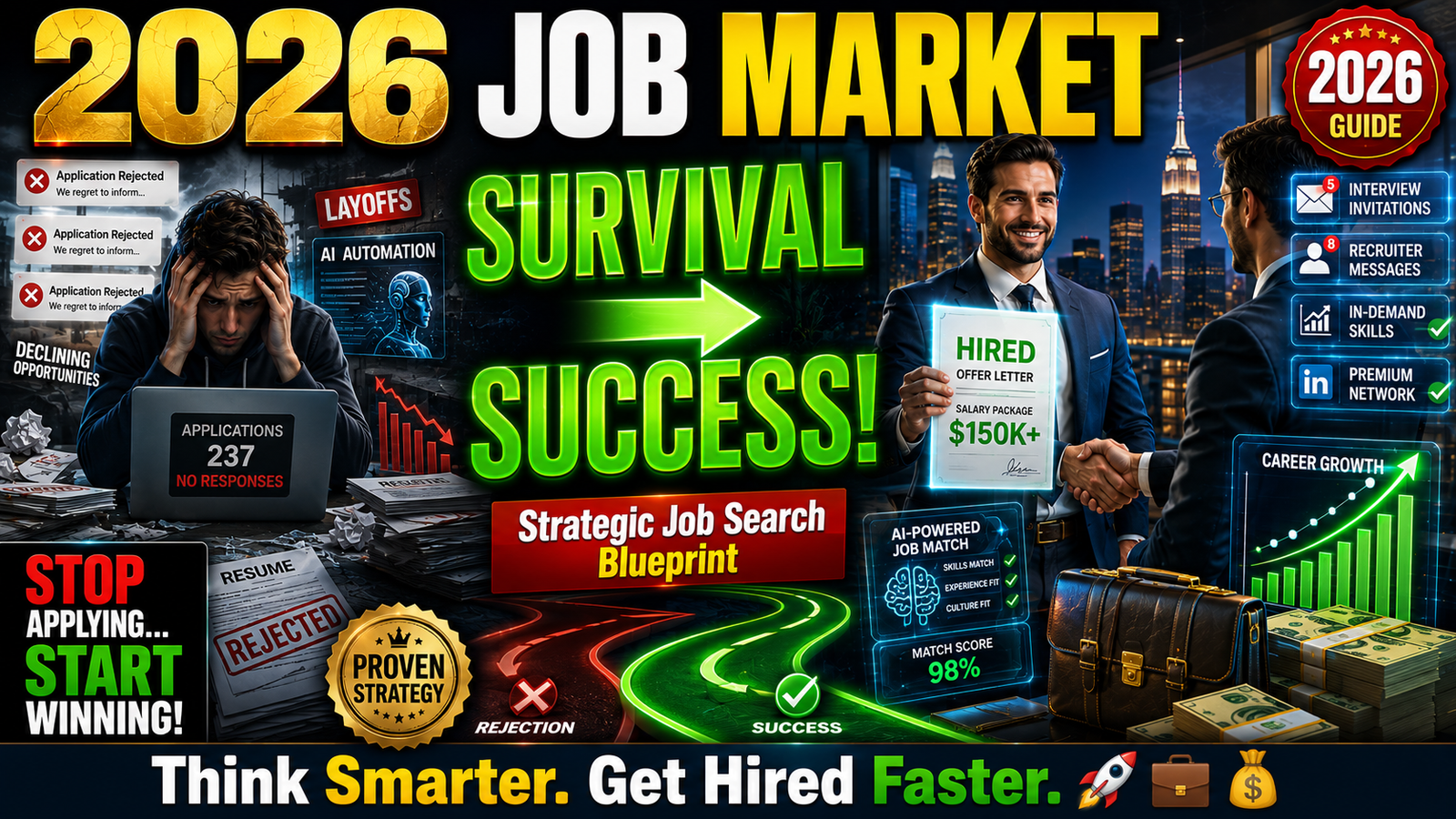
If you have been sending out applications and hearing nothing back, you are not alone. The 2026 US job market is defined by a “low-hire, low-fire” economy, where employers are holding onto workers but creating few new opportunities. The old rules no longer apply.
The “Low-Hire, Low-Fire” Reality
The U.S. labor market remains in an unusual phase characterized by restrained hiring and unusually low job churn. From January 2025 through May 2026, job gains averaged just 40,000 per month. While more recent data shows improvement—a firmer +188,000 average over March–May 2026—the underlying dynamic remains cautious.
The Numbers That Explain Everything
Why “Low-Hire, Low-Fire” Matters for You
Job growth is positive not because hiring is strong, but because separations have fallen even faster than hires. The gap between hires and separations is what creates net employment gains—and right now, that gap is small and fragile.
As Indeed’s Hiring Lab explains: “Growth that leans on people staying put rather than employers ramping up hiring is a fragile kind of growth”. All it would take is an uptick in quits or layoffs to produce softer job reports.
What’s Driving the Slowdown
- Demographic shifts: Rising retirements, lower birth rates, and reduced immigration have shrunk the labor pool. The “breakeven” job growth needed to keep unemployment stable has fallen sharply, with U.S. Bank Economics estimating it at roughly 25,000–50,000 jobs per month.
- Tariff-related cost pressures: Higher tariffs have increased costs and uncertainty, discouraging hiring.
- Federal spending cuts: Reductions have created localized shocks and weighed on confidence among contractors.
- Consumer spending softness: Lower- and middle-income households face mounting affordability pressures.
- AI impact: Demand for some entry-level tech roles is easing as firms reassess staffing needs amid rapid AI adoption.
The Hidden Job Market
Online Applications Alone Are No Longer Enough
A Glassdoor Community poll found that over 70% of workers are pessimistic about their job search prospects in 2026, citing repeated rejections and delayed responses. Candidates who secured interviews through referrals were 35% more likely to receive job offers than those who applied online. About 64% of respondents said personal connections helped them advance their careers.
Online applications still account for nearly 60% of job offers, but experts say they are no longer sufficient on their own. The “hidden job market” —referrals, recruiter outreach, and direct employer engagement—accounts for 40% of hiring.
What the Hidden Job Market Really Is
Experts estimate that between 50 and 80 percent of all positions are filled through this hidden market. What is visible on job portals represents only a small share of real demand for talent.
Why do companies use the hidden market? Public advertising, selection, and interviewing can be lengthy and costly, especially for senior roles. At the same time, companies increasingly try to avoid situations where a single ad generates hundreds or thousands of applications, many of which do not match the required profile.
The “Phantom Job Ad” Problem: More than a third of managers globally keep job ads active even when there is no immediate hiring need, to build a candidate pool in advance. More than 40% publish ads to create the impression of growth and stability.
The AI Two-Track Labor Market
PwC’s 2026 Global AI Jobs Barometer, analyzing more than one billion job ads across six continents, reveals that AI is creating a “two-track” global labor market.
Track 1: Professionalised Roles
In these roles, AI acts as a “force multiplier” for experts, automating routine tasks so human judgment, creativity, and leadership are emphasized. These roles are seeing twice the job growth and 42% faster salary growth than democratised roles.
Examples: Radiologists, recruiters, air traffic controllers.
Track 2: Democratised Roles
In these roles, AI makes the job itself easier for non-experts to perform. These roles are growing slower and with lower wages.
Examples: Some IT service managers, medical secretaries.
The AI Skill Premium
- Jobs requiring specific AI skills are growing 69% since 2019, while the overall job market grew just 9%
- The average wage premium for workers with AI skills has surged to 62%, up from 57% last year
- The premium reaches as high as 118% in consumer markets
The Entry-Level Shift
AI-exposed entry-level roles are now seven times more likely to require traditionally senior-level skills like leadership, creativity, and strategic thinking. These “seniorised” entry-level roles have grown 35% since 2019, while other entry-level roles have declined by 10%.
Protecting Your Mental Health
The job search in 2026 can be psychologically corrosive. Career experts offer practical advice.
Create a Proof File
Eva Chan, career expert at Resume Genius, recommends a running document of your wins, positive feedback, and problems solved. “Read it before interviews to counter that distortion” of feeling you’re not good enough.
Shift from Cold to Warm Outreach
“If you’re sending dozens of cold applications into job boards and hearing nothing, shift some of that effort toward warm outreach: a referral, a LinkedIn message, a former colleague. A single human connection beats 50 automated submissions”.
Archive Ghosting and Move On
Margaret Buj, an experienced recruiter, advises following up professionally once or twice, then closing the loop mentally. “A company that ghosts you in hiring is showing you how it communicates—which is reason enough not to lose sleep over their decision”.
Manage Your Energy
Tara Kermiet, a burnout and career coach, advises: “Treat the job search like a work block with a start and an end, not a 24/7 job. You will be sharper tomorrow for having actually walked away today”.
Protect Your Identity
“When your entire week is filled with applications, interviews, and rejections, your sense of self starts to shrink to someone who’s just trying to get hired”. Maintain routine, exercise, relationships, and activities unrelated to the job search.
Reframe Rejection
Career and leadership coach Dante Rosh: “Treat rejection as data, and nothing more”.
Your Action Plan for 2026
1. Stop Relying on Online Applications Alone
Referrals are 35% more likely to lead to job offers. Shift from cold applications to warm outreach.
2. Tap Into the Hidden Job Market
Connect with employees at target companies before submitting applications. Participate in professional communities. The hidden job market accounts for 40% of hiring.
3. Develop AI Fluency
AI skills command a 62% wage premium. You don’t need a degree—demonstrated work carries more weight.
4. Target Growth Sectors
Software development roles linked to AI are up 14% year-over-year. Healthcare and manufacturing postings remain well above pre-pandemic levels.
5. Protect Your Mental Health
Create a proof file, archive ghosting, and set boundaries. Reframe rejection as data.