
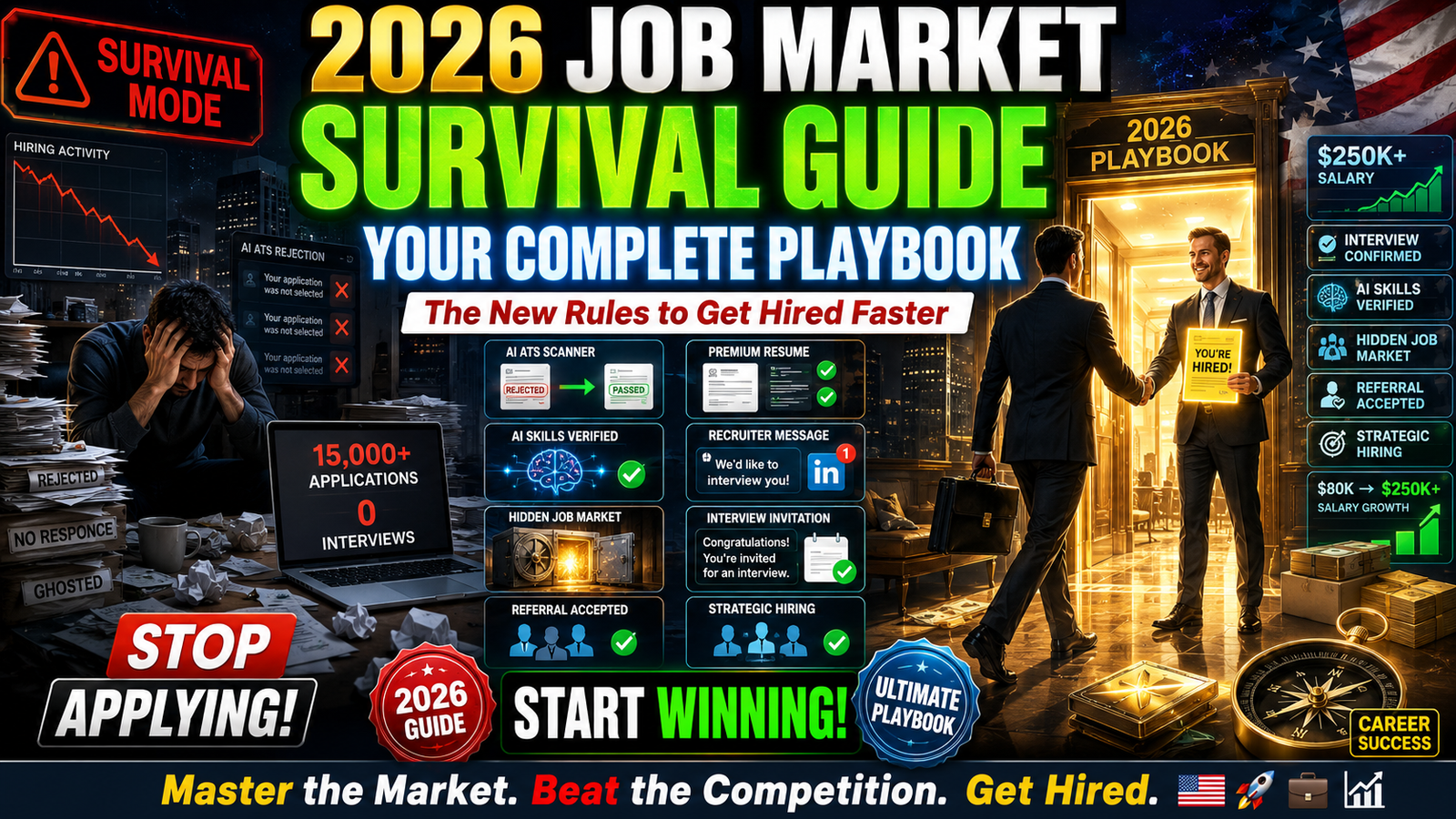
If you’re searching for a job in 2026 and finding the process grueling, you’re not alone. The US job market has fundamentally changed. This is your complete playbook for navigating it successfully.
Understanding the “Low-Hire, Low-Fire” Economy
The US labor market is in what economists call a “low-hire, low-fire” equilibrium. Firms are “worker hoarding”—holding on to the workers they have—but hiring has slowed as employers become more cautious. This creates a challenging environment for job seekers, especially those entering the workforce for the first time.
Key Statistics
The labor market has become two-tiered. As the Dallas Fed explains, roughly 55% of the population exists in a primary sector with high wages and immense job stability. All the volatility is concentrated in a much smaller secondary sector comprising just 14% of the population—the “bottom rung” of the employment ladder. The transmission mechanism that once allowed job-to-job churn to create entry-level vacancies “seems either weak, lagged or broken”.
Why Online Applications Are Failing You
The “spray-and-pray” approach to job applications is “not moving the needle,” says Beth Hendler-Grunt, founder of career coaching firm Next Great Step. The rise of AI-automated application tools has flooded job boards, creating a “digital black hole” where even qualified candidates disappear.
What Actually Works
- 85% of career opportunities now come through professional relationships
- Candidates who secured interviews through referrals were 35% more likely to receive job offers
- The “hidden job market”—referrals, recruiter outreach, and direct engagement—accounts for 40% of hiring
The 10/10 Rule: Your Networking Strategy
Career coach Beth Hendler-Grunt advocates for the “10/10 rule”:
- Identify 10 companies that interest you
- Find 10 people across those companies working in roles you’d like
- Contact them to build genuine connections—not to ask for a job
“It’s not just, ‘Hi, do you have a job for me?’ That’s like asking to get married on the first date.” — Beth Hendler-Grunt
What to ask when you connect:
- How they got to where they are
- What their biggest challenges are in their role
- How their success is measured
“One person connects you to the next, and all of a sudden you have your own network. This is like the hidden job market.”
The Hidden Job Market: Where Careers Actually Happen
Summer Delaney, founder and CEO of CollabWORK, describes the hidden job market as “the places where careers actually happen, not just where jobs are posted”.
Three Layers of the Hidden Job Market
Layer 1: Trusted Professional Communities
- Facebook groups, Slack communities, Discord servers, Reddit threads
- Industry newsletters, alumni networks, professional associations
- People ask peers where to work and what it’s really like
Layer 2: AI-Powered Discovery
- ChatGPT, Gemini, Claude, and Perplexity increasingly rely on trusted sources
- Employers need to ensure they are represented accurately in AI searches
Layer 3: Existing Talent Databases
Practical Ways to Tap In
- Connect with employees inside target organizations before submitting applications
- Participate in professional communities in your industry
- Leverage “weak ties”—acquaintances and indirect contacts often provide access to opportunities unavailable through close networks
The AI Skills Premium: Your Career Leverage
Two numbers tell you almost everything about career leverage in 2026:
- Workers with AI skills earn a 62% wage premium
- Job postings requiring AI skills have grown 144% year over year
AI Engineer Compensation (2026)
Among 4,155 active AI Engineer postings analyzed:
| Skill Level | Median Base Salary |
|---|---|
| With generative AI skills | $140,000 |
| Without AI skills | $77,600 |
| Gap | $62,400 |
Most In-Demand AI Skills
| Skill | % of Postings |
|---|---|
| Machine Learning | 58.9% |
| LLMs | 55.5% |
| AI Agents | 47.3% |
| Generative AI | 40.6% |
| RAG | 39.6% |
| Prompt Engineering | 27.8% |
| Vector Databases | 24.5% |
| LangChain | 23.4% |
Source: InterviewStack analysis of 4,155 active AI Engineer postings
Data Scientist Compensation (2026)
Among 7,590 active Data Scientist postings:
| Skill Level | Median Base Salary |
|---|---|
| With AI skills | $130,000 |
| Without AI skills | $98,000 |
| Gap | $32,000 |
Key Insight
The wage premium is “increasingly independent of traditional credentials”. An individual who can effectively fine-tune a large language model may not require a master’s degree to land a job. A product manager who can showcase successful AI product launches is discovering more opportunities than those relying only on their educational background.
What Employers Are Looking For
Intentional Hiring
The March jobs report points to a labor market that’s “still moving, but with more discipline behind every hiring decision”. As Christine Belmonte, President of Technology Staffing at The Planet Group, told USA TODAY: “Hiring isn’t slowing. It’s becoming more intentional. Employers are raising the bar. Timelines are stretching. And the focus is clear: Bring in talent that can deliver immediate impact.”
What Employers Value
- Specialized skills over general experience
- Immediate impact—can you contribute from day one?
- Digital fluency—comfort with AI and automation tools
- Strategic thinking—not just task completion
Where AI Hiring Is Growing Fastest
AI hiring is no longer concentrated in tech:
- Finance and banking postings jumped year over year
- Manufacturing investing heavily in predictive maintenance and quality control
- Healthcare applying AI to diagnostics and operational efficiency
Protecting Your Mental Health
The job search in 2026 is a marathon, not a sprint. Career experts emphasize that protecting your mental health is a strategic necessity.
Create a Proof File
Eva Chan, career expert at Resume Genius, recommends a “proof file”—a running document of your wins, positive feedback, and problems solved.
“Your brain will start filtering for evidence that you’re not good enough. Read it before interviews to counter that distortion.”
Shift from Cold Applications to Warm Outreach
“If you’re sending dozens of cold applications into job boards and hearing nothing, shift some of that effort toward warm outreach: a referral, a LinkedIn message, a former colleague. A single human connection beats 50 automated submissions.” — Eva Chan
Archive Ghosting and Move On
Margaret Buj, an experienced recruiter, advises: follow up professionally once or twice, then close the loop mentally.
“A company that ghosts you in hiring is showing you how it communicates—which is reason enough not to lose sleep over their decision.” — Eva Chan
Manage Your Energy
Tara Kermiet, a burnout and career coach, frames the challenge differently:
“Treat the job search like a work block with a start and an end, not a 24/7 job. You will be sharper tomorrow for having actually walked away today.”
Protect Your Identity
“When your entire week is filled with applications, interviews, and rejections, your sense of self starts to shrink to someone who’s just trying to get hired.” — Tara Kermiet
Reframe Rejection
Career and leadership coach Dante Rosh offers a final, grounding reframe:
“Treat rejection as data, and nothing more.”
Your Complete Action Plan
The 2026 US job market rewards strategic, intentional, and human-centric job searching.
1. Stop Relying on Online Applications Alone
Networking and referrals are 35% more likely to lead to job offers. Shift from cold applications to warm outreach.
2. Implement the 10/10 Rule
Identify 10 companies and 10 people at each to build genuine connections. Ask thoughtful questions—not for a job, but to learn.
3. Tap Into the Hidden Job Market
Participate in professional communities, leverage weak ties, and connect with employees at target companies before applying. The hidden job market accounts for 40% of hiring.
4. Develop AI Fluency
AI skills command up to a $62,400 salary premium. The most in-demand skills include LLMs, AI Agents, and RAG. You don’t need a degree—demonstrated work carries more weight than coursework.
5. Protect Your Mental Health
Create a proof file, archive ghosting, and protect your identity outside the search. Set boundaries on time and energy.