
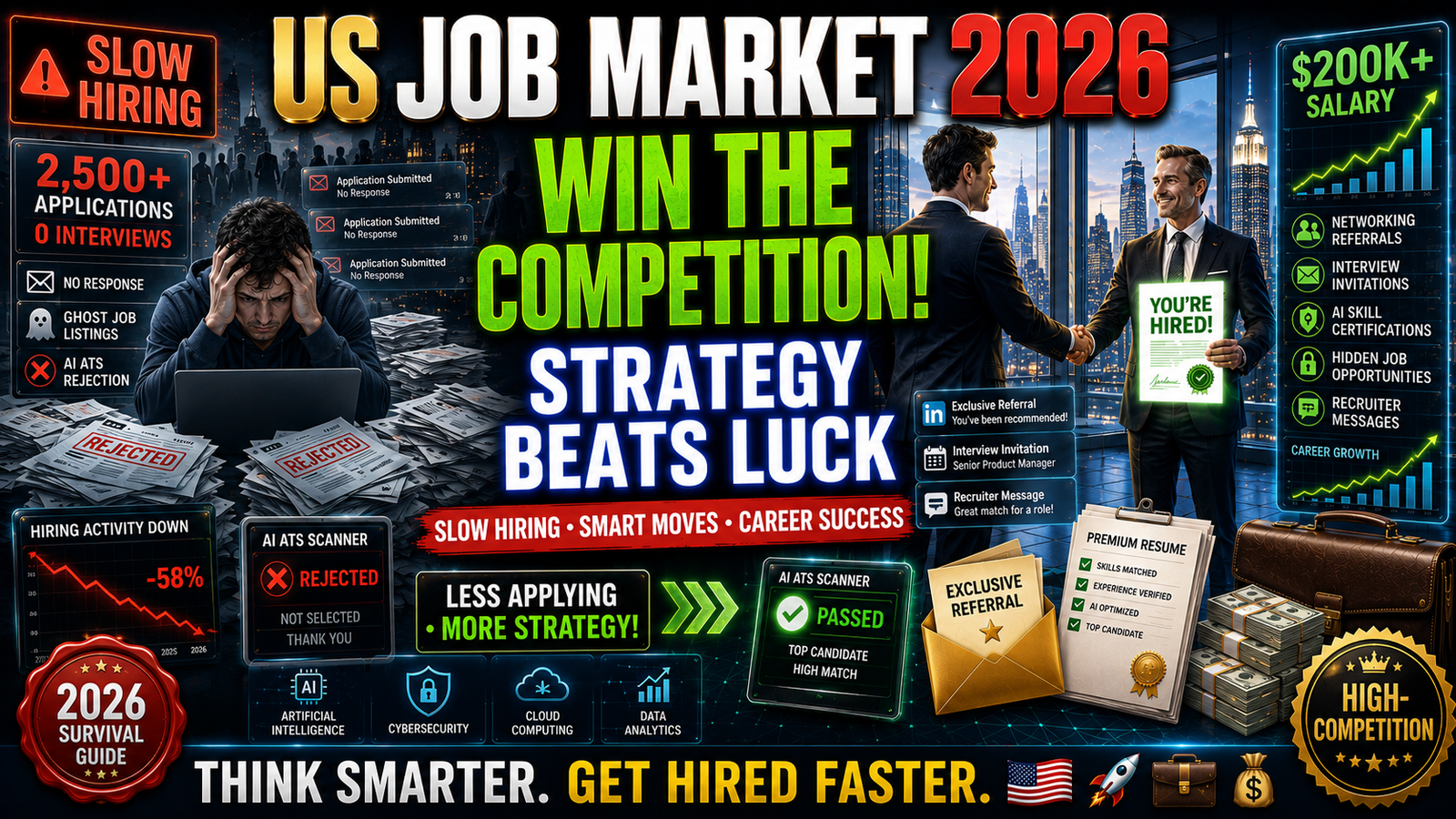
The US job market in 2026 is a study in contradiction. On paper, the unemployment rate stands at a historically low 4.2% . Yet for millions of job seekers—particularly young Americans—the experience feels anything but prosperous. The market is defined by what economists call a “low-hire, low-fire” dynamic: companies are not conducting mass layoffs, but they are also not expanding their workforces aggressively .
This environment creates a competitive, selective hiring landscape where job searches take longer, employers hold more leverage, and the old strategies of mass online applications are becoming obsolete. This guide provides a data-driven roadmap to navigate the 2026 job market, focusing on the industries that are hiring, proven strategies to stand out, and the psychological tools needed to endure the process.
Section 1: Understanding the 2026 Labor Market
To succeed, you must first understand the currents you are swimming against. The data shows a labor market that is stable but cooling, where a low unemployment rate can be deceiving.
The Reality Behind the Headline Numbers
The economy added an average of 92,000 jobs per month in the first half of 2026, a recovery from the sluggish growth of 2025 but still below the 122,000 monthly average of 2024 . June’s report was particularly weak, with only 57,000 jobs added, significantly missing expectations . This indicates that while a collapse is not imminent, momentum is fading.
A critical concept for understanding this trend is “breakeven employment growth” —the number of jobs needed each month just to keep the unemployment rate stable. Due to deep uncertainty around immigration flows, the Federal Reserve Bank of St. Louis estimates this breakeven rate to be between a very wide range of 15,000 and 87,000 jobs per month . This means that even modest job gains could be enough to keep the unemployment rate low, explaining the paradox of a “healthy” unemployment rate alongside a sluggish hiring market .
Key Trends Defining the Job Search
Several structural shifts are shaping the experience of job seekers in 2026.
- The “Stay-Put” Mentality: Workers are not quitting their jobs at the rate they once were. The quits rate is at its lowest level since 2018 . This stagnation is a direct response to the lack of opportunities; people are staying put because they are unsure they can find anything better.
- Wage Growth vs. Inflation: Nominal wages grew at a modest 3.5% year-over-year in June 2026 . However, because inflation has been driven higher by energy prices, the real wage growth (purchasing power) has been minimal, hovering around just 0.6% . You are not getting a significant raise by switching jobs; you are merely keeping pace.
- The Gen Z Crisis: Young workers are bearing the brunt of the slowdown. The unemployment rate for Generation Z stands at a staggering 8.3%, more than double the national average . This demographic is finding it particularly difficult to enter the workforce .
- The ATS and AI Black Hole: The rise of AI-powered application tools has flooded job boards with resumes . This has turned online applications into what many recruiters call a “digital black hole” . A recent graduate survey found that candidates are sending out hundreds or even thousands of applications and only hearing back from two or three employers . The sheer volume means your perfectly tailored resume is likely lost in the noise.
Section 2: Where the Jobs Are – Industries and Roles in Demand
While the overall market is slow, specific sectors are actively hiring. According to Robert Half’s analysis of job postings for the second half of 2025, five key industries contributed over 1.1 million new positions .
1. Business and Professional Services
This was the largest engine of job creation, adding 648,100 jobs . It is a broad category, but the demand is highly concentrated.
- Tech and IT (34% of openings): The single most in-demand role in the US is Software Engineer, with 149,400 total job postings across all industries and over 60,000 within this sector alone . Systems Engineers, Network/Cloud Engineers, and Systems Administrators are also highly sought after .
- Administrative and Customer Support (26%): Demand is strong for Administrative Project Managers (39,200 job postings) and Customer Service Specialists (27,300 postings) .
- Finance and Accounting (24%): Tax Managers, Senior Accountants, and Staff Accountants are all in demand as companies prioritize financial planning and reporting .
2. Manufacturing and Distribution
This sector added 140,700 jobs, driven by reshoring and government infrastructure spending . The unemployment rate here was 3.5% in 2025.
- Top Roles: The most in-demand roles mirror the tech sector, with Software Engineer (16,300 postings) and Customer Service Specialist (16,200 postings) leading the way . Administrative Project Managers and Systems Engineers are also needed .
3. Financial Services
With 137,800 job openings, this sector saw a 16% year-over-year increase . The unemployment rate here is a low 2.3%, making it a competitive talent market.
- Tech and IT (38% of openings): Software Engineer (19,000 postings), Data Engineer, and AI/ML Engineer are top roles as firms modernize their systems .
- Finance and Accounting (28%): There is a steady demand for Loan Processors, Senior Financial Analysts, and Business Analysts .
4. Healthcare
The healthcare sector added 126,000 professional job openings . The demand here is not just for clinicians, but also for a vast administrative and support infrastructure.
- Administrative Roles (40% of openings): The most in-demand roles are Medical Receptionist (15,600 postings), Medical Administrative Assistant (10,400 postings), and Medical Front Desk Coordinator (8,100 postings) .
5. Consumer Products
This industry added 89,300 jobs, with a massive focus on customer-facing and support roles.
- Administrative and Customer Support (55%): The top roles are Customer Service Specialist (25,500 postings), Software Engineer (5,500), and Customer Service Manager (4,900) .
A Note on Salary Growth
With employers being selective, salary growth is modest but targeted. Robert Half projects average increases of around 2.1%, but with sharper uplifts for specialist skills . For example, the top 10 forecasters in the Blue Chip survey expect average salary increases of 3.5%-4.0% in 2026 . Compensation strategies are increasingly focused on total rewards—including bonuses, hybrid work, and professional development—rather than just base salary .
Section 3: Strategic Job Search Tactics for 2026
In a market where online applications are drowning in a sea of AI-generated resumes, a new strategy is required. Experts agree that the “spray-and-pray” method is “not moving the needle” . The solution is a shift in focus from quantity to quality.
Strategy 1: The “10/10 Rule” and the Power of Networking
Career coach Beth Hendler-Grunt advocates for the “10/10 rule” as a primary strategy to tap into the “hidden job market” .
- The Rule: Identify 10 companies you are interested in. Then, find 10 people at those companies working in roles you’d like. Contact them .
- The Approach: This is not about asking for a job. The goal is to build a genuine relationship. Send a brief, focused message referencing a shared interest or a specific question about their career path. As Hendler-Grunt says, it’s not “Hi, do you have a job for me?” which is “like asking to get married on the first date” .
- The Outcome: Research shows that 70% of professionals say who you know matters more than what is on your resume . “One person connects you to the next, and all of a sudden you have your own network,” and this network is how you bypass the ATS.
Strategy 2: Stop Tailoring Every Resume, Start Networking Instead
Conventional wisdom says to tailor your resume for every single job. In 2026, that strategy is often a poor use of your time.
Former recruiter Emily Durham suggests that while a tailored resume is more likely to be picked up by an algorithm, you are still facing a “backlog of thousands of other applicants” . Her advice: create one strong, keyword-rich resume that can work for multiple positions, and then put your energy into networking and seeking referrals .
Strategy 3: Use AI Wisely, Not Lazily
AI can be a useful tool for polishing your resume, but it should not write it for you. “People can tell” if your resume is AI-generated, as it often results in generic phrasing that fails to communicate your specific experience . Use AI as a “fine tuner” or editor, not an author .
Strategy 4: Rethink What Counts as Experience
This is particularly crucial for new graduates and those pivoting careers. You don’t have to be paid for an experience for it to count.
- Highlight Projects: Class projects, capstone assignments, and hackathons can demonstrate valuable skills .
- Leverage Volunteer and Freelance Work: Treat volunteer leadership roles and freelance gigs like jobs on your resume, describing your responsibilities and results .
- Create Opportunities: Use platforms like Fiverr or Upwork to gain experience. “All it takes is one person, and suddenly that’s work experience on your resume” .
Section 4: Protecting Your Mental Health
The psychological toll of the 2026 job search is significant. Sustained rejection and silence can be corrosive . Here is how to protect yourself.
- Create a “Proof File”: This is a running document of your wins, positive feedback, and problems you have solved. Read it before interviews to counter the self-doubt that rejection breeds .
- Treat Job Searching Like a Part-Time Job: Do not spend eight hours a day on applications. Create a schedule with a start and an end. “You will be sharper tomorrow for having actually walked away today” .
- Archive Ghosting: If a company does not respond after one or two polite follow-ups, archive it and move on. A company that ghosts you during hiring is showing you how it communicates . Do not keep investing emotionally in that opportunity.
- Protect Your Identity: “When your entire week is filled with applications, interviews, and rejections, your sense of self starts to shrink to someone who’s just trying to get hired” . Maintain your routine, exercise, and relationships. Do not let the job search consume your identity.
- Rejection is Data: As one coach put it, “Treat rejection as data, and nothing more” . It does not define your value.
Conclusion
The 2026 US job market is a challenging but navigable landscape. The era of the easy job search is over, replaced by a more strategic and demanding process. However, opportunities are not gone; they are concentrated in specific sectors—Healthcare, Tech, Financial Services, and Manufacturing—and they are accessible to those who adapt.
The path forward requires you to abandon the “spray-and-pray” approach and embrace a targeted, people-first strategy. Stop mass-applying online. Start networking. By focusing on building human connections, utilizing the “10/10 rule,” and managing your mental health, you can bypass the automated filters and secure a role in this competitive market. Success in 2026 is not about the number of applications you submit—it’s about the quality of the relationships you build.