
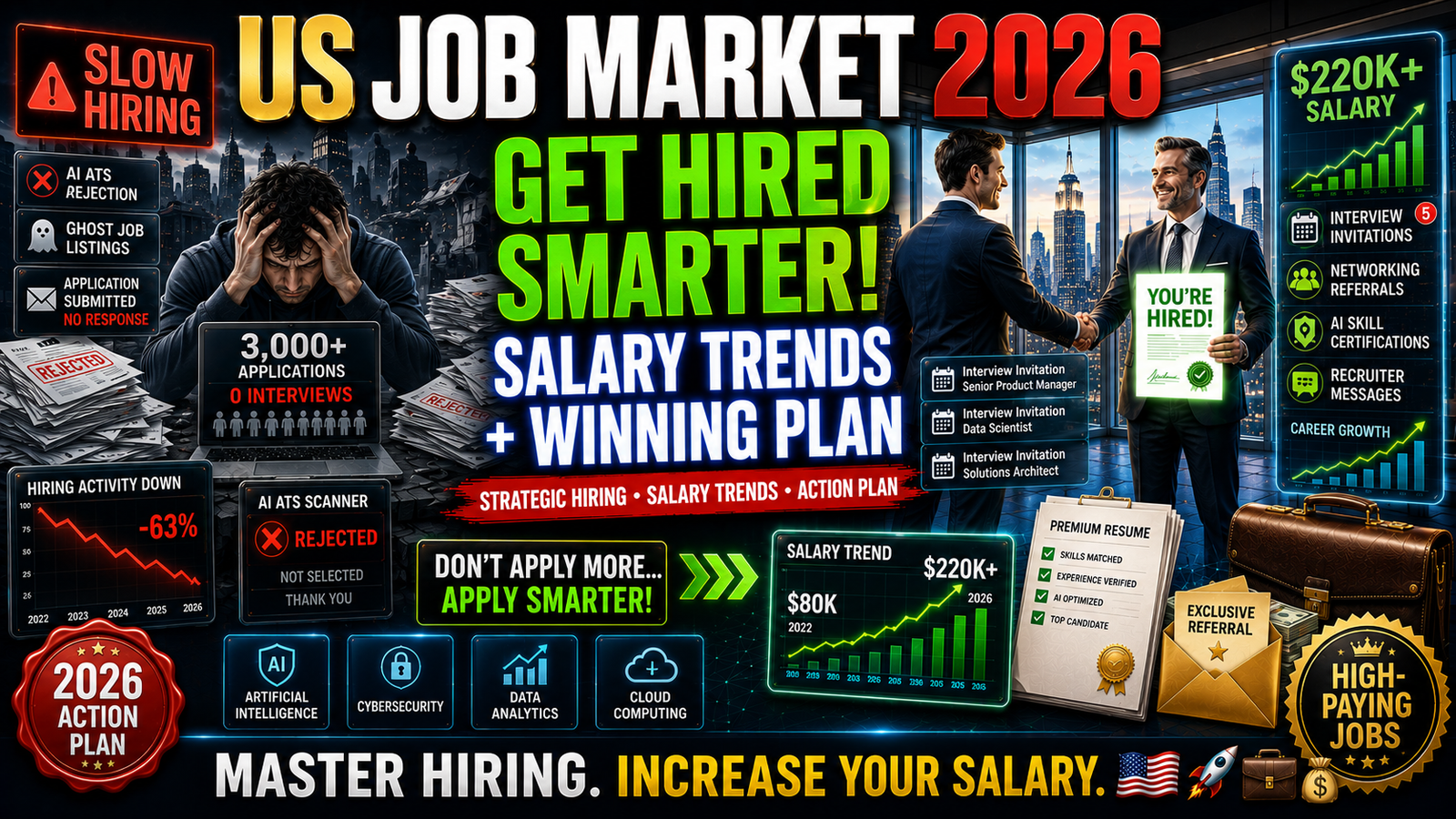
The US job market of 2026 is a complex landscape defined by a paradox. While the unemployment rate remains historically low at 4.2%, millions of job seekers—particularly young Americans—are finding the search for work more grueling and disheartening than ever before . This is the reality of a market economists describe as “moderating, not collapsing” .
It is a “low-hire, low-fire” environment where companies are not conducting mass layoffs, but they are also not expanding their workforces with the enthusiasm of previous years . Hiring has become a more deliberate, strategic process. For job seekers, this means the “spray and pray” method of submitting hundreds of applications is not just ineffective—it is a path to burnout. Success in 2026 requires a shift from volume to value, from passive applications to active networking, and a clear understanding of where the opportunities truly lie .
This comprehensive guide breaks down the 2026 job market into actionable insights. We will analyze the key economic indicators and hiring trends, identify the industries and roles with the most openings, and provide a detailed, step-by-step action plan to navigate your job search with strategy, resilience, and confidence.
Part 1: Understanding the 2026 Labor Market—A Data-Driven Overview
To navigate the job market, you must first understand the forces shaping it. The data reveals a story of cautious optimism and strategic hiring.
The Key Economic Indicators
The job market in the first half of 2026 has sent mixed signals. Payroll data, which measures net job gains, showed the economy adding an average of 92,000 jobs per month . While this is a recovery from the anemic growth of 2025 (which averaged just 10,000 jobs per month), it is still significantly below the 2024 average of 122,000 . A deeper look reveals a market that lost momentum in June, adding only 57,000 jobs, well below expectations, and the gains from the prior two months were revised down by a significant 74,000 .
However, a low unemployment rate can be deceptive. It can remain stable even as hiring cools if the labor force shrinks, meaning fewer people are actively looking for work . This is precisely what happened in June, when the unemployment rate dipped to 4.2% partly because the labor force participation rate fell to 61.5%, down from 62.3% a year earlier . Roughly 2 million workers have left the labor force since December 2025 . This “exit” from the workforce is a critical factor in understanding the market’s paradox.
Wage growth also remains modest. Average hourly earnings grew by just 3.5% on an annual basis in June . However, with headline inflation being driven up by higher energy costs, the real wage growth—the actual purchasing power of paychecks—has been minimal, hovering around a mere 0.6% . As the OECD notes, while real wages grew by 0.6% in the year to Q1 2026, they remained 1.4% below their pre-inflation surge level of Q1 2021 . In short, job switchers are not seeing the massive salary bumps of previous years.
Understanding “Breakeven Employment Growth”
An important concept for interpreting monthly jobs reports is “breakeven employment growth”—the number of jobs the economy must add each month just to keep the unemployment rate from rising . This number is highly sensitive to immigration flows, which have been notoriously difficult to forecast. The Federal Reserve Bank of St. Louis estimates the 2026 breakeven rate to be in a wide range, from as low as 15,000 to as high as 87,000 jobs per month . This uncertainty means that even modest job gains could be enough to stabilize the unemployment rate, further explaining why a low jobless rate can coexist with a sluggish hiring market for individual job seekers .
Hiring Sentiment: Optimism Returns
Despite the tepid headline numbers, a survey of more than 2,000 U.S. hiring managers by Robert Half shows a significant uptick in hiring plans for the second half of 2026. A robust 66% of employers plan to increase permanent hiring, up from 60% in the first half of the year and 57% one year ago . This suggests that while the overall market is not booming, employer confidence is returning, and they are prepared to invest in strategic roles. The most aggressive hiring plans are in the Technology (78%), Healthcare (75%), and Finance and Accounting (74%) specializations .
Part 2: Where the Jobs Are—Industries and Top Roles in Demand
While the national picture is one of cautious growth, specific sectors are actively recruiting. Knowing where to focus your job search is crucial.
Top Hiring Industries
Robert Half’s analysis of job postings from the second half of 2025 identifies five key industries that are the primary engines of job creation .
| Industry | Total Job Postings | Key Professional Fields (%) |
|---|---|---|
| Business and Professional Services | 648,100+ | Tech/IT (34%), Admin & Customer Support (26%), Finance & Accounting (24%) |
| Manufacturing and Distribution | 140,700+ | Tech/IT (34%), Admin & Customer Support (31%), Finance & Accounting (19%) |
| Financial Services | 137,800+ | Tech/IT (38%), Finance & Accounting (28%), Admin & Customer Support (20%) |
| Healthcare | 126,000+ | Administrative (40%) |
| Consumer Products | 89,300+ | Admin & Customer Support (55%) |
Source: Robert Half analysis of U.S. job postings provided by Textkernel, second half of 2025 .
In-Demand Roles
The table below showcases the most in-demand professional roles across these top industries, based on total job postings.
| Role | Total Job Postings | Primary Industries |
|---|---|---|
| Software Engineer | 149,400 | Business & Professional Services, Financial Services, Manufacturing |
| Customer Service Specialist | 140,800 | Consumer Products, Manufacturing, Business & Professional Services |
| Administrative Assistant | 81,700 | Across all sectors |
| Administrative Project Manager | 39,200+ | Business & Professional Services, Manufacturing |
| Medical Receptionist | 15,600 | Healthcare |
| Medical Administrative Assistant | 10,400 | Healthcare |
| Systems Engineer | 9,300+ | Business & Professional Services, Manufacturing |
| Senior Accountant | 8,700+ | Business & Professional Services |
| AI/ML Engineer | 16,400+ | Financial Services, Tech |
Source: Robert Half analysis of U.S. job postings provided by Textkernel, second half of 2025 .
Regional Hiring Hotspots
Hiring demand is not uniform across the country. Robert Half’s survey pinpointed the cities where employers are most eager to add permanent staff .
- Denver (83%)
- Minneapolis (76%)
- San Francisco (73%)
- Houston (69%)
- Seattle (69%)
- Boston (66%)
- Dallas (65%)
- Los Angeles (64%)
- Atlanta (63%)
- Chicago (63%)
Part 3: The Strategic Job Search Playbook for 2026
In a market where employers are prioritizing “quality over quantity,” a passive approach will not suffice . Here is a practical, step-by-step playbook to give you an edge.
Step 1: Focus Your Search
Stop applying to every job you vaguely qualify for. Be intentional. Identify the industries and roles where your skills are in demand and where employers are actively hiring . Use the data in Part 2 to guide your targeting. If you are a software engineer, your primary focus should be on the Business and Professional Services, Financial Services, and Manufacturing sectors.
Step 2: Ditch the “Spray and Pray” Mentality
Submitting dozens of generic applications into online portals is the least effective strategy in 2026 . The rise of AI application tools means these portals are flooded, and your resume is likely to be lost in a “digital black hole” . Instead, adopt the “10/10 Rule” recommended by career coach Beth Hendler-Grunt:
- Choose 10 companies you want to work for.
- Find 10 people at those companies in roles you’d like.
- Contact them to build a genuine connection, not to ask for a job .
This is about tapping into the “hidden job market.” As one recruiter put it, “A single human connection beats 50 automated submissions” . Research shows that 70% of professionals believe who you know matters more than what is on your resume .
Step 3: Stop Over-Tailoring Your Resume
Conventional wisdom says to tailor your resume for every job. In 2026, that is often a poor use of time. While a tailored resume might perform better with an algorithm, you are still one of thousands . Instead, former recruiter Emily Durham advises creating one strong, keyword-rich resume that works for multiple positions in your target field. Then, put your energy into networking .
This is not a call to be lazy. It is a strategic reallocation of your most precious resource: time. Use the time you would have spent on endless tweaks to reach out to people.
Step 4: Rethink What Counts as Experience
You do not have to be paid for it to be relevant experience. This is especially critical for new graduates and career changers. On your resume and in interviews, highlight:
- Class projects, capstone assignments, and hackathons that demonstrate your skills .
- Volunteer work and leadership roles in student organizations .
- Freelance projects from platforms like Fiverr or Upwork. As Durham puts it, “All it takes is one person, and suddenly that’s work experience on your resume” .
Step 5: Use AI Wisely, Not Lazily
Artificial intelligence can be a powerful tool for polishing your resume, but it should not write it for you. “People can tell” when a resume is AI-generated, as it often results in generic phrasing that fails to communicate your unique experience and personality . Use AI as an editor or “fine tuner,” not an author .
Part 4: Protecting Your Mental Health—Surviving the Search
The job search in 2026 is a psychological marathon. Sustained rejection and silence can be corrosive, leading to burnout and self-doubt . Taking care of your mental health is not a luxury; it is a strategic necessity.
- Create a “Proof File”: This is a running document of your achievements, positive feedback, and problems you have solved. Read it before interviews to counter the self-doubt that rejection breeds .
- Archive Ghosting and Move On: If a company does not respond after one or two polite follow-ups, archive it and move on. “A company that ghosts you in hiring is showing you how it communicates, which is reason enough not to lose sleep over their decision,” says career expert Eva Chan .
- Treat Job Searching Like a Part-Time Job: Do not spend eight hours a day on applications. Set a schedule with a clear start and end time. “You will be sharper tomorrow for having actually walked away today” .
- Protect Your Identity: “When your entire week is filled with applications, interviews, and rejections, your sense of self starts to shrink to someone who’s just trying to get hired,” warns burnout coach Tara Kermiet . Maintain your routine, exercise, and relationships. Do not let the job search consume your identity.
- Reframe Rejection: “Treat rejection as data, and nothing more,” advises leadership coach Dante Rosh. It does not define your value .
Conclusion: Your Action Plan for 2026
The US job market in 2026 demands a more strategic, resilient, and human-centric approach to job seeking. The era of the “easy” job search is over, but opportunities are far from gone. They are simply concentrated in specific sectors and accessible to those who adapt.
Your action plan is clear:
- Focus your search on the industries that are hiring: Business & Professional Services, Financial Services, Manufacturing, and Healthcare.
- Abandon the “spray and pray” method. Start networking using the “10/10 rule” to tap into the hidden job market.
- Stop over-tailoring every resume. Create one strong resume and invest your time in building human connections.
- Reframe your experience. Don’t dismiss unpaid projects, volunteer work, or freelance gigs.
- Protect your mental health. Job searching is a marathon, not a sprint. Manage your energy, archive ghosting, and don’t let rejection define you.
By adopting these strategies, you can stop struggling against the market and start navigating it with confidence and purpose. Success in 2026 is not about the number of applications you submit—it is about the quality of the relationships you build and the resilience you cultivate.