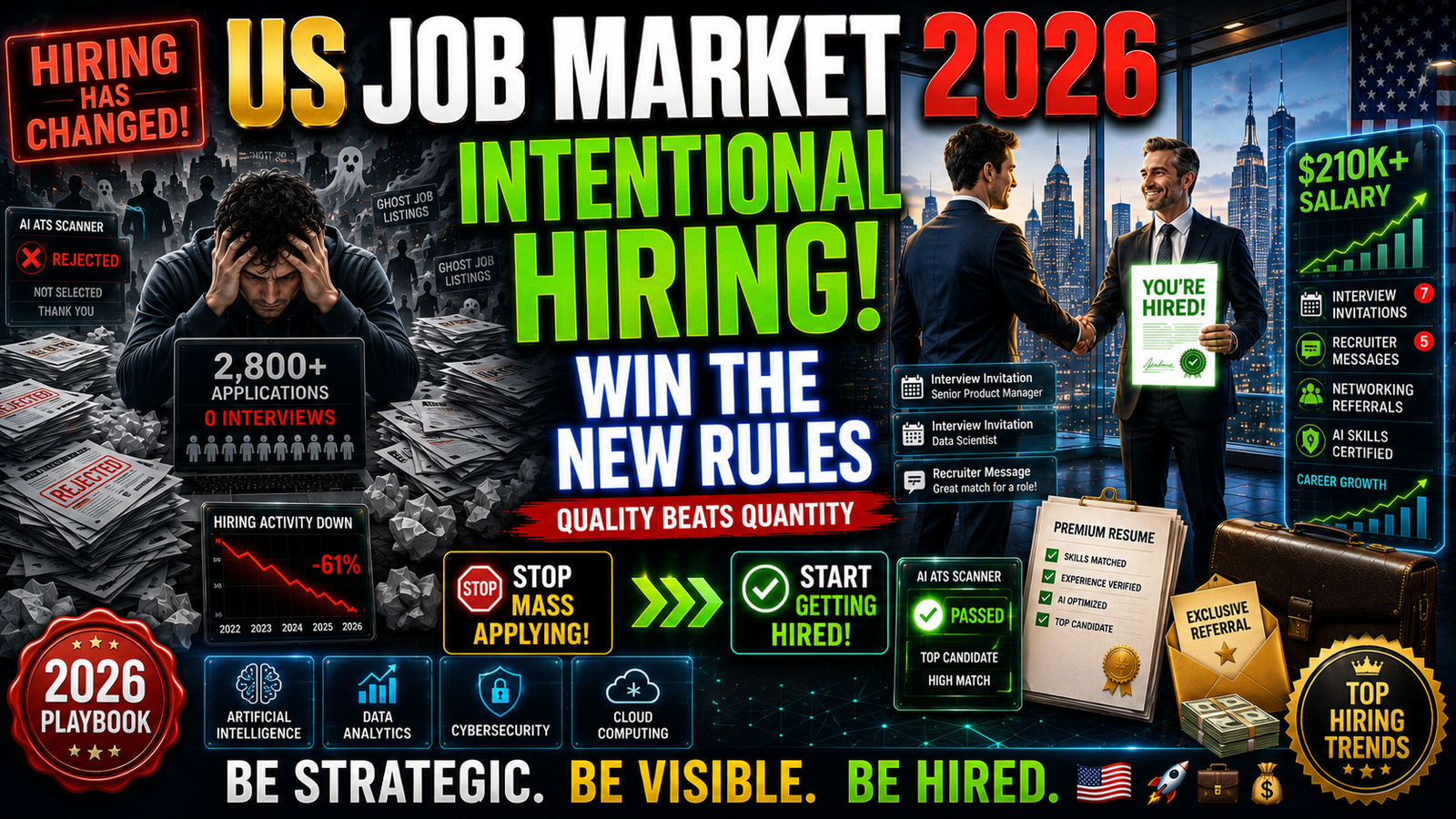
If you’ve been searching for a job in 2026 and finding the process more grueling than expected, you are not alone—and it is not because something is wrong with you. The US job market has entered what experts call an “intentional hiring” era . Employers are not laying off in large numbers, but they are also not expanding aggressively. Instead, they are hiring with precision, targeting only roles that directly impact business strategy and revenue .
This is the reality of a “moderating, not collapsing” labor market . For job seekers, this means the old rules of the game have changed. Mass applications and generic resumes no longer work. Success requires a strategic, targeted approach that emphasizes quality over quantity and human connection over automated submissions.
Part 1: The 2026 Labor Market by the Numbers
The latest data from J.P. Morgan paints a picture of a market that is stable but slow. The economy has added an average of 92,000 jobs per month in the first half of 2026 . While this is an improvement from 2025’s anemic growth, it remains well below the 2024 average of 122,000 . June’s report was particularly weak, with only 57,000 jobs added, significantly below expectations . This cooling momentum is a defining feature of the current landscape.
Unemployment and Participation: The Deceptive Low Rate
The national unemployment rate fell slightly to 4.2% in June 2026 . While this number appears healthy, it can be deceptive. The dip in unemployment coincided with a drop in the labor force participation rate to 61.5% . In simpler terms, the unemployment rate went down partly because fewer people are actively looking for work. Roughly 2 million workers have left the labor force since December 2025 . This “exit” from the workforce is a critical factor in understanding why the job market feels so difficult even with a low unemployment rate.
The OECD confirms that the US labor market remains resilient with only modest signs of slowing, but also notes that young people in the US have become increasingly exposed to unemployment . The unemployment gap for young college graduates and those without degrees has widened significantly since early 2024 .
Wage Growth and Inflation: The Squeeze on Purchasing Power
Wage growth remains steady but unspectacular. Average hourly earnings grew by just 3.5% on an annual basis in June . However, with headline inflation driven higher by energy prices, the real wage growth—the actual purchasing power of paychecks—has been minimal, hovering at just 0.6% . The OECD reports that real wages in the US grew by 0.6% in the year to Q1 2026 but remained 1.4% below their Q1 2021 level, prior to the post-COVID inflation surge . This means workers are not seeing significant gains in purchasing power, making salary negotiations more challenging.
Part 2: The Two-Track AI Revolution in Hiring
Artificial Intelligence is not just a buzzword—it is fundamentally reshaping the labor market. The 2026 PwC AI Jobs Barometer, which analyzed over one billion job ads across six continents, reveals a “two-track” labor market .
Track 1: Professionalised Roles (Winners)
In “professionalised” roles, AI acts as a force multiplier for experts, automating routine tasks and allowing humans to focus on high-value activities like judgment, creativity, and leadership . These roles are seeing twice the job growth and 42% faster salary growth than their “democratised” counterparts . Examples include radiologists, recruiters, and other roles where human expertise is amplified by AI.
Track 2: Democratised Roles (Challenged)
In “democratised” roles, AI makes the job itself easier for non-experts to perform, potentially reducing the value of specialized skills and increasing competition . These roles include IT service managers and medical secretaries . For job seekers, this means the type of role you pursue matters more than ever.
The Entry-Level Shift: Senior Skills Required Earlier
Perhaps the most striking finding from the PwC report is the transformation of entry-level roles. AI-exposed entry-level positions are now seven times more likely to require traditionally senior-level skills like leadership, creativity, and face-to-face interactions . Job openings for these “seniorised” entry-level roles have grown 35% since 2019, while other entry-level roles have shrunk by 10% . This means entry-level candidates must demonstrate skills that were once expected only after years of experience.
The AI Skill Premium
The demand for AI skills is exploding. Jobs requiring specific AI skills—like prompt engineering or machine learning—are growing eight times (69%) faster than the overall jobs market . The average wage premium for workers with AI skills has surged to 62%, up from 57% last year, and can be as high as 118% in some sectors like consumer markets . The PwC report shows that the number of AI jobs is almost twice as high as 2024, with growth in AI jobs outpacing all jobs since 2015 .
However, employers are increasingly expecting AI proficiency, which could eventually reduce the premium as skills become more widespread . The message is clear: developing AI fluency is no longer optional—it is becoming a baseline requirement.
Part 3: What Employers Want in 2026
Hiring with Intention
Employers are creating jobs and pursuing talent only when the business case is clear . New roles are tied to specific priorities: improving security, strengthening financial planning, enabling digital workflows, or enhancing customer experience . This means your application must demonstrate a direct connection to business outcomes.
A survey by Express Employment Professionals found that 84% of US hiring managers feel positive about their company’s hiring outlook for the remainder of 2026, but 44% say they currently have open positions they cannot fill—the highest share since spring 2023 . This “mismatch” suggests that while opportunities exist, employers are struggling to find candidates with the right skills.
The top reason companies are hiring is increased volumes of work (53%) , followed by filling newly created positions (49%) . Even optimistic companies expect challenges, with navigating AI in recruitment (49%) and finding qualified candidates (42%) topping the list .
Total Compensation Takes Center Stage
With economic uncertainty keeping staffing budgets tight, employers are adopting a broader view of rewards known as total compensation—blending pay, incentives, flexibility, and long-term career value . Key trends include:
- More intentional compensation strategies: Employers are benchmarking pay more frequently and using sign-on bonuses, retention incentives, and midyear adjustments to secure skilled talent .
- Flexibility as compensation: Many professionals are willing to trade a slightly lower salary for hybrid or remote options that reduce commuting costs and improve work-life balance .
- Career development as a perk: Employers are making career growth a more visible part of their value proposition .
Robert Half projects average salary increases of around 2.1% in 2026, with sharper uplifts for specialist skills . Hays expects junior roles to see increases of 2.5%-3.0%, mid-level professionals 3.0%-3.5%, and senior professionals up to 3.6% .
Part 4: Job Search Strategies That Actually Work in 2026
1. Focus on Quality Over Quantity
One of the biggest shifts in recent years is the move away from mass applications . Candidates who apply thoughtfully to fewer roles consistently perform better. Employers can quickly tell when an application is generic, and those tend to blend into the background . Be selective with your search, targeting roles that genuinely align with your skills and interests .
2. Build and Use Your Network Intentionally
Research continues to show that a large percentage of roles are filled through referrals and connections rather than solely through job boards . Networking does not mean asking for a job—it means building relationships, having conversations, and staying visible within your professional community .
Effective networking includes:
- Reconnecting with former colleagues or managers
- Booking informational conversations with people in roles or industries you are curious about
- Engaging thoughtfully on LinkedIn by commenting and sharing insights
- Letting your network know what you are exploring and why
3. Use AI as a Tool, Not a Crutch
AI can give you a genuine edge in your job search, but it requires smart prompting and human judgment . Here’s how to use it effectively:
- Tell AI your career goals and experience: Input your elevator pitch and ask for job roles, company types, and career paths that align with your goals .
- Feed your resume to AI: Ask for suggestions and advice on enhancing your career profile .
- Get AI to generate a list of top companies: Have AI produce targeted lists of companies to reach out to, including smaller, more accessible options .
- Write tailored messages to recruiters: Use AI to draft introductory messages, then personalize them to sound like you .
However, avoid over-reliance on AI-generated content. Recruiters can tell when applications are generic . Use AI as an editor and research assistant, not an author.
4. Strengthen Your Personal Brand
Your online presence is often part of the hiring process . A strong LinkedIn profile reinforces your credibility. In 2026, a strong personal brand includes:
- A clear headline that reflects what you do and where you add value
- A summary that tells a cohesive career story
- Experience descriptions that focus on outcomes and impact
- Engagement with relevant industry content
5. Emphasize Skills and Outcomes Over Job Titles
Job titles vary widely between organizations. Employers are increasingly focused on what candidates can do, how they solve problems, and how quickly they can contribute . When updating your resume:
- Focus on measurable results where possible
- Call out skills that are relevant across roles or industries
- Share examples of how you adapted, learned, or took ownership
6. Customize Your Application
Even with a focus on quality over quantity, customization matters. Personalize your cover letter and resume for every role you apply for . Include keywords from the job description to help your application pass through Applicant Tracking Systems .
7. Protect Your Mental Health
The job search in 2026 is a psychological marathon. The constant silence and rejection can be corrosive. Career experts recommend:
- Treat job searching like a part-time job: Set a schedule with a clear start and end time .
- Archive ghosting and move on: A company that ghosts you in hiring is showing you how it communicates .
- Create a “proof file”: Keep a running document of your wins, positive feedback, and problems you’ve solved. Read it before interviews to counter self-doubt .
Conclusion: Your Action Plan for 2026
The 2026 US job market rewards strategic, intentional, and human-centric job searching. The era of the “easy” job search is over, but opportunities remain for those who adapt.
Your action plan:
- Focus your search on sectors that are hiring: financial services, technology, healthcare, and manufacturing .
- Develop AI fluency —it’s becoming a baseline requirement .
- Build your network intentionally —referrals and connections are your best path to opportunities .
- Emphasize outcomes and skills over job titles in your resume and interviews .
- Use AI as a tool for research and editing, but maintain your authentic voice .
- Protect your mental health —the search is a marathon, not a sprint .
By adopting these strategies, you can navigate the 2026 job market with confidence and purpose. The opportunities are there—you just need the right approach to find them.