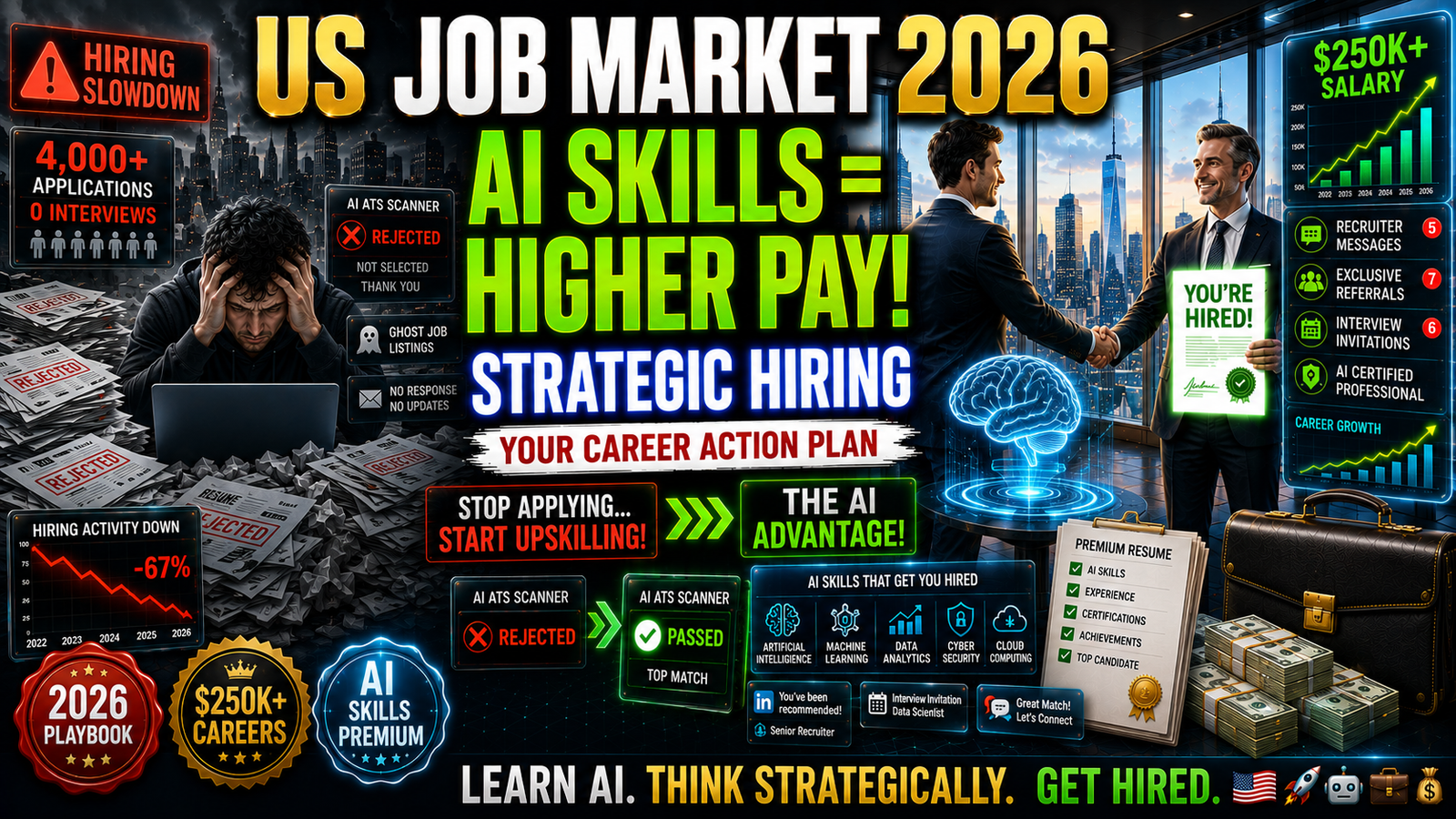
The US job market in 2026 is a landscape of contrasts. It is not crashing, but it is not booming. It is a market defined by “intentional hiring,” where employers are selective, strategic, and laser-focused on roles that deliver immediate business impact . The era of the “easy” job search is over, replaced by a more demanding but navigable environment.
For job seekers, understanding the new rules of this game is essential. Success in 2026 is not about the sheer volume of applications you submit. It is about strategic targeting, demonstrating AI fluency, and leveraging human connections to bypass the increasingly automated and impersonal online application process.
Part 1: The 2026 Labor Market by the Numbers
Job Growth: A Story of Moderation and Precision
The latest data paints a picture of a market that is growing, but at a measured pace. In June 2026, the U.S. economy added only 57,000 jobs, falling well below economists’ expectations . Job gains were largely concentrated in a few key sectors: Professional and Business Services (+36,000), Healthcare (+21,500), and Social Assistance (+25,100) .
This pattern of growth is reflected in the small business sector as well, where healthcare and construction continue to lead, though the pace of hiring has cooled from the spring .
The Deceptive Unemployment Rate
The national unemployment rate fell to 4.2% in June . While this figure suggests a healthy job market, the decline was not driven by a surge in hiring. Instead, it was largely due to a significant 720,000 people leaving the labor force . The labor force participation rate slipped to 61.5%, extending a long-term decline that is particularly concerning among workers under 25 . This means the low unemployment rate masks a more complex reality: fewer people are actively looking for work, which can make it seem like the job market is stronger than it actually is.
Wage Growth and Inflation: A Modest Squeeze
Wage growth remains steady but unspectacular. Average hourly earnings rose 3.5% year-over-year in June . This is a modest increase that is barely keeping pace with inflation. The result is that workers’ purchasing power has not significantly improved. As Robert Half projects, average salary increases in 2026 will be around 2.1%, with sharper uplifts reserved for specialist skills .
Part 2: The AI Revolution and the “Two-Track” Job Market
Artificial intelligence is not just a buzzword; it is the single most significant force reshaping the labor market. PwC’s 2026 Global AI Jobs Barometer, which analyzed over one billion job ads, reveals a “two-track” employment landscape .
Track 1: Professionalised Roles (The Winners)
In these roles, AI acts as a “force multiplier” for human expertise. AI automates routine tasks, allowing professionals to focus on high-value activities like judgment, creativity, and leadership . These roles are thriving.
- Job Growth: Professionalised roles are seeing twice the growth in available jobs compared to democratised roles .
- Wage Growth: They also command 42% faster salary growth .
- Examples: Radiologists, employment recruiters, and air traffic controllers are examples of professionalised roles where AI amplifies human expertise .
Track 2: Democratised Roles (The Challenged)
In these roles, AI makes the job itself easier for non-experts to perform, potentially reducing the value of specialized skills and increasing competition .
- Growth: These roles are growing slower and with lower wages.
- Examples: Software developers, loan officers, and finance managers are experiencing some of their tasks being automated, changing the nature of their work .
The AI Skill Premium: Your Most Valuable Asset
The demand for AI skills is exploding, and workers who possess them are being rewarded handsomely.
- Massive Wage Premium: Jobs requiring specific AI skills are growing eight times (69%) faster than the overall jobs market . The average wage premium for workers with AI skills has surged to 62%, and can be as high as 118% in some sectors like consumer markets .
- Entry-Level Advantage: Perhaps most strikingly, entry-level workers with verified AI skills earn a 25% premium over their peers without those skills . This premium is not just for engineers; it applies to content writers, customer service representatives, and analysts who use AI tools in their existing work . This is the new credential gap, and it’s accessible to those willing to invest the time to learn .
- “Seniorised” Entry-Level Roles: AI is also changing the nature of entry-level work. AI-exposed junior roles are seven times more likely to require traditionally senior-level skills like leadership, creativity, and strategic thinking . While overall early-career job postings have flatlined, these “seniorised” entry-level roles have grown 35% since 2019 .
AI Skills in High Demand
Specific AI skills are commanding some of the highest salaries in the market.
Part 3: What Employers Want in 2026
Intentional Hiring and the Focus on Impact
Employers are not just filling roles; they are making strategic investments. They are prioritizing quality over quantity in their hiring . New roles are tied to specific business priorities: improving security, strengthening financial planning, enabling digital workflows, or enhancing customer experience . Your application must demonstrate a direct connection to these business outcomes.
The End of the Online Application “Black Hole”
The rise of AI-powered application tools has flooded job boards, making it nearly impossible for even qualified candidates to stand out through standard portals . This is what experienced recruiters call a “digital black hole” . As a result, the most effective job search strategies are moving away from mass online applications.
Networking: The 85% Solution
Research shows that 85% of career opportunities now come through professional relationships . In 2026, your network is your greatest asset. Referred candidates are 4-5 times more likely to be hired and get placed 55% faster than cold applicants .
This doesn’t mean asking people for a job on the first contact. It means building genuine connections, having informational conversations, and staying visible within your professional community.
Part 4: Winning Job Search Strategies for 2026
1. Stop Applying, Start Networking
The “spray and pray” method of submitting dozens of applications online is dead. Veteran recruiters now advise job seekers to move away from online applications and prioritize direct networking and internal referrals . This is the most effective way to bypass the ATS and connect directly with hiring managers.
Actionable Steps:
- Use the “10/10 Rule”: Identify 10 companies you want to work for. Find 10 people at those companies in roles you’re interested in. Reach out to them for an informational conversation, not to ask for a job .
- Leverage LinkedIn: Connect with supervisors and colleagues. A personalized note after a positive interaction can go a long way .
- Focus on Relationship Building: Treat every professional interaction as a networking opportunity. As a gig worker, you meet more people per month than traditional employees, so make each shift count .
2. Develop AI Fluency
AI fluency is no longer a nice-to-have; it is a baseline requirement. Even if you are not an engineer, demonstrating an ability to use AI tools in your work can significantly boost your earning potential and employability .
Actionable Steps:
- Start with the Basics: Learn how to use prompt engineering and no-code tools. These have the lowest barrier to entry .
- Understand the Fundamentals: Invest time in understanding how large language models (LLMs) behave, their limitations, and how to integrate them into your workflow .
- Showcase Your Skills: Highlight your AI fluency on your resume and LinkedIn profile.
3. Emphasize Skills and Outcomes Over Job Titles
Employers are looking for what you can do, how you solve problems, and how quickly you can contribute. Job titles vary, so focus on the skills and outcomes you can deliver .
Actionable Steps:
- Update Your Resume: Focus on measurable results. Instead of listing duties, describe the impact you made.
- Connect Your Skills to Business Needs: In your resume and interviews, explain how your skills translate to outcomes like “improving efficiency,” “reducing risk,” or “advancing priority initiatives.”
4. Be Open to Different Types of Roles
Flexibility is a significant advantage in the 2026 job market. Consider expanding your search to include part-time roles, temporary positions, freelance opportunities, or even global companies . This can help you build skills, gain momentum, and potentially lead to a permanent offer.
5. Protect Your Mental Health
The job search in 2026 is a marathon, not a sprint. The constant silence and rejection can take a toll. Taking care of your mental health is a strategic necessity.
Actionable Steps:
- Create a “Proof File”: Keep a running document of your wins, positive feedback, and problems you’ve solved. Read it before interviews to counter self-doubt.
- Treat It Like a Job: Set a schedule with a clear start and end time to avoid burnout.
- Reframe Rejection: Treat rejection as data, not a reflection of your value. It does not define you.
Conclusion: Your Action Plan for 2026
The 2026 US job market rewards strategic, intentional, and human-centric job searching. The opportunities are there, but they require a different approach than in the past.
Your Action Plan:
- Focus Your Search: Target the industries that are hiring: Healthcare, Financial Services, Technology, and Manufacturing.
- Develop AI Fluency: It’s the new credential gap. Even basic proficiency can significantly boost your earning potential.
- Build Your Network: 85% of jobs are filled through networking. Stop spending all your time on online applications and start building human connections.
- Emphasize Outcomes: Connect your skills directly to business needs in your resume and interviews.
- Be Patient and Persistent: The job search is a marathon. Protect your mental health and keep moving forward.
By adopting these strategies, you can navigate the 2026 job market with confidence and purpose. Success is not about the number of applications you submit—it is about the quality of the relationships you build and the skills you bring to the table.