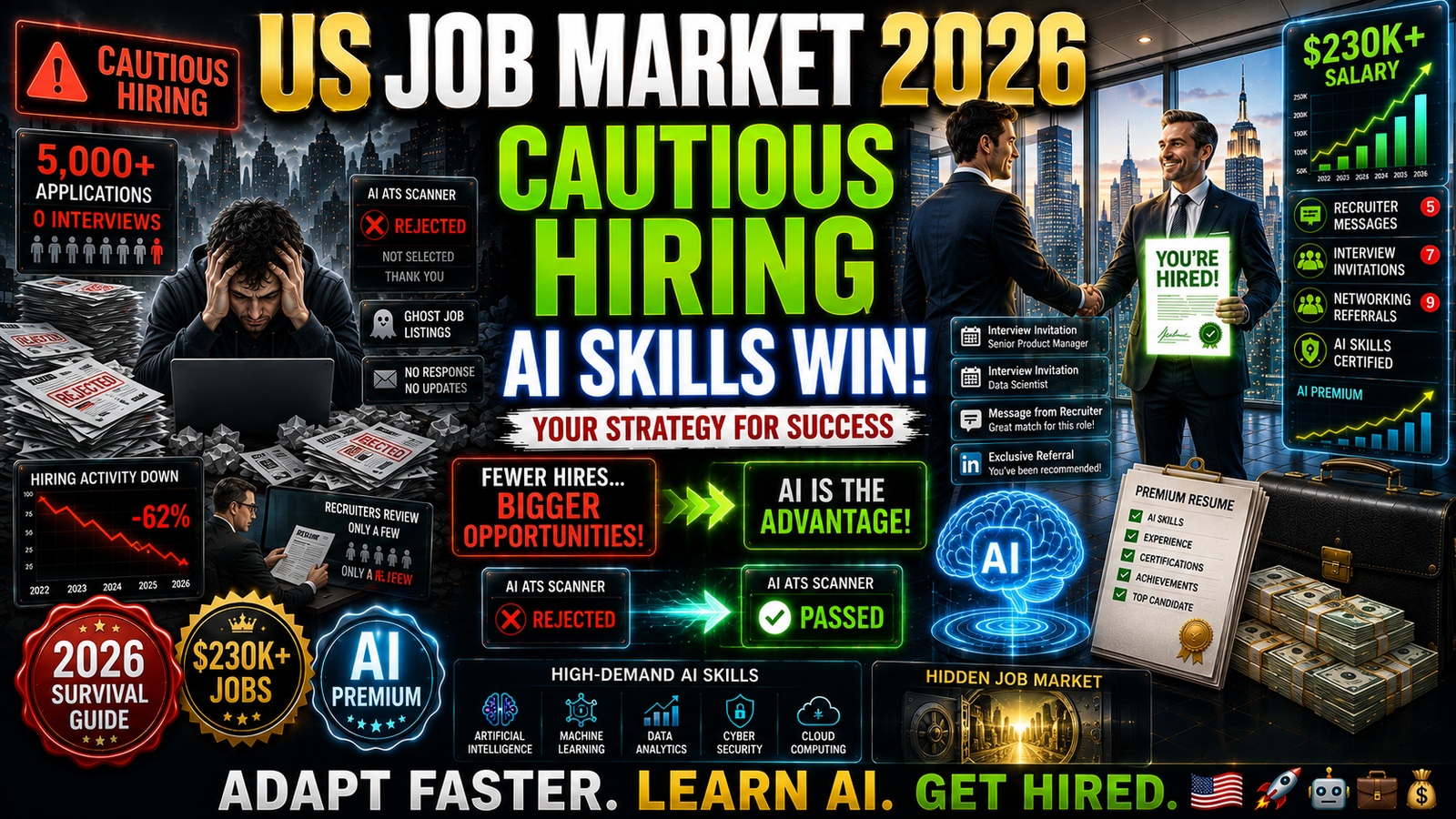
The US job market in mid-2026 is navigating a “moderating, not collapsing” phase . Job growth has stabilized from the lows of 2025, yet a feeling of caution persists. Hiring is more intentional, employers are selective, and the path to a new role requires a strategic approach rather than a high-volume one.
This creates a challenging but navigable environment. Those who understand where the opportunities lie, how to position themselves, and the new value of AI skills can find success. This guide provides a data-driven look at the 2026 job market, outlines the industries and skills in demand, and offers a strategic action plan for job seekers.
Part 1: Decoding the 2026 Labor Market
The headline numbers for 2026 present a mixed but stable picture. The U.S. economy added an average of 92,000 jobs per month in the first half of the year. While this is a significant rebound from 2025’s sluggish growth, it remains below the 122,000 monthly average of 2024 . June’s report was a clear signal of cooling momentum, with only 57,000 jobs added, well below economist expectations of 113,000. Prior months’ job gains were also revised downward by 74,000, further underscoring a slowdown .
The Deceptive Unemployment Rate
The unemployment rate dipped slightly to 4.2% in June . While historically low, this drop was partly attributed to a decrease in the labor force participation rate, which fell to 61.5%. An estimated 2 million workers have left the labor force since December 2025, meaning the unemployment rate fell partly because fewer people were actively looking for work . This is a key reason why a “low” unemployment rate can coexist with a job market that feels difficult for many job seekers .
Wage Growth and Real Earnings
Wages grew at a steady but unspectacular pace, with average hourly earnings rising 3.5% year-over-year in June . However, real wage growth—which accounts for inflation—remained minimal, rising just 0.6% in the year to Q1 2026 and still lagging 1.4% below pre-COVID levels from Q1 2021 . This means any real gains in purchasing power remain elusive, placing a premium on higher-paying, specialized roles.
Part 2: Key Trends Shaping the Job Market
The Rise of “Intentional Hiring”
Employers are moving away from broad workforce expansion and focusing on “hiring with intention.” New positions are being created to address specific business needs, such as strengthening financial planning, improving security, or supporting business growth . A survey by Express Employment Professionals found that 84% of U.S. hiring managers are optimistic about their company’s outlook, but 44% currently have open positions they cannot fill—the highest share since spring 2023 . This skills mismatch suggests that while opportunities exist, employers are struggling to find qualified talent. The top reasons cited for hiring were increased work volumes (53%) and filling newly created positions (49%) .
This cautious approach is also reflected in the finance sector, where employers are prioritizing roles that have a clear, strategic impact on revenue and decision-making . The market is defined by “intent rather than urgency,” with recruiters focusing on quality and strategic fit .
The AI Skills Premium and the “Two-Track” Market
Artificial intelligence is creating a fundamental divide in the labor market. PwC’s 2026 AI Jobs Barometer, which analyzed over one billion job ads, describes a “two-track” employment landscape .
- Track 1: Professionalised Roles. In these roles, AI acts as a “force multiplier” for human expertise, automating routine tasks and allowing professionals to focus on high-value work like judgment, creativity, and leadership. Examples include radiologists and recruiters. These roles are seeing twice the growth in available jobs and 42% faster salary growth than the other track .
- Track 2: Democratised Roles. In these roles, AI makes the job itself easier for non-experts to perform, potentially reducing the value of specialized skills. Examples include some IT service managers and medical secretaries .
The wage premium for AI skills is substantial and growing. Jobs requiring specific AI skills are growing nearly eight times faster (69%) than the overall jobs market (9%) . The average wage premium for workers with these skills has surged to 62% , up from 57% last year, and can be as high as 118% in some consumer-facing sectors . This is no longer just a tech-industry story; it’s a broad labor market signal .
The Changing Face of Entry-Level Work
The AI revolution is also transforming entry-level roles. AI-exposed junior positions are now seven times more likely to require traditionally senior-level skills like leadership and creativity . While overall early-career job postings have stagnated, these “seniorised” entry-level roles have grown 35% since 2019 . This means new graduates and career-changers need to demonstrate a higher level of strategic thinking and problem-solving earlier in their careers.
Part 3: Winning Job Search Strategies for 2026
In a market defined by “intentional” hiring and fierce competition for AI and specialized skills, a targeted, modern approach is essential.
1. Prioritize Quality Over Quantity
The “spray and pray” method of mass applications is no longer effective. Recruiters can quickly identify generic applications, which “blend into the background” . Candidates who are selective and apply to roles that genuinely align with their skills and interests perform much better .
Action: Target roles that are a strong fit and tailor your resume for each position, highlighting the specific experience most relevant to the job description .
2. Build and Leverage Your Network
Networking remains one of the most powerful tools. Many opportunities are never publicly advertised; they emerge through conversations and referrals . This means building relationships, having informational conversations, and staying visible within your professional community . A substantial percentage of roles are filled through referrals, making this a priority over simply submitting applications .
Action: Reconnect with former colleagues, reach out to professionals in roles you’re curious about, and engage thoughtfully on LinkedIn .
3. Embrace AI and Human Skills
The data is clear: AI fluency is becoming a baseline requirement. Candidates should highlight their ability to use AI tools effectively. At the same time, human skills are more valuable than ever. Employers are putting a premium on creativity, emotional intelligence, resilience, and innovation, viewing these as vital enablers of new AI tools . In our AI-enabled future, the ability to apply human judgment and context to AI outputs will be a key differentiator .
Action: Showcase your AI skills on your resume. Simultaneously, emphasize your uniquely human skills—like learning agility, adaptability, and ethical decision-making—which are becoming “outsized in importance” .
4. Emphasize Skills and Outcomes Over Job Titles
Employers are more interested in what you can do and the results you’ve delivered than in past job titles. Focus your resume on measurable outcomes, problem-solving examples, and transferable skills .
Action: When updating your resume, use quantifiable examples of your impact. Frame your experience by the outcomes you achieved, not just the responsibilities you held.
5. Be Open to Different Types of Roles
Flexibility is a major advantage in this market. Expanding your search to include part-time roles, temporary positions, or freelance work can help you gain new skills, build momentum, and potentially lead to a permanent offer .
Action: Consider a wider range of opportunity types. Contract or temporary roles are being used by many businesses to access hard-to-find skills and keep projects moving forward .
Conclusion: Your Action Plan for 2026
The 2026 job market rewards a strategic, intentional, and skills-focused approach. The era of the easy job search is over, but opportunities abound for those who adapt.
Your action plan is clear:
- Target Your Search: Focus your applications on roles that genuinely fit your skills and target sectors like financial services, technology, healthcare, and manufacturing, where hiring remains steady .
- Build Your Network: Dedicate time to building and nurturing your professional relationships. This is your most effective tool for accessing the hidden job market .
- Develop AI Fluency: Invest in understanding and using AI tools relevant to your role. This skill commands a significant wage premium and is increasingly non-negotiable .
- Tell a Story of Impact: Reframe your resume and interview narratives around the outcomes you’ve achieved and the problems you’ve solved, not just the tasks you’ve performed .
- Stay Flexible: Be open to contract roles or temporary assignments as a way to build momentum and showcase your value .
Success in 2026 is not about the number of applications you submit—it is about the clarity of your strategy, the strength of your network, and the skills you bring to the table.