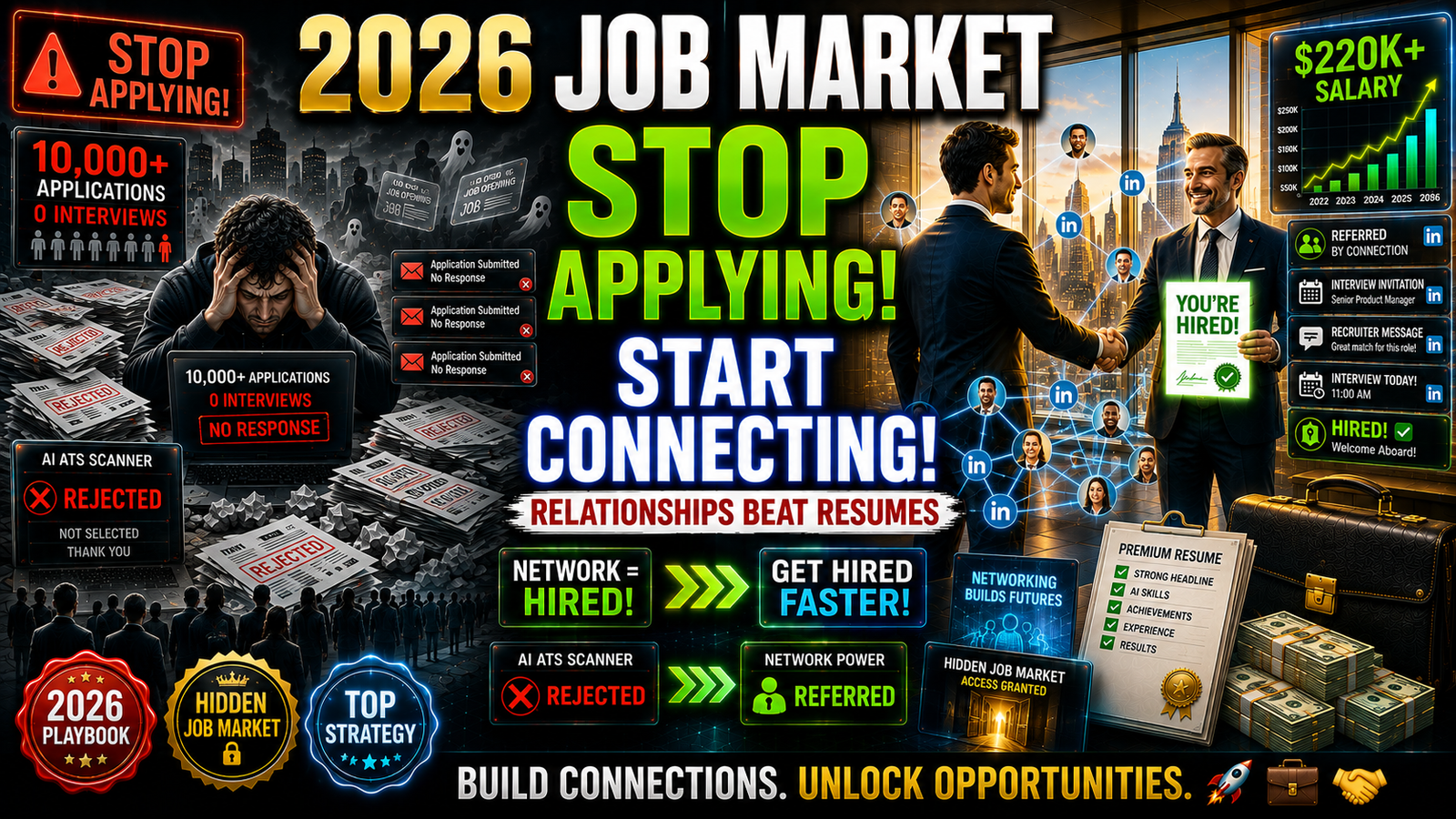
If you are sending out dozens of applications and hearing nothing back, you are not alone—and it is not because something is wrong with you. The 2026 job market has fundamentally changed, and the old rules of job searching no longer apply.
This guide offers a different perspective: a practical, ground-level view of what is actually working for job seekers right now, backed by the latest data.
The New Reality: Why Online Applications No Longer Work
The job market in 2026 is defined by “intentional hiring”. Employers are not slowing down; they are becoming more selective. Christine Belmonte, President of Technology Staffing at The Planet Group, explained it this way: “Hiring isn’t slowing. It’s becoming more intentional. Employers are raising the bar. Timelines are stretching. And the focus is clear: Bring in talent that can deliver immediate impact”.
This selectivity is creating a “digital black hole” for online applications. The rise of AI-automated application tools has flooded job boards, making it nearly impossible for even qualified candidates to stand out through standard portals. A veteran recruiter with 30 years of experience now advises job seekers to move away from traditional online applications entirely and prioritize direct networking and internal referrals instead.
This shift in strategy is not just anecdotal—the data backs it up.
The Numbers You Need to Know
Hiring Is Up, But Selectivity Is Higher
A survey of more than 2,000 U.S. hiring managers by Robert Half found that 66% of employers plan to increase permanent hiring in the second half of 2026, up from 57% a year ago. The strongest demand is in:
However, 58% of hiring managers say finding qualified talent is more difficult than it was a year ago. The skills hardest to find include industry-specific knowledge (47%), software proficiency (42%), and leadership abilities (40%). This skills mismatch is causing significant business problems:
- 63% of employers have experienced project delays due to skills shortages
- 48% have canceled projects because they lacked staff with necessary skills
The AI Skills Premium Is Real
Workers with AI skills are earning a 62% wage premium over those without them, according to PwC’s Global AI Jobs Barometer, which analyzed more than 1 billion job advertisements across 27 countries. The wage premium has climbed fast: 25% in 2024, 57% in 2025, and now 62% in 2026.
At the same time, U.S. job postings requiring AI skills grew 144% year over year as of spring 2026, compared to just 7% growth for job postings overall. This growth is no longer concentrated in tech—finance and banking, manufacturing, and healthcare are all investing heavily in AI-related hiring.
Where the Jobs Are
The top hiring markets in the U.S. for the second half of 2026 are:
| Rank | City | Plans to Increase Hiring |
|---|---|---|
| 1 | Denver | 83% |
| 2 | Minneapolis | 76% |
| 3 | San Francisco | 73% |
| 4 | Houston | 69% |
| 5 | Seattle | 69% |
| 6 | Boston | 66% |
| 7 | Dallas | 65% |
| 8 | Los Angeles | 64% |
| 9 | Atlanta | 63% |
| 10 | Chicago | 63% |
The Network Advantage
85% of career opportunities now come through professional relationships, according to LinkedIn’s 2026 Economic Graph report. Referred candidates are 4-5 times more likely to be hired and get placed 55% faster than cold applicants. Another survey found that candidates who secured interviews through referrals were 35% more likely to receive job offers than those who applied online.
What’s Actually Working Right Now
1. Stop Applying, Start Networking
The single most effective strategy in 2026 is to shift your focus from application volume to high-quality human connections. This means:
- Reconnecting with former colleagues and managers—they already know your work quality
- Booking informational conversations with people in roles or industries you are curious about
- Engaging thoughtfully on LinkedIn by commenting and sharing insights
- Letting your network know what you are exploring and why
The “10/10 Rule” is a proven strategy: identify 10 companies you want to work for, find 10 people at those companies in roles you are interested in, and reach out to them for an informational conversation—not to ask for a job, but to build a genuine connection.
2. Treat Every Interaction as a Networking Opportunity
For gig and temp workers especially, networking can be integrated into every shift. A warehouse worker who completes 15 shifts across 5 companies in a month meets more decision-makers than most office workers meet in a year. That volume of contacts is your biggest career asset—but only if you treat each shift as a relationship-building opportunity.
A server in Los Angeles worked three shifts at a hotel catering company, remembered each supervisor’s name, and asked about upcoming events. By the fourth visit, the catering manager added her to the Talent Pool and later recommended her for a full-time event coordinator role paying $22/hour.
What works:
- Introduce yourself by name at the start of every shift
- Do excellent work—reliability is the foundation
- Ask one genuine question about the business
- Thank them by name at the end
- Say: “I really enjoyed working here. I’d love to come back if shifts open up.”
What does not work:
- Asking for favors before you have proven your work
- Canceling shifts at companies where you have contacts
- Over-messaging supervisors between shifts
3. Build Your Digital Presence
92.6% of HR professionals and recruiters see a candidate’s LinkedIn profile as at least “useful” in hiring decisions, with over 1 in 5 (22.3%) arguing that LinkedIn profiles are “critical” in determining who the best candidates are for a role.
Beyond just having a profile, 86.1% of HR professionals check candidates’ online presence at least occasionally, with over a quarter (27.2%) doing so consistently for all candidates that pass the initial resume screening. Almost 9 in 10 HR professionals report catching resume lies thanks to what candidates reveal online.
What to do:
- Optimize your LinkedIn profile with a clear headline and cohesive career story
- Connect with supervisors after 3+ successful shifts together
- Include a personalized note: “Great working with you at [company]. Would love to stay connected.”
- Post updates about certifications earned or milestones reached
4. Develop AI Fluency
The 62% wage premium for AI skills makes this the single most important investment you can make in your career. You do not need to become an AI engineer—entry-level workers with AI skills earn 25% more than their peers without those skills.
Free resources to build AI skills:
- Fast.ai: Free deep learning courses built for people without heavy math backgrounds. Practical, project-based, and used widely by people who go on to work in the field.
- Kaggle: Hosts AI competitions and free courses in Python, machine learning, and deep learning. Completing a few competitions—even without placing—produces work samples worth showing.
- Google’s AI Essentials and Microsoft’s AI Skills Initiative: Free, self-paced courses aimed at building foundational fluency. Neither requires a technical background to start.
The AI skills market is moving fast enough that demonstrated work often carries more weight than coursework. That is true for a 17-year-old and a 45-year-old making a career change.
5. Quality Over Quantity
Candidates who apply thoughtfully to fewer roles consistently perform better than those who apply broadly without customization. Employers can quickly tell when an application is generic, and those tend to blend into the background.
What to do:
- Target roles that genuinely align with your skills and interests
- Tailor your resume to highlight the experience most relevant to each position
- Adjust your summary to reflect why the role makes sense for your next step
The Entry-Level Shift: AI Is Changing Early Careers
There has been much debate about how AI might impact entry-level roles. However, 68% of leaders believe entry-level roles will grow or remain stable, while just 2% expect them to shrink because of AI.
What is changing is the nature of these roles:
- 45% of executives expect more AI-assisted entry-level positions
- 30% say entry-level roles will require significantly greater technical fluency
Rather than eliminating opportunity, AI is accelerating the learning curve, allowing entry-level talent to focus on higher-level problem solving and strategy earlier in their careers.
Protecting Your Mental Health
The job search in 2026 is a marathon, not a sprint. The constant silence and rejection can take a toll.
What helps:
- Create a “Proof File”: Keep a running document of your wins, positive feedback, and problems you have solved. Read it before interviews to counter self-doubt.
- Archive ghosting and move on: A company that ghosts you in hiring is showing you how it communicates.
- Treat it like a part-time job: Set a schedule with a clear start and end time to avoid burnout.
- Reframe rejection: Treat rejection as data, and nothing more. It does not define your value.
Your Action Plan
Stop relying on online applications alone. The data is clear: 85% of jobs are filled through networking. Referrals are 35% more likely to lead to job offers.
Your path forward:
- Focus on networking—identify 10 target companies, connect with 10 people at each
- Build your LinkedIn presence—92.6% of recruiters find it useful
- Develop AI fluency—the 62% wage premium makes this non-negotiable
- Emphasize strategic impact—employers want candidates who can deliver immediate results
- Be patient and persistent—the market is defined by intent, not urgency
The 2026 job market rewards strategic, intentional, and human-centric job searching. The era of the “easy” job search is over, but opportunities remain for those who adapt.