
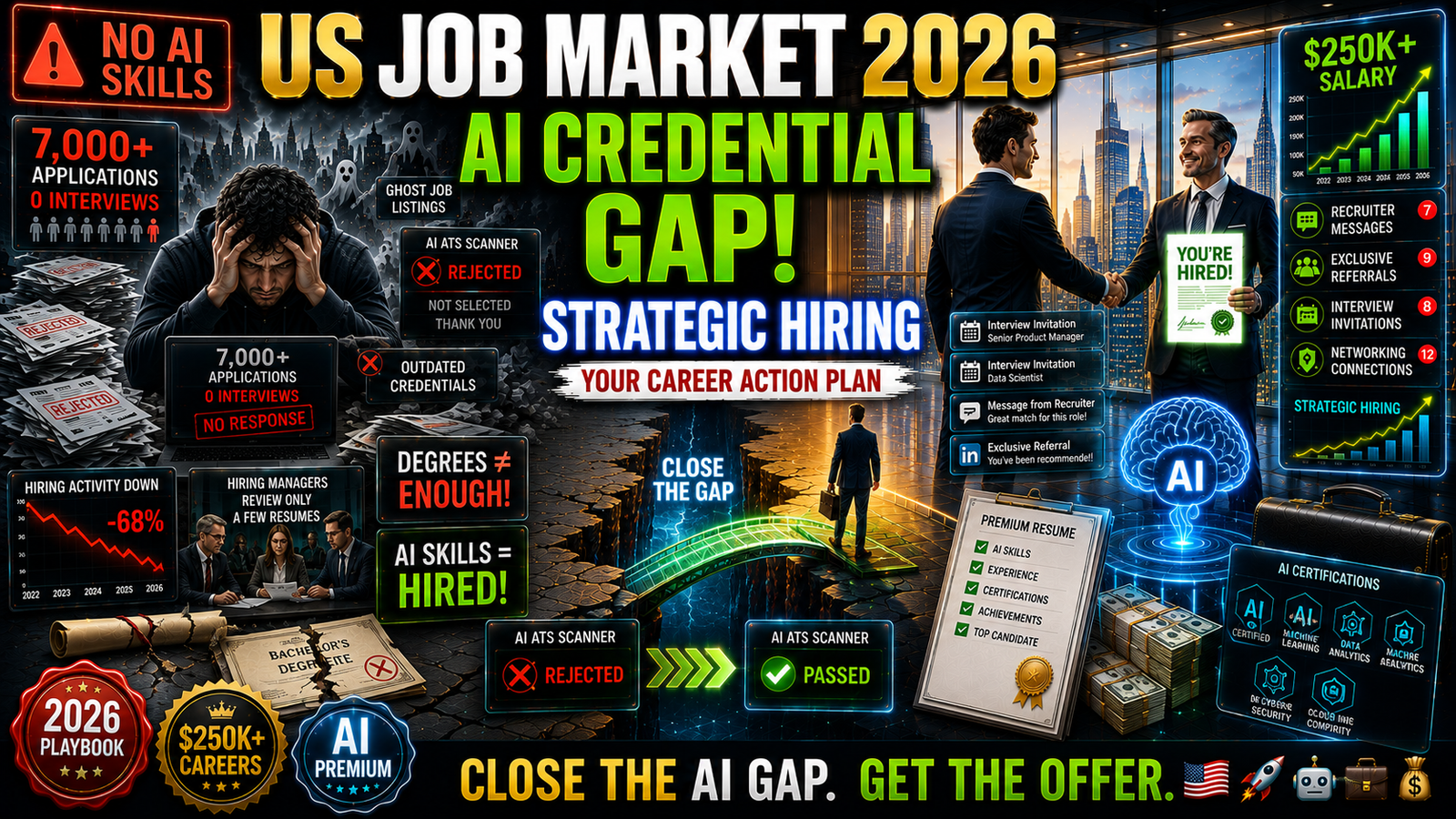
If you’ve been searching for a job in 2026 and finding the process more grueling than expected, you are not alone—and it is not because something is wrong with you. The US job market has entered what experts call an “intentional hiring” era . Employers are not laying off in large numbers, but they are also not expanding aggressively. Instead, they are hiring with precision, targeting roles that directly impact business strategy and revenue.
Success in 2026 requires a different approach—one that prioritizes strategic networking, AI fluency, and quality over quantity. This guide provides a data-driven look at the current market, identifies the skills in highest demand, and offers a practical action plan for navigating your job search.
Part 1: The 2026 Labor Market by the Numbers
Job Growth: Measured and Slowing
The U.S. economy added 57,000 jobs in June 2026, about half of what economists expected . The prior two months’ job gains were also revised downward by 74,000, meaning the level of employment at the end of June was lower than previously believed . This cooling momentum is a defining feature of the 2026 job market.
The Deceptive Unemployment Rate
The national unemployment rate fell slightly to 4.2% in June . However, this drop was driven by an unusual decline in the labor force participation rate, which retreated three-tenths to 61.5% . The labor force shrank by 720,000 people in a single month . The prime-age labor force participation rate plunged by 0.6 percentage points—the single largest monthly decline since January 1968, outside of the COVID period . This is “quite extraordinary and hard to explain,” according to State Street’s analysis . The unemployment rate fell partly because fewer people were actively looking for work.
Wage Growth: Modest and Targeted
Wage growth in 2026 is expected to be steady rather than spectacular. Robert Half projects average increases of around 2.1%, but with sharper uplifts for specialist skills . According to Steve Saah, executive director at Robert Half: “Compensation is increasingly tied to specialized expertise and not just tenure alone” . Hays expects junior roles to see increases of 2.5%–3.0%, mid-level professionals 3.0%–3.5%, and senior professionals up to 3.6%, particularly in leadership and ESG-focused roles .
Part 2: AI Is Reshaping the Labor Market
The New Credential Gap: AI Skills = 25% Higher Pay
Perhaps the most important labor market finding of 2026 comes from Randstad’s analysis of more than 35 million job postings between 2021 and 2026: entry-level workers with verified AI skills earn 25 percent more than their peers without those skills .
Here’s the breakdown:
- Entry-level content writers with AI skills earn 25% more than non-AI peers
- AI-fluent customer service professionals command salary premiums of roughly 24%
- Across industries, professionals with verified AI certifications are being promoted up to 3.5 times faster than those without them
This is not about becoming an AI engineer. The premium applies to people who use AI tools in their existing work—writers who use AI to draft and edit, analysts who use AI to process data, customer service representatives who use AI to handle routine queries so they can focus on complex cases .
“The message from the labor market is clear: AI fluency is not a nice-to-have for entry-level workers. It is the new credential gap” .
Which AI Skills Pay the Most?
A study by GoHumanize examined 55 AI skills across active job listings and average pay :
| AI Skill | Active Job Listings | Average Annual Pay |
|---|---|---|
| LLM Fine-Tuning | ~7,200 | $208,000 |
| Large Language Model (LLM) | ~57,000 | $199,000 |
| Agentic AI | ~42,000 | $197,400 |
| AI Product Management | ~26,000 | $195,000 |
| Deep Learning | ~67,000 | $179,000 |
Source: GoHumanize study via Forbes
The Forbes analysis notes that these skills are “increasingly independent of traditional credentials”—an individual who can effectively fine-tune a large language model may not require a master’s degree to land a job .
Industries Hiring AI Talent
AI hiring has spread far beyond Big Tech. The largest waves of demand are now in sectors applying AI to their own problems :
- Financial Services: Banks and fintech firms are hiring aggressively for fraud detection, risk modeling, and algorithmic decisioning roles. Data scientists earn a median of $112,590, with 34% projected growth .
- Healthcare: AI is being applied to diagnostics, imaging, drug discovery, and operational efficiency .
- Manufacturing: Demand is driven by predictive maintenance, quality control, robotics, and supply chain optimization .
- Retail and E-Commerce: Retailers need data scientists and machine learning engineers for demand forecasting, personalization, and pricing .
How Entry-Level Roles Are Changing
More than two-thirds (68%) of U.S. executives believe entry-level roles will grow or remain stable, while just 2% expect them to shrink because of AI . However, the nature of these roles is changing:
- 45% of executives expect more AI-assisted entry-level positions
- 30% say entry-level roles will require significantly greater technical fluency
Rather than eliminating opportunity, AI is accelerating the learning curve, allowing entry-level talent to focus on higher-level problem solving and strategy earlier in their careers .
Part 3: What Employers Want in 2026
“Intentional Hiring” Is the New Normal
The March jobs report points to a labor market that’s “still moving, but with more discipline behind every hiring decision” . Christine Belmonte, President of Technology Staffing at The Planet Group, told USA TODAY: “Hiring isn’t slowing. It’s becoming more intentional. Employers are raising the bar. Timelines are stretching. And the focus is clear: Bring in talent that can deliver immediate impact” .
According to G-P’s survey of 500 U.S. executives :
- 72% of leaders feel confident that global economic conditions will support business growth in 2026
- 32% of executives plan to expand headcount or invest in new roles
- 47% expect to maintain current staffing levels, largely by backfilling existing positions
The common thread is more intentional hiring, with a focus on filling critical gaps and aligning talent decisions with evolving business needs .
Strong Hiring Sectors
According to Hays and Robert Half, sectors pulling ahead include :
- Financial services
- Technology
- Healthcare
- Datacenters
- ESG-driven industries
- Real estate and infrastructure
By contrast, manufacturing and smaller bookkeeping firms are under pressure from automation and tighter margins .
The Shift from Transactional to Strategic Roles
In finance and accounting, organizations are moving away from transactional work. As automation continues to absorb routine processes, demand is shifting toward higher-value roles like FP&A, business partnering, and compliance expertise . The Americas’ finance recruitment market in 2026 is “defined by intent rather than urgency” . Employers are hiring with a sharper sense of purpose, and candidates who can demonstrate strategic impact, digital fluency, and adaptability will continue to find opportunities.
Part 4: Job Search Strategies That Actually Work in 2026
1. Online Applications Alone Are No Longer Enough
A veteran recruiter with 30 years of experience argues that job seekers in 2026 should move away from traditional online applications, which have become a digital “black hole” . The rise of AI-automated application tools has flooded job boards, making it nearly impossible for even qualified candidates to stand out .
A Glassdoor Community poll indicates that over 70% of workers are pessimistic about their job search prospects in 2026, citing repeated rejections and delayed responses . However, candidates who secured interviews through referrals were 35% more likely to receive job offers than those who applied online. About 64% of respondents said personal connections helped them advance their careers .
2. Focus on Quality Over Quantity
One of the biggest shifts in recent years is the move away from mass applications . Candidates who apply thoughtfully to fewer roles consistently perform better than those who apply broadly without customization. Employers can quickly tell when an application is generic, and those tend to blend into the background .
Effective approach:
- Target roles that genuinely align with your skills and interests
- Tailor your resume to highlight the experience most relevant to each position
- Adjust your summary to reflect why the role makes sense for your next step
3. Tap Into the “Hidden Job Market”
Job seekers are increasingly focusing on the “hidden job market”, which includes referrals, recruiter outreach, and direct engagement with employers. This segment accounts for 40% of hiring, according to industry estimates .
Career experts recommend:
- Connecting with employees inside target organizations before submitting applications
- Building an online professional presence by regularly sharing industry insights
- Engaging meaningfully with target companies’ content to increase visibility
Another emerging strategy involves leveraging “weak ties” —acquaintances and indirect contacts who can introduce candidates to new professional circles. Research suggests these connections often provide access to opportunities unavailable through close networks .
4. Strengthen Your Personal Brand on LinkedIn
Employers and recruiters regularly review LinkedIn profiles to better understand a candidate’s background, communication style, and career progression . A strong profile reinforces your credibility and makes it easier for opportunities to find you.
5. Build AI Fluency
The Randstad data is clear: AI fluency is the new credential gap . Even if you are not an engineer, demonstrating an ability to use AI tools in your work can significantly boost your earning potential and employability.
Free Resources to Build AI Skills :
- Fast.ai: Free deep learning courses built for people without heavy math backgrounds
- Kaggle: Hosts AI competitions and free courses in Python, machine learning, and deep learning
- Google’s AI Essentials and Microsoft’s AI Skills Initiative: Free, self-paced courses aimed at building foundational fluency
Conclusion: Your Action Plan for 2026
The 2026 US job market rewards strategic, intentional, and human-centric job searching. The era of the “easy” job search is over, but opportunities remain for those who adapt.
Your Action Plan:
- Target your search—focus on sectors that are hiring: financial services, technology, healthcare, and ESG-driven industries
- Develop AI fluency—the 25% entry-level premium makes this the single most important investment you can make
- Stop relying on online applications alone—networking and referrals are 35% more likely to lead to job offers
- Emphasize strategic impact—employers want candidates who can deliver immediate business results
- Be patient and persistent—the market is defined by intent, not urgency
By adopting these strategies, you can navigate the 2026 job market with confidence and purpose.