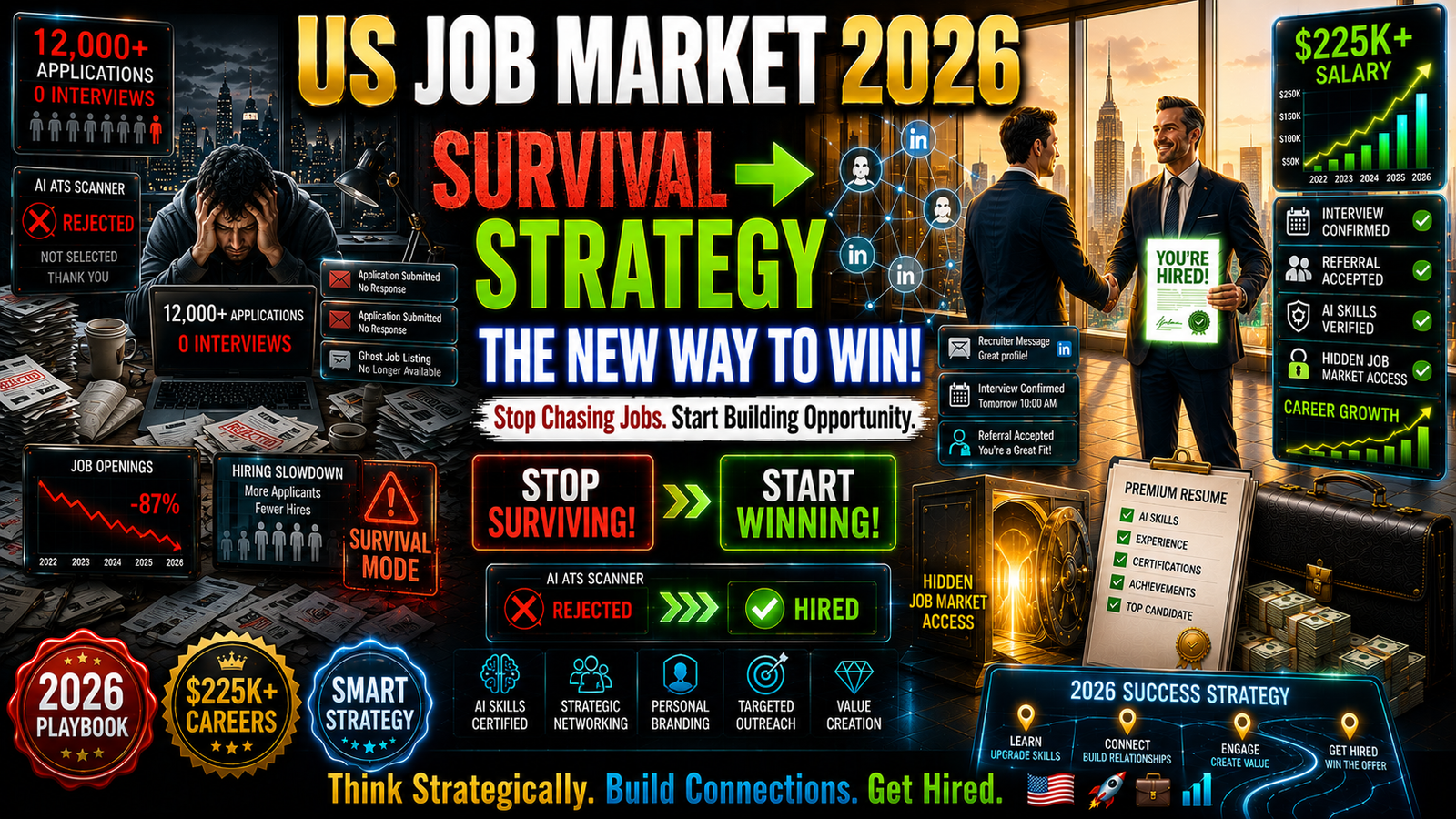
If you are searching for a job in 2026 and finding the process more grueling than expected, you are not alone—and it is not because something is wrong with you. The US job market has entered what experts call an “intentional hiring” era . Employers are not laying off in large numbers, but they are also not expanding aggressively. Instead, they are hiring with precision, targeting roles that directly impact business strategy and revenue.
This article provides a practical, ground-level view of what is actually working right now—backed by the latest data.
The New Reality: Why Online Applications Alone No Longer Work
The “spray and pray” method of mass online applications is becoming increasingly ineffective. The rise of AI-automated application tools has flooded job boards, making it nearly impossible for even qualified candidates to stand out through standard portals .
The numbers tell the story. A Glassdoor Community poll found that over 70% of workers are pessimistic about their job search prospects in 2026, citing repeated rejections and delayed responses . Candidates who secured interviews through referrals were 35% more likely to receive job offers than those who applied online. About 64% of respondents said personal connections helped them advance their careers .
Online applications still account for nearly 60% of job offers, but experts say they are no longer sufficient on their own . As a result, job seekers are increasingly focusing on the “hidden job market”—which includes referrals, recruiter outreach, and direct engagement with employers. This segment accounts for 40% of hiring .
The Market Right Now: Mixed but Moving
Job Growth Is Positive but Uneven
The U.S. economy added an average of 92,000 jobs per month in the first half of 2026. While this is a significant rebound from the sluggish growth of 2025, it remains below the 2024 average of 122,000 . June’s report was particularly weak, with only 57,000 jobs added, well below expectations, and prior months’ gains were revised downward by 74,000 .
Job gains are heavily concentrated in specific sectors:
- Healthcare and social assistance: +47,000 jobs in June
- Professional and business services: +36,000 jobs
- Leisure and hospitality: -61,000 jobs, reflecting weaker-than-usual seasonal hiring
The Deceptive Unemployment Rate
The unemployment rate fell slightly to 4.2% in June . However, this drop was largely due to a decline in the labor force participation rate, which fell to 61.5%—meaning an estimated 720,000 people exited the labor force in a single month . Since December 2025, roughly 2 million workers have left the labor force . The unemployment rate fell partly because fewer people were actively looking for work.
The OECD confirms that while the U.S. labor market remains resilient, there are increasing signs of weakening. Young people in the U.S. have become increasingly exposed to unemployment, with the gap widening not just for college graduates but also for those without a degree .
Hiring Confidence Is Growing
Despite the uneven picture, a survey of more than 2,000 U.S. hiring managers by Robert Half found that 66% of employers plan to increase permanent hiring in the second half of 2026, up from 57% a year ago . The strongest demand is in technology (78%), healthcare (75%), and finance and accounting (74%) .
The AI Skills Premium: Your Career Leverage
The Numbers That Matter
Two numbers tell you almost everything you need to know about career leverage in 2026:
- Workers with AI skills earn a 62% wage premium over those without them
- Job postings requiring AI skills have grown 144% year over year—nearly eight times faster than the overall job market
The premium has climbed fast: 25% in 2024, 57% in 2025, and now 62% in 2026 . It reaches as high as 118% in consumer-facing roles .
AI Skills Paying More Than a College Degree
A study examined 55 AI skills and their earning potential :
| AI Skill | Average Annual Pay |
|---|---|
| LLM Fine-Tuning | $208,000 |
| Large Language Model (LLM) | $199,000 |
| Agentic AI | $197,400 |
| AI Product Management | $195,000 |
| Deep Learning | $179,000 |
The Entry-Level Shift
Entry-level workers with AI skills earn significantly more than their peers without them. The “message from the labor market is clear: AI fluency is not a nice-to-have for entry-level workers. It is the new credential gap” .
A survey of employers found that 40% of organizations pay 11-30% more for AI roles than for non-AI roles, while another 26% offer salary premiums as high as 31-50% . However, 54% of workers in AI-exposed roles have seen their salaries stagnate or decline, highlighting a growing disconnect .
Integrating, Not Just Building
Employers are not just looking for AI builders. They are seeking candidates who can integrate AI into existing business operations . Demand for “AI integration” skills has grown 178% year-over-year . Alongside AI proficiency, employers are placing a premium on human skills like creativity, emotional intelligence, resilience, and learning agility .
As one expert noted, these non-technical skills are becoming “outsized in importance” relative to some technology skills .
Where the Jobs Are
Top Hiring Cities
Robert Half identified the top U.S. cities for planned hiring increases in the second half of 2026 :
| Rank | City | Plans to Increase Hiring |
|---|---|---|
| 1 | Denver | 83% |
| 2 | Minneapolis | 76% |
| 3 | San Francisco | 73% |
| 4 | Houston | 69% |
| 5 | Seattle | 69% |
| 6 | Boston | 66% |
| 7 | Dallas | 65% |
| 8 | Los Angeles | 64% |
| 9 | Atlanta | 63% |
| 10 | Chicago | 63% |
Fastest-Growing Cities for Job Opportunities
LinkedIn’s 2026 “Cities on the Rise” list highlights emerging job markets:
- Augusta, Georgia
- Richmond, Virginia
- Reno, Nevada
- North Port-Bradenton-Sarasota, Florida
- Harrisburg, Pennsylvania
Augusta is driven by defense, cybersecurity, and healthcare sectors .
Where AI Skills Are Growing Fastest
AI hiring has spread far beyond Big Tech :
- Finance and banking postings jumped year over year
- Manufacturing is investing heavily in AI-related hiring for predictive maintenance and quality control
- Healthcare is applying AI to diagnostics and operational efficiency
Job Search Strategies That Actually Work in 2026
1. Focus on Quality Over Quantity
One of the biggest shifts in recent years is the move away from mass applications. Candidates who apply thoughtfully to fewer roles consistently perform better than those who apply broadly without customization . Employers can quickly tell when an application is generic, and those tend to blend into the background .
- Target roles that genuinely align with your skills and interests
- Tailor your resume to highlight the experience most relevant to each position
- Adjust your summary to reflect why the role makes sense for your next step
2. Stop Relying on Online Applications Alone
A veteran recruiter with 30 years of experience argues that job seekers in 2026 should move away from traditional online applications, which have become a digital “black hole” . The rise of AI-automated application tools has flooded job boards, making it nearly impossible for even qualified candidates to stand out .
Instead, prioritize direct networking and internal referrals to bypass automated filters and connect directly with hiring managers .
3. Build and Use Your Network Intentionally
Research continues to show that a large percentage of roles are filled through referrals and connections rather than solely through job boards . Networking does not mean asking for a job—it means building relationships, having conversations, and staying visible within your professional community .
Effective networking includes :
- Reconnecting with former colleagues or managers
- Booking informational conversations with people in roles or industries you are curious about
- Engaging thoughtfully on LinkedIn by commenting and sharing insights
- Letting your network know what you are exploring and why
Many opportunities never become public postings—they surface through conversations first .
4. Leverage the “Hidden Job Market”
The “hidden job market”—which includes referrals, recruiter outreach, and direct engagement with employers—accounts for 40% of hiring . Summer Delaney, founder and CEO of CollabWORK, describes it as “the places where careers actually happen, not just where jobs are posted” .
Practical ways to tap into it :
- Connect with employees inside target organizations before submitting applications
- Participate in professional communities, Slack groups, industry newsletters, and alumni networks
- Build relationships by consistently providing value, not by repeatedly asking someone to apply
5. Leverage “Weak Ties”
Acquaintances and indirect contacts can introduce you to new professional circles. Research suggests these connections often provide access to opportunities unavailable through close networks .
6. Strengthen Your Personal Brand
Employers and recruiters regularly review LinkedIn profiles to better understand a candidate’s background, communication style, and career progression . A strong profile reinforces your credibility and makes it easier for opportunities to find you .
In 2026, a strong personal brand includes :
- A clear headline that reflects what you do and where you add value
- A summary that tells a cohesive career story
- Experience descriptions that focus on outcomes and impact
- Engagement with relevant industry content
7. Emphasize Skills and Outcomes Over Job Titles
Employers are increasingly focused on what candidates can do, how they solve problems, and how quickly they can contribute . Focus your resume on measurable results and transferable skills .
8. Tailor Your Application to Stand Out
In a crowded market, a tailored approach matters . Use the language of the job description to clearly show how your experience meets the employer’s needs. Include keywords to help your application pass through Applicant Tracking Systems .
9. Develop AI Fluency
The 62% wage premium for AI skills makes this the single most important investment you can make in your career . You do not need to become an AI engineer—practical fluency in using AI tools in your existing role is what employers value most .
10. Be Open to Different Types of Roles
Flexibility is a major advantage in this market. Expanding your search to include part-time roles, temporary positions, or freelance work can help you gain new skills, build momentum, and potentially lead to a permanent offer .
Protecting Your Mental Health
The job search in 2026 is a marathon, not a sprint. The constant silence and rejection can take a toll .
What helps:
- Create a “Proof File”: Keep a running document of your wins, positive feedback, and problems you have solved. Read it before interviews to counter self-doubt.
- Archive ghosting and move on: A company that ghosts you in hiring is showing you how it communicates.
- Treat it like a part-time job: Set a schedule with a clear start and end time to avoid burnout.
- Reframe rejection: Treat rejection as data, and nothing more. It does not define your value.
Your Action Plan for 2026
The 2026 US job market rewards strategic, intentional, and human-centric job searching. The era of the “easy” job search is over, but opportunities remain for those who adapt.
Your Action Plan:
- Target your search—focus on sectors that are hiring: healthcare, financial services, technology, and professional services
- Develop AI fluency—the 62% wage premium makes this the single most important investment you can make
- Stop relying on online applications alone—networking and referrals are 35% more likely to lead to job offers
- Leverage the “hidden job market”—40% of hiring happens through referrals and direct engagement
- Emphasize skills and outcomes over job titles in your resume and interviews
- Be patient and persistent—the market is defined by intent, not urgency
By adopting these strategies, you can navigate the 2026 job market with confidence and purpose.