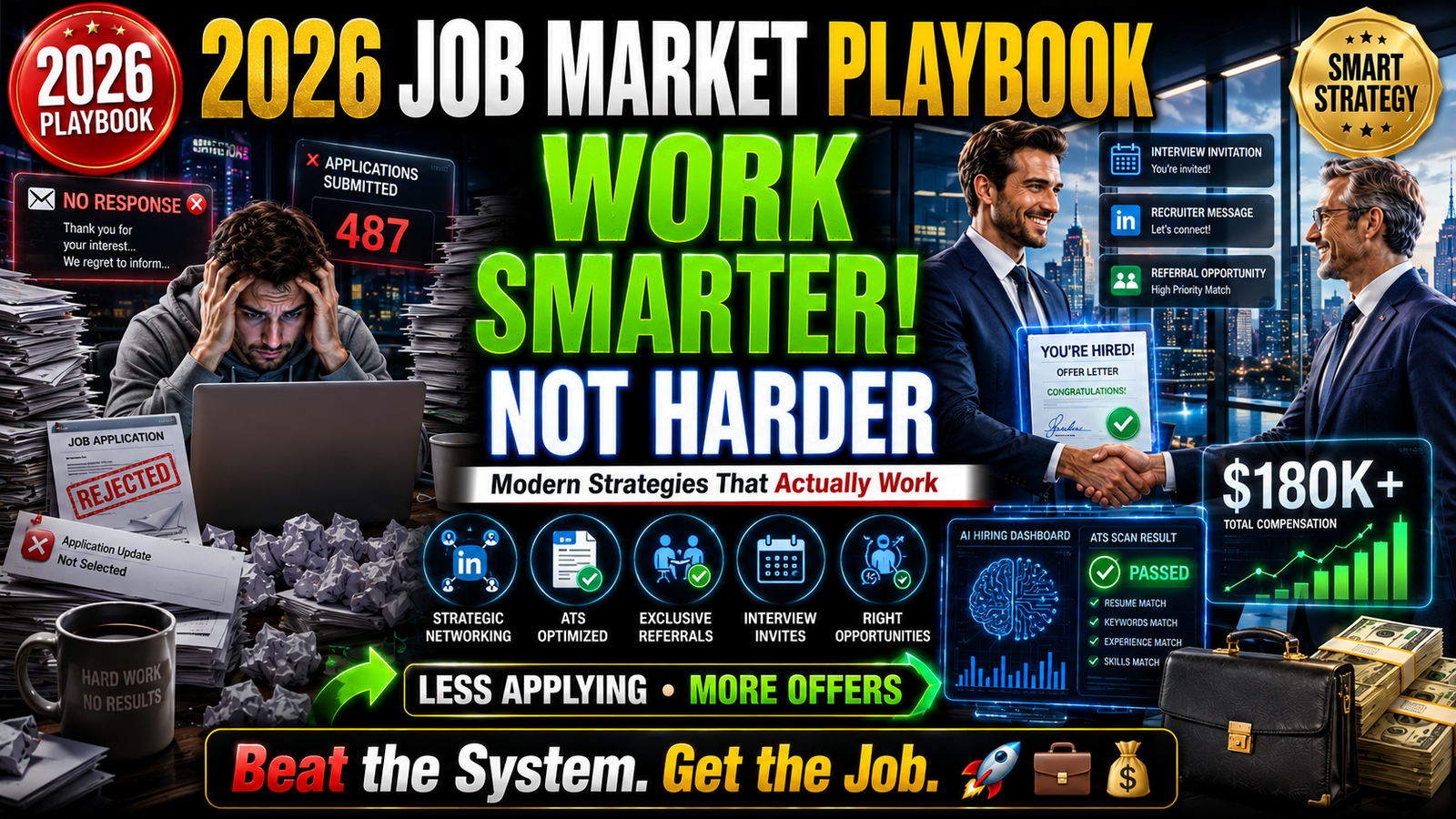
If you have been sending out applications and hearing nothing back, you are not alone—and it is not because something is wrong with you. The 2026 job market is not broken, but it operates by fundamentally different rules. Success requires a shift from volume to strategy, from chasing ghost listings to building real connections.
Why the Job Market Feels So Hard Right Now
The “Low-Hire, Low-Fire” Economy
The U.S. labor market is in a “low-hire, low-fire” equilibrium . Firms are holding on to the workers they have—known as “worker hoarding”—but hiring has slowed as employers become more cautious . The result? Fewer new opportunities, less job-to-job switching, and greater difficulty for new entrants to gain a foothold .
From January 2025 through May 2026, job gains averaged just 40,000 per month . While recent data suggests hiring may be stabilizing—job creation averaged a firmer +188,000 over March–May 2026—the underlying dynamic remains fragile . As Indeed’s Hiring Lab explains: “Growth that leans on people staying put rather than employers ramping up hiring is a fragile kind of growth” .
| What’s Happening | Why It Matters |
|---|---|
| Hiring rate near 2013 lows | Fewer entry points into the labor market |
| Quits rate at post-2008 levels | Workers are “job hugging”—staying put |
| Job openings-to-unemployed ratio near 1:1 | More job seekers than openings |
| Long-term unemployment (27+ weeks) rising | Searches are taking significantly longer |
The Bottom Rung Is Broken
The Federal Reserve Bank of Dallas has documented a stark divide: roughly 55% of the population exists in a primary sector with high wages and job stability, while all volatility—accounting for 61% of total unemployment—is concentrated in a much smaller secondary sector comprising just 14% of the population .
The normal “trickle-down” mechanism where senior workers changing jobs creates entry-level vacancies has broken down . The transmission mechanism “seems either weak, lagged or broken” . This explains why even as some sectors hire, new entrants are being left behind.
Young Workers Are Hit Hardest
Since April 2023, the employment-to-population ratio of new-entrant college graduates has fallen 3.2 percentage points nationally . Even recent college graduates are facing longer job searches, higher unemployment rates, and lower employment-to-population ratios . The unemployment rate for Generation Z stands at roughly double the national average .
The Ghost Job Problem: Why Your Applications Vanish
The Data Is Alarming
A study analyzing 176,268 live job listings found that 1 in 7 job posts were ghost jobs, with 4% active for four months or longer . Over half of wholesale jobs (51%) were ghost postings, and 21% of senior-level roles fell into this category .
The human cost is significant. A comprehensive study of 1,000 U.S. professionals found :
| Metric | Percentage |
|---|---|
| Job seekers paying a “ghost tax” (out-of-pocket costs) | 37% |
| Candidates who applied for nonexistent roles | 47% |
| Tech workers reporting ghost jobs | 85.7% |
| Marketing professionals reporting ghost jobs | 87.5% |
| Job seekers who abandoned major job boards entirely | 12.1% |
“When job seekers are losing actual money to engage with a company’s brand, we aren’t just looking at an HR problem, we’re looking at a systemic breakdown of the professional social contract.” — Volen Vulkov, Enhancv co-founder
Industry data suggests that between 18% and 22% of roles posted on Greenhouse fall into the ghost job category at any given time . A JobLeads poll found that nearly 80% of professionals have applied to a role they believed was not real, with almost 60% saying it has happened more than once .
Why Companies Post Ghost Jobs
A “ghost job” is essentially a live job listing with no real intent to hire because the role is already filled, canceled, or never existed . Corporations use these postings to :
- Gather competitive intelligence about the application pool
- Signal the appearance of growth
- Build a “talent pipeline” for future needs
“This tactic is a common strategy now among mainstream corporations.” — Enhancv study
Where the Real Opportunities Are
The Hidden Job Market
Experts estimate that between 50 and 80 percent of all positions are filled through the hidden job market—referrals, recruiter outreach, and direct engagement with employers . What is visible on job portals represents only a small share of real demand for talent.
Summer Delaney, founder and CEO of CollabWORK, describes the hidden job market as “the places where careers actually happen, not just where jobs are posted” .
The three layers of the hidden job market :
- Trusted Professional Communities — Facebook groups, Slack communities, Discord servers, Reddit threads, industry newsletters, alumni networks, and professional associations. People ask peers where to work and what it’s really like.
- AI-Powered Discovery — ChatGPT, Gemini, Claude, and Perplexity increasingly rely on trusted sources to understand employers and recommend opportunities.
- Existing Talent Databases — Former applicants, finalists, interns, and passive candidates already in employer ATS or CRM systems.
The “10/10 Rule”
Career coach Beth Hendler-Grunt advocates for the “10/10 rule” :
- Identify 10 companies that interest you
- Find 10 people across those companies working in roles you’d like
- Contact them to build genuine connections—not to ask for a job
“It’s not just, ‘Hi, do you have a job for me?’ That’s like asking to get married on the first date.” — Beth Hendler-Grunt
What to ask when you connect :
- How they got to where they are
- What their biggest challenges are in their role
- How their success is measured
“One person connects you to the next, and all of a sudden you have your own network. This is like the hidden job market.” — Beth Hendler-Grunt
Where Employers Are Hiring
Top Hiring Cities
A Robert Half survey of more than 2,000 U.S. hiring managers found that 66% plan to increase permanent hiring in the second half of 2026, up from 57% a year ago .
| Rank | City | Plans to Increase Hiring |
|---|---|---|
| 1 | Denver | 83% |
| 2 | Minneapolis | 76% |
| 3 | San Francisco | 73% |
| 4 | Houston | 69% |
| 5 | Seattle | 69% |
| 6 | Boston | 66% |
| 7 | Dallas | 65% |
| 8 | Los Angeles | 64% |
| 9 | Atlanta | 63% |
| 10 | Chicago | 63% |
Strongest demand by specialization: Technology (78%), Healthcare (75%), and Finance and Accounting (74%) .
LinkedIn’s “Cities on the Rise”
Smaller metros with growing job markets include :
- Augusta, Georgia — Fastest-growing hub for cybersecurity and defense
- Richmond, Virginia — Finance, manufacturing, and biotech employers
- Reno, Nevada — Manufacturing and technology hub (Tesla’s Gigafactory)
- North Port-Bradenton-Sarasota, Florida — Expanding with major hospital investment
- Harrisburg, Pennsylvania — Regional hub for logistics and manufacturing
Healthcare is the common thread—it ranks among the top hiring industries in 23 of the 25 metros on the list .
The AI Skills Premium: Your Career Leverage
PwC’s 2026 Global AI Jobs Barometer, analyzing more than one billion job advertisements across 27 countries, reveals that AI is splitting the labor market into two distinct tracks :
- Professionalised roles (such as radiologists and recruiters) where AI magnifies expert judgment are seeing twice the job growth and 42% faster salary increases than democratised roles .
- Democratised roles where AI simplifies tasks for non-experts are growing much slower .
The AI Skill Premium
- Jobs requiring specific AI skills are growing nearly eight times (69%) faster than the overall job market
- The average wage premium for workers with AI skills has risen to 62%, up from 57% last year
- The premium reaches as high as 118% in consumer markets
The Entry-Level Shift
AI-exposed entry-level roles are now seven times more likely to require traditionally senior-level skills like judgement, leadership, and strategic thinking . These “seniorised” entry-level roles have grown 35% since 2019, while other entry-level roles have declined by 10% .
“The traditional relationship between experience and expertise is changing. AI is removing some of the routine work that once acted as an apprenticeship, while increasing demand for judgement, leadership and adaptability much earlier in careers.” — Pete Brown, PwC’s Global Workforce Leader
Your Action Plan
1. Stop relying on online applications alone. Online applications are no longer sufficient on their own . Candidates who secured interviews through referrals were 35% more likely to receive job offers than those who applied online .
2. Implement the 10/10 Rule. Identify 10 target companies and 10 people at each to build genuine connections.
3. Tap into the hidden job market. Connect with employees inside target organizations before submitting applications. Participate in professional communities. The hidden job market accounts for 40% of hiring .
4. Develop AI fluency. The 62% wage premium makes this non-negotiable . Focus on understanding how to direct AI tools and evaluate their output critically.
5. Target growth sectors. Healthcare, technology, financial services, and professional services are actively hiring .
6. Consider emerging cities. Augusta, Richmond, and Reno are seeing strong hiring momentum .
7. Be patient and persistent. The market is defined by intent, not urgency. Searches are taking longer.
FAQs
Why is it so hard to find a job right now?
The US is in a “low-hire, low-fire” economy. Hiring rates are near recession levels while layoffs remain low. The bottom rung of the job ladder is “broken” for new entrants .
What are ghost jobs?
Listings for positions that don’t exist. Companies post them to gather competitive intelligence or signal growth .
What is the AI skills premium?
Workers with AI skills earn a 62% wage premium over those without them, reaching 118% in consumer-facing roles .
What cities are hiring most?
Denver (83%), Minneapolis (76%), and San Francisco (73%) lead hiring plans .
What’s the best way to get hired in 2026?
Networking. Referrals are 35% more likely to lead to job offers than online applications .