
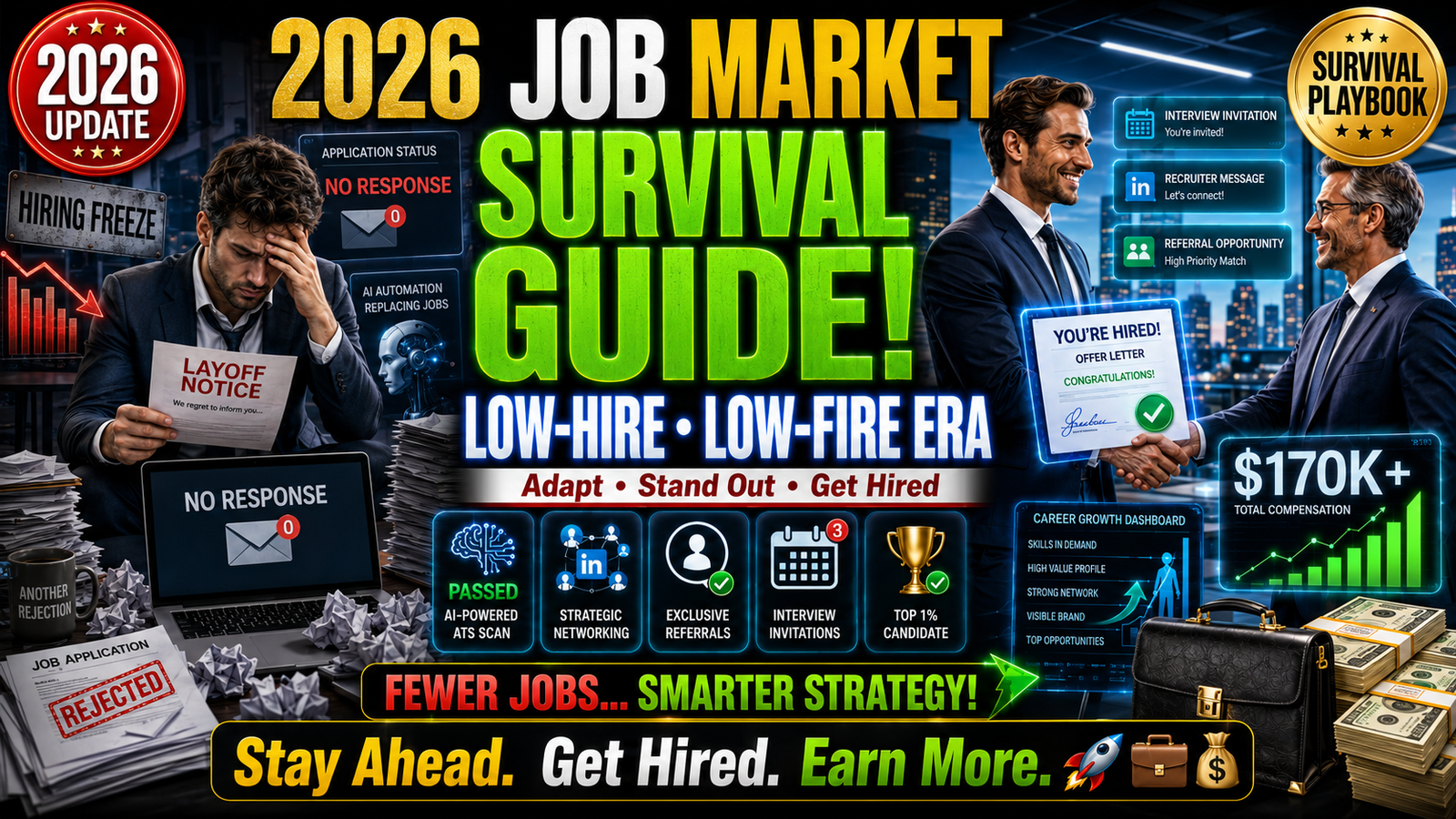
If you’ve been applying online and hearing nothing, you are not alone—and it’s not because something is wrong with you. The 2026 US job market is fundamentally different. Here’s what’s happening and how to actually get hired.
The “Low-Hire, Low-Fire” Reality
The U.S. labor market is in what economists call a “low-hire, low-fire” equilibrium . Firms are holding onto workers (“worker hoarding”) but hiring has slowed. The result: fewer new opportunities, less job switching, and greater difficulty for new entrants .
What This Means for You
| Indicator | Current State | Impact |
|---|---|---|
| Hiring rate | Near weakest since 2013 | Fewer entry points into the labor market |
| Quits rate | 2.0% (post-2008 levels) | Workers “job hugging”—staying put |
| Job openings-to-unemployed ratio | ~1:1 | More competition for each role |
The Bottom Rung Is Broken
The Dallas Fed found that roughly 55% of the population exists in a primary sector with high wages and job stability, while all volatility—accounting for 61% of unemployment—is concentrated in a secondary sector of just 14% of the population . The normal “trickle-down” where senior workers changing jobs creates entry-level vacancies has broken down .
Young Workers Are Hit Hardest
Since April 2023, the employment-to-population ratio for new college graduates has fallen 3.2 percentage points nationally . Young workers are bearing the brunt of the slowdown .
Is There Any Good News?
Recent data shows hiring may be stabilizing—job creation averaged +188,000 over March-May 2026 . Layoffs remain historically low .
The Ghost Job Problem
An analysis of 176,268 live job listings found that 1 in 7 job posts were ghost jobs—positions that don’t actually exist . Over half of wholesale jobs (51%) were ghost postings, and 21% of senior-level roles fell into this category .
The “Ghost Tax”
A March 2026 study of 1,000 U.S. professionals found:
- 37% of job seekers are paying a “ghost tax”—out-of-pocket costs chasing phantom listings
- 47% have applied for roles they later discovered were nonexistent
- 85.7% of tech workers and 87.5% of marketing professionals report ghost jobs
- 12.1% have abandoned major job boards entirely due to the “soul-crushing” cycle
Why Companies Post Ghost Jobs
Corporations use job postings to gather competitive intelligence about the application pool and signal growth .
How to Spot a Ghost Job
- Posting age: Real roles are often filled within 30 days. Anything live 3+ months is likely a ghost job.
- Reposting patterns: Same job appearing every few weeks.
- Missing from company site: The role appears on job boards but not on the employer’s careers page.
Where the Jobs Actually Are
Top Hiring Cities
Robert Half survey of 2,000+ hiring managers :
| Rank | City | Plans to Increase Hiring |
|---|---|---|
| 1 | Denver | 83% |
| 2 | Minneapolis | 76% |
| 3 | San Francisco | 73% |
| 4 | Houston | 69% |
| 5 | Seattle | 69% |
Strongest demand by specialization: Technology (78%), Healthcare (75%), and Finance & Accounting (74%) .
Cities on the Rise (Smaller Metros)
LinkedIn’s 2026 “Cities on the Rise” list :
- Augusta, Georgia – Defense, cybersecurity, medtech, data centers
- Richmond, Virginia – Finance, manufacturing, biotech
- Reno, Nevada – Manufacturing, technology (Tesla Gigafactory)
- North Port-Bradenton-Sarasota, Florida – Healthcare expansion
- Harrisburg, Pennsylvania – Logistics, healthcare, manufacturing
Healthcare is the top hiring industry in 23 of the 25 metros on the list .
Where Hiring Is Hardest
The Lever Recruiter Pressure Index shows the tightest hiring markets are in the Great Plains and Mountain West—not coastal hubs :
- South Dakota (Pressure Score 82.1) – highest quits rate (3.8%), lowest unemployment (2.2%)
- West Virginia – highest job openings rate (5.9%), but shrinking workforce
- California (Score 17.5) – 5.5% unemployment, quits rate just 1.5%
- Washington, D.C. (Score 8.3) – highest unemployment (6.7%), lowest quits (1.4%)
The Hidden Job Market
Experts estimate 50-80% of all positions are filled through referrals, recruiter outreach, and direct employer engagement . What’s visible on job portals is only a small share of real demand.
The “10/10 Rule”
Career coach Beth Hendler-Grunt’s strategy: identify 10 target companies, find 10 people at each in roles you’d like, and build genuine connections—not to ask for a job .
“It’s not just, ‘Hi, do you have a job for me?’ That’s like asking to get married on the first date.” — Beth Hendler-Grunt
The AI Skills Premium
Workers with AI skills earn a 62% wage premium, and job postings requiring AI skills have grown 144% year over year . The premium has climbed fast: 25% in 2024, 57% in 2025, 62% in 2026 .
Highest-Paying AI Skills
| AI Skill | Average Pay |
|---|---|
| LLM Fine-Tuning | $208,000 |
| Large Language Model (LLM) | $199,000 |
| Agentic AI | $197,400 |
| AI Product Management | $195,000 |
“Skills Independent of Credentials”
Specific AI skills are “increasingly independent of traditional credentials” . An individual who can effectively fine-tune a large language model may not require a master’s degree to land a job .
Where AI Exposure Is Hidden
Teneo’s analysis of 83.6 million workers shows the biggest hidden exposure sits in sectors with thick administrative workflow :
- Retail: 2.3 million workers under pressure
- Healthcare: 1.5 million workers (administration moves first, clinical moves slower)
- Manufacturing: 1.4 million workers
The near-term effect is compression of work inside jobs, not wholesale elimination . The first visible effects are slower hiring, lower backfill, and smaller support teams—not immediate mass layoffs .
Your Action Plan
1. Stop relying on online applications alone.
The hidden job market accounts for 50-80% of hiring. Networking and referrals are your best path.
2. Implement the 10/10 Rule.
Identify 10 target companies and 10 people at each. Build genuine connections—not to ask for jobs.
3. Develop AI fluency.
The 62% wage premium makes this non-negotiable. Focus on practical skills—LLMs, prompt engineering, and evaluation of AI outputs.
4. Target growth sectors.
Technology, healthcare, and finance & accounting lead hiring plans .
5. Consider emerging cities.
Augusta, Richmond, and Reno are seeing strong momentum outside coastal hubs .
6. Protect your mental health.
Treat the search like a part-time job with clear boundaries. Reframe rejection as data.
FAQs
Why is it so hard to get hired right now?
The US is in a “low-hire, low-fire” economy. Hiring rates are near recession levels while layoffs remain low. The bottom rung of the job ladder is “broken” for new entrants .
What are ghost jobs?
Listings for positions that don’t exist. 1 in 7 job posts are ghost jobs. Companies post them to gather competitive intelligence or signal growth .
What cities are hiring most?
Denver (83%), Minneapolis (76%), and San Francisco (73%) lead. Among smaller metros, Augusta, Richmond, and Reno top the list .
What is the AI skills premium?
Workers with AI skills earn a 62% wage premium over those without them .
What’s the best way to get hired in 2026?
Networking. The hidden job market accounts for 50-80% of hiring. Use the 10/10 rule to build genuine connections.