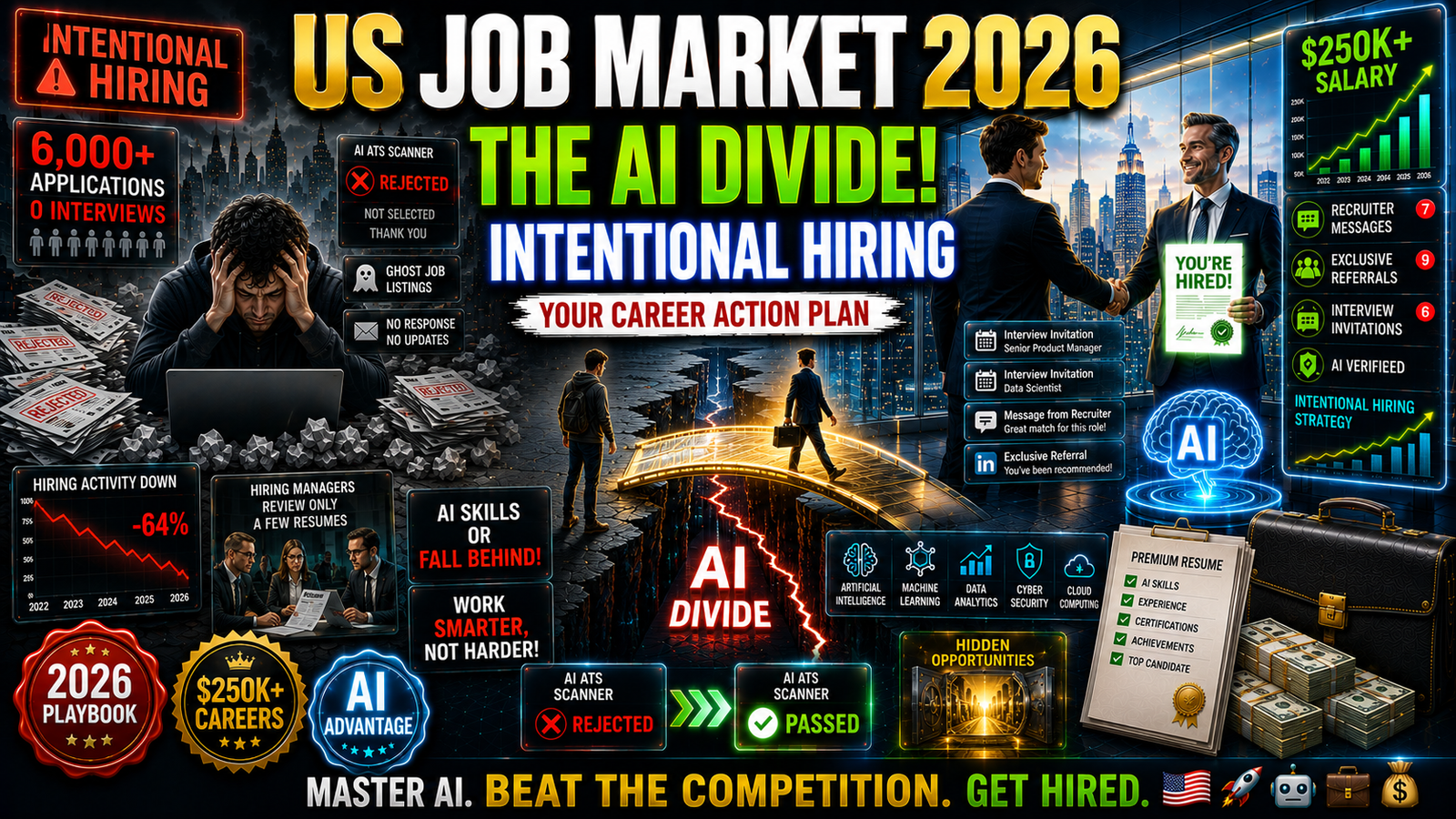
The US job market in 2026 is a landscape of stark contrasts. It is not collapsing, but it is not booming either. This is the era of “intentional hiring,” where employers are selective, strategic, and laser-focused on roles that deliver immediate business impact.
For job seekers, the old rules no longer apply. Mass applications and generic resumes are ineffective. Success requires a targeted approach, a clear understanding of where value lies in the AI-driven economy, and a resilient mindset. This guide decodes the 2026 job market and provides a clear action plan for navigating it.
Part 1: The 2026 Labor Market by the Numbers
The U.S. economy has added an average of 92,000 jobs per month in the first half of 2026. While this is a recovery from 2025’s slump, it remains well below the 2024 average of 122,000. The market’s momentum cooled in June, with only 57,000 jobs added, and the prior months’ gains revised down by 74,000.
The national unemployment rate fell slightly to 4.2% in June, but this drop was partly due to a decline in the labor force participation rate to 61.5%. Roughly 2 million workers have left the labor force since December 2025. This means the low unemployment rate masks a softer hiring market—fewer people are actively looking, which can make it harder for job seekers to find new opportunities.
The OECD confirms that while the U.S. labor market remains resilient, there are increasing signs of weakening. Young people in the U.S. have become increasingly exposed to unemployment, with the gap for college graduates and non-graduates widening since early 2024. Real wages grew by just 0.6% in the year to Q1 2026 and remain 1.4% below Q1 2021 levels, meaning purchasing power has not recovered from the post-COVID inflation surge.
Part 2: The AI Skills Premium and the “Two-Track” Market
Artificial intelligence is creating a fundamental divide in the labor market, described by PwC’s 2026 AI Jobs Barometer as a “two-track” employment landscape. The demand for AI skills is exploding, and workers who possess them are being rewarded handsomely.
The Wage Premium
The average wage premium for workers with AI skills has surged to 62% in 2026, up from 57% in 2025 and 25% in 2024. This premium can be as high as 118% in consumer-facing roles. At the same time, job postings requiring AI skills have grown 144% year-over-year, a pace nearly eight times faster than the overall job market.
This is no longer a tech-industry story. Finance, manufacturing, and healthcare are all actively creating roles that require AI proficiency.
The Dichotomy in Practice
The numbers reveal a growing divide. According to a survey, 40% of organizations pay 11-30% more for AI roles than for non-AI roles, while another 26% offer salary premiums of 31-50%. However, 54% of workers in AI-exposed roles have seen their salaries stagnate or decline.
What Employers Want: Integration, Not Just Building
Employers are not just looking for AI builders. They are seeking candidates who can integrate AI into existing business operations and maximize its impact using uniquely human skills. Demand for “AI integration” skills has grown 178% year-over-year. Alongside AI proficiency, employers are placing a premium on human skills like creativity, emotional intelligence, resilience, and learning agility. As one expert noted, these non-technical skills are becoming “outsized in importance” relative to some technology skills.
Part 3: What Employers Want in 2026
Intentional Hiring and the Focus on Impact
Employers are not just filling roles; they are making strategic investments. They are creating jobs or pursuing talent recruitment only when the business case is clear. New or open positions are tied to specific priorities: improving security, strengthening financial planning, enabling digital workflows, or enhancing customer experience. Your application must demonstrate a direct connection to these outcomes.
The End of the “Spray and Pray”
The “spray-and-pray” approach is not moving the needle. Hiring has slowed by 7.5% compared to last year, and candidates are sending out hundreds of applications with no response. A major mistake is “mass applying”—sending applications everywhere without tailoring them to the actual role. In this environment, focusing on quality over quantity is essential.
Total Compensation Takes Center Stage
With economic uncertainty keeping staffing budgets tight, employers are adopting a broader view of rewards known as total compensation. This blends pay, incentives, flexibility, and long-term career value.
- Flexibility as Compensation: Many professionals are willing to trade a slightly lower salary for hybrid or remote options. As a result, fully on-site positions often need to offer a “flexibility premium” through higher pay or stronger perks.
- Career Development: Employers are making career growth a more visible part of their value proposition as professionals weigh long-term growth alongside competitive pay.
Part 4: Job Search Strategies That Actually Work in 2026
1. Abandon the “Spray and Pray” Method
Submit fewer, more thoughtful applications. Employers can quickly tell when an application is generic, and those tend to blend into the background. Be selective, targeting roles that genuinely align with your skills and interests.
2. Build and Use Your Network Intentionally
Networking is your most powerful tool. Research shows that a large percentage of roles are filled through referrals and connections rather than solely through job boards. The “10/10 Rule” is a proven strategy: identify 10 companies that interest you, find 10 people across those companies working in entry-level roles you’d like, and contact them.
This is not about asking for a job. It’s about building genuine relationships, having informational conversations, and staying visible within your professional community.
“It’s not just, ‘Hi, do you have a job for me?’ That’s like asking to get married on the first date.” – Beth Hendler-Grunt, career coach at Next Great Step
3. Develop AI Fluency
AI fluency is no longer optional. Even if you are not an engineer, demonstrating an ability to use AI tools in your work can significantly boost your earning potential and employability. This is the new credential gap, and it is accessible to those willing to invest the time to learn. Highlight your AI skills on your resume and LinkedIn profile.
4. Emphasize Skills and Outcomes Over Job Titles
Employers are more interested in what you can do and the results you’ve delivered than in past job titles. On your resume, focus on measurable outcomes, problem-solving examples, and transferable skills. Frame your experience by the outcomes you achieved, not just the responsibilities you held. This aligns with the broader shift towards skills-based hiring.
5. Be Open to Different Types of Roles
Flexibility is a major advantage in this market. Expanding your search to include part-time roles, temporary positions, or freelance work can help you gain new skills, build momentum, and potentially lead to a permanent offer.
Part 5: Protecting Your Mental Health
The job search in 2026 is a psychological marathon. The constant silence and rejection can be corrosive. Career experts emphasize that protecting your mental health is a strategic necessity.
- Create a “Proof File”: This is a running document of your wins, positive feedback, and problems you’ve solved. Read it before interviews to counter the self-doubt that rejection breeds.
- Archive Ghosting and Move On: If a company does not respond after one or two polite follow-ups, archive it and move on. A company that ghosts you in hiring is showing you how it communicates.
- Treat Job Searching Like a Part-Time Job: Do not spend eight hours a day on applications. Set a schedule with a clear start and end time. “You will be sharper tomorrow for having actually walked away today”.
- Protect Your Identity: Do not let the job search consume your identity. Maintain your routine, exercise, relationships, and activities that have nothing to do with the job search.
- Reframe Rejection: “Treat rejection as data, and nothing more.” It does not define your value.
Conclusion: Your Action Plan for 2026
The 2026 US job market rewards strategic, intentional, and human-centric job searching. The era of the “easy” job search is over, but opportunities remain for those who adapt.
Your Action Plan:
- Target Your Search: Focus your applications on roles that genuinely fit your skills and target sectors like healthcare, financial services, and manufacturing where hiring remains steady.
- Develop AI Fluency: Invest in understanding and using AI tools relevant to your role. This skill commands a significant wage premium and is increasingly non-negotiable.
- Build Your Network: Dedicate time to building and nurturing your professional relationships. This is your most effective tool for accessing the hidden job market.
- Tell a Story of Impact: Reframe your resume and interview narratives around the outcomes you’ve achieved and the problems you’ve solved, not just the tasks you’ve performed.
- Stay Flexible: Be open to contract roles or temporary assignments as a way to build momentum and showcase your value.
- Protect Your Mental Health: The job search is a marathon, not a sprint. Manage your energy, archive ghosting, and don’t let rejection define you.
By adopting these strategies, you can navigate the 2026 job market with confidence and purpose.